
Celic: I’m not optimistic about the results of the Special Court in The Hague; no justice for Serbian victims
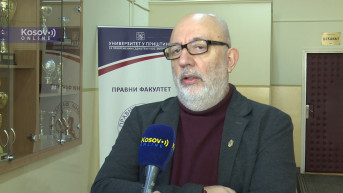
Associate Professor of the Faculty of Law in North Mitrovica, Dusko Celic, expressed his expectation that a first-instance verdict in the case of Hashim Thaci and three former senior KLA officers could be delivered by the end of this year or early next year, however, he said that he is not optimistic about the outcomes of the Kosovo Specialist Chambers based in The Hague, as no new indictments are expected, and the existing ones do not cover most crimes against Serbs.
"I don’t believe there will be more indictments, unfortunately. These indictments are incomplete, and as for verdicts, considering the current pace, it is possible that we might see a verdict for the trial of Hashim Thaci and the co-accused by the end of this year or the beginning of next," Celic told Kosovo Online.
He believes that regardless of the trial outcomes, the indictment of Thaci and the group of former KLA officers for joint criminal enterprise shows that the wartime events were not as "black-and-white" as portrayed by Pristina.
"From the perspective of Serbian victims, it may be significant that these indictments qualify crimes as part of a joint criminal enterprise by former KLA members. Regardless of the individualization of guilt and the eventual trial outcomes, this indicates that the KLA was part of that criminal enterprise. Therefore, it can be said that the situation in Kosovo and Metohija was not as black-and-white as Pristina portrays it," Celic specified.
Summarizing the work of the Specialist Chambers, Celic described it from the outset as a "hybrid court."
"The formation of this quasi-judicial body indicates that even the Western part of the international community has acknowledged that the institutions in Kosovo and Metohija are incapable of delivering justice, particularly for Serbian victims of war crimes and Albanian perpetrators. The fact that these quasi-judicial bodies were established in a hybrid manner, formally belonging to the so-called Kosovo institutions but operating from The Hague with foreign judges and prosecutors, further highlights a lack of trust in Pristina's institutions," Celic evaluated.
This approach, he claims, has caused several issues.
"First, institutions in Pristina have understood that they are no longer responsible for prosecuting Albanian perpetrators for crimes against Serbs but only 'Serbian' crimes, and we’ve seen this manifest in recent years. They have been arbitrarily arresting Serbs and charging them with war and other crimes," Celic pointed out.
The second issue, he noted, is the inefficiency of the indictments.
"Reviewing the indictments, it is clear that the majority of crimes against Serbian victims have not been included. Only a few dozen Serbian victims are mentioned, alongside a few dozen Albanian victims. There is no mention of the crimes at the 'Yellow House' or the hundreds of Serbs affected. As someone who has long chaired the Coordination of Serbian Associations of Missing and Murdered Persons in the former Yugoslavia, I can say that during the Kosovo conflict, there were over a thousand Serbian victims. Yet, these indictments include only a few dozen victims. Furthermore, there are already indictments for witness intimidation, which again shows the inefficiency of this mechanism. Considering all of this, I cannot be optimistic about the results and cannot say that the victims' families will receive fair satisfaction in terms of truth and justice," Celic emphasized.
He argues that the Specialist Chambers should have been under the auspices of the UN Security Council, not the Kosovo system.
Another critical issue he highlighted is witness intimidation, which began during the work of the International Criminal Tribunal for the Former Yugoslavia (ICTY).
"Especially considering the experience with witness intimidation, and the fact that we saw such situations during the ICTY trials, such as the indictments and acquittals of Fatmir Limaj and Ramush Haradinaj, I am even less optimistic here," Celic stated.
He believes that the only solution for families and associations of kidnapped and missing persons is to ensure transparency in these trials.
"What we might need to do, and can do, is to ensure that the work of this Tribunal doesn’t proceed in the dark. Media outlets, victim families, and associations should actively monitor the process to ensure transparency, as there is a public interest and a family interest in obtaining some form of justice, even though I have absolutely no confidence in this mechanism," Celic concluded.



0 comments