
Arms race in the Balkans: Kosovo still dependent on foreign support
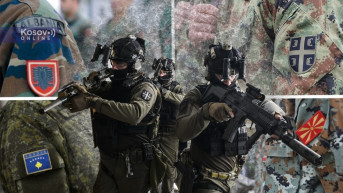
The Balkans are following the rest of Europe when it comes to rearmament and strengthening their defense industrial bases, Kosovo Online’s interlocutors agree, stressing that Kosovo currently lacks the capacity to keep pace militarily with the rest of the region without external assistance.
Written by: Veljko Nestorovic
At the recent summit in Ankara, defense contracts worth more than $50 billion were concluded between Alliance members and companies from the United States, the EU, and Turkey.
Ahead of the summit, the European Commission proposed a budget of nearly two trillion euros for the 2028–2034 period when it comes to defense capabilities.
As for the Balkans, the recent announcement of the construction of an ammunition factory near Djakovica, as well as the delivery of drones from Turkey to Kosovo last year, once again demonstrated Ankara’s strong interest in maintaining a military presence in the Balkans, as well as its role as one of the principal sponsors of the transformation of the KSF into an army.
Also noteworthy is the signing of a military alliance between Kosovo and two NATO member states, Croatia and Albania, aimed at strengthening military capabilities.
Meanwhile, plans have also been announced for the construction of a drone factory in Simanovci as part of a strategic partnership between Serbia and the Israeli company Elbit Systems.
Security expert Daniel Sunter told Kosovo Online that it was very difficult to speak of an arms race in the region and that the term was a convenient media construct, since nothing was happening here that was not also taking place elsewhere in Europe, where all countries were working to strengthen their defense industrial bases.
“So, everyone is working to strengthen their defense industrial base. This is one of the requirements now being set not only by NATO but also by the European Union for its member states. The same therefore applies to the countries of the region. They are doing this, they are receiving certain financial resources that they can invest in this development, and there are various interesting regional examples,” Sunter said.
He stressed that what distinguished the Balkans were the political disputes that existed in the region.
“In our region, this primarily concerns the issue of Kosovo’s status, and it is therefore perceived as a security issue. But the answer to the question of how much of a security risk it represents depends on whom you ask. Countries that have not recognized Kosovo’s independence naturally view it one way, while those that have recognized it view it differently. What they have in common, however, is that they all recognize the Western Balkans, in one way or another, as an area where the situation is not entirely stable, and they project their military power through participation in NATO and European Union missions,” Sunter said.
Analyst Blerim Burjani said that Kosovo needed to acquire arms because it had a new military, although he would not describe this as an arms race.
He stressed that Kosovo was still far from being able to compete with the other countries in the region.
“Kosovo’s armament must comply with NATO standards and its rules. On the other hand, Serbia is a regional power. The region should cooperate economically, but also in other areas,” Burjani told Kosovo Online.
Security studies researcher Nikola Vujinovic told Kosovo Online that there was currently a mini arms race across the region, with Serbia, Croatia, Albania, and Bulgaria competing over which country would acquire more new weapons.
Regarding the announced construction of an ammunition factory in Djakovica, Vujinovic believes that it depends primarily on the Turkish partners.
“For now, we are seeing criticism from the opposition directed at Kurti because even the initial steps have yet to be taken. The land on which the ammunition factory is supposed to be built has not yet been expropriated, so we will see what pace the Turkish partner wants to pursue,” Vujinovic said.
“On the other hand, we have the drone factory in Simanovci, which is being prepared. That is a good investment for two reasons. First, it will help us bridge the technological gap that, for example, our Military Technical Institute has compared with modern drone technology. Second, we will have the opportunity to develop new types of drones, and I hope these will include interceptor drones because developments in Eastern Europe are showing us that they represent a new dimension of air defense. Expensive missiles and expensive systems will cease to be used against drones. Drones that destroy other drones, as well as other aircraft, will be the future of air defense,” he said.

0 comments