
Djuric: Northern Kosovo has become a police protectorate for Serbs, violence part of everyday life
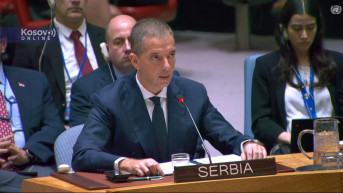
Serbian Foreign Minister Marko Djuric told the UN Security Council this evening that northern Kosovo had become a police protectorate for Serbs, where intimidation and violence against civilians had become part of everyday life. Speaking about the war crimes judgment against the KLA leaders and the reactions among Albanians, he stressed that Serbia’s position was clear—justice for victims must never be sacrificed for political interests and must apply equally to everyone.
“The report describes the situation in northern Kosovo and Metohija as calm but fragile. A street may be calm because a family has decided that it is safer to stay indoors. A town may appear quiet because its young people have left. A community may slowly disappear without a single dramatic event occurring that would attract the world’s attention,” Djuric warned.
He stressed that the absence of conflict was not the same as the presence of security.
“Imagine an entirely ordinary morning for a Serbian family in Kosovo and Metohija. A parent is getting a child ready for school. An elderly family member needs medication. Someone needs to collect a pension. None of this should require diplomatic negotiations. And yet, when schools and healthcare institutions are threatened, when institutions are closed, when the payment of salaries or social benefits is prevented, everyday life itself becomes subject to political pressure.
“And those pressures are not imaginary,” the Serbian Foreign Minister said.
He added that the report itself recorded closures and disruptions affecting institutions on which Serbs depended, as well as unresolved issues concerning the return of Serbian judges, prosecutors and court staff.
“The report also records the demolition of Serbian-owned homes and property around Lake Gazivode, alongside serious allegations of police mistreatment. Just imagine: in the 21st century, the homes of an entire community are being demolished while its members are simultaneously struggling to exercise their legal rights. For these Serbian families, the message is devastating: their homes, their property and their future can be taken away from them at any moment,” Djuric said.
Return of Serbian judges and prosecutors to the system a key step toward restoring trust
Recalling that the United States, where the meeting was taking place, was marking the 250th anniversary of the Declaration of Independence this year, and that the protection of private property was deeply rooted in the American constitutional tradition and constituted a pillar of civilization, Djuric noted that this year, in the heart of Europe, Serbian families in Kosovo had watched their homes and property being demolished while their legal claims remained unresolved.
“In the 21st century, we are witnessing scenes that should belong to the distant past. What message does that send to those families? Do the right to a home, the right to private property and legal protection somehow depend on whether you are a Serb? Imagine a Serbian citizen walking into a courtroom but no longer believing that the system understands his language, his rights or his community. That is precisely why the return of Serbian judges, prosecutors and court staff to the system is not merely a technical issue. It is a crucial step toward restoring trust, without which the judiciary cannot function,” Djuric said.
He also said that 37 people, including one minor, had been arrested following the Vidovdan commemoration at Gazimestan, reminding those present that Vidovdan was one of the holiest days for Orthodox Serbs, symbolizing centuries of faith, sacrifice and the enduring spiritual bond of the Serbian people with Kosovo.
He added that UNMIK human rights personnel had observed bruises and other injuries on several detainees who reported mistreatment during transportation and detention.
Djuric pointed out that, viewed separately, each of these events could be attributed to a different institution, a different case or a different explanation. Taken together, however, they told the story of a community pushed into uncertainty—uncertainty over whether it had any future at all.
Threats to religious and cultural heritage are not minor incidents, KFOR remains essential
The Minister noted that one figure in the report should make everyone stop and reflect: among the 47 members of non-majority communities who voluntarily returned to their homes during the reporting period, not a single one was a Serb.
“Not one,” Djuric stressed, adding that migration statistics and return programs could be discussed, but behind that figure was a human question that remained unanswered—why would someone longing to return to the place of their childhood still believe it was safer to remain far away?
“Returning home does not simply mean receiving the keys to a rebuilt house. It means knowing that you will be able to keep your land, that your children can go to school, that you can see a doctor, that your church and the graves of your ancestors will be respected, and that if something goes wrong, the law will protect you,” Djuric said.
He stressed that this was precisely why threats to Serbian Orthodox religious and cultural heritage could not be dismissed as minor incidents, because a monastery was not merely stone and a cemetery was not merely land.
“Gracanica, Visoki Decani and the Patriarchate of Pec embody centuries of faith, memory and belonging. They are living places of worship. They need security, not reassurances that arrive only after the damage has already been done. Therefore, any changes to the protection arrangements at the Visoki Decani Monastery and the main bridge over the Ibar must be based on credible security assessments and meaningful consultations,” Djuric said.
He stressed that KFOR’s role remained essential and that decisions affecting people’s security could not be imposed without their trust.
“The families of missing persons expect the same respect. There are still parents and children, both Serbs and Albanians, who cannot visit a grave because they do not know where their loved ones rest. Every credible lead must be investigated, including the eight locations identified through the Working Group on Missing Persons where the remains of victims from the Serbian and other non-majority communities may be located. No family’s right to the truth should depend on day-to-day politics,” the Serbian Foreign Minister said.
Justice must apply equally to everyone
Djuric recalled the guilty verdict against four KLA leaders—Hashim Thaci, Kadri Veseli, Rexhep Selimi and Jakup Krasniqi—who were found guilty at first instance of war crimes including arbitrary detention, torture, cruel treatment and murder.
“The judgment concerns, among other things, 96 people who were killed. That means 96 human lives, 96 stories cut short and families that have carried the burden of those losses for more than a quarter of a century. But justice should have gone further. The charges of crimes against humanity did not result in convictions, while many other crimes have remained unpunished—from the murder of Serbian harvesters in Staro Gracko and the killings at Lake Radonjic to the persecution and mass exodus of Serbs and other non-Albanians. Justice cannot be considered served while so many victims are still waiting for answers,” Djuric said.
He noted that wars and armed conflicts were never black and white, but complex, multilayered tragedies in which suffering could not be reduced to a one-sided narrative of victims and perpetrators.
“We must have the courage to face the whole truth: Serbs were victims too. They were persecuted, abducted, killed and driven from their homes in Kosovo and Metohija. As Orthodox Christians, Serbs also watched their churches, monasteries and holy sites being attacked and destroyed. Their suffering cannot be erased from history simply because it does not fit a convenient political narrative,” the Serbian Minister said.
He pointed out that for the victims’ families, September 16 was not merely another date in a legal proceeding, but a moment when their suffering could no longer be ignored.
“And what happened then? Instead of calling for reflection, some of the most prominent political figures in Pristina and Tirana responded by attacking the judgment and glorifying those convicted,” Djuric said, adding that Albin Kurti had described the verdict as an “unacceptable injustice,” while Albanian President Bajram Begaj had said that “nothing can tarnish the KLA” and repeated the slogan “Freedom has a name.”
“But the victims had names too. They were not a footnote in someone else’s national narrative. They were not an ‘inconvenience’ to be justified or minimized. They were human beings—Serbs, Albanians and others—whose rights and lives mattered,” Djuric stressed.
According to him, the judgment established individual responsibility and did not declare the Albanian people collectively guilty, as Albanian families had also suffered crimes committed by various actors, including the KLA.
“However, there is an enormous difference between defending the right to a fair trial and telling an entire society that a court has no right to find its supposed heroes guilty. If we accept that logic, we are effectively saying that justice applies only to the powerless,” Djuric said.
He also pointed to another development that occurred only a few weeks after the verdicts were handed down.
“The parliament in Pristina adopted amendments seeking to restrict the mandate of the Kosovo Specialist Chambers. The European Union itself stated that these amendments were contrary to Pristina’s international obligations and called for respect for the independence of the court and the protection of witnesses. Consider the message this sends. First, a court issues a decision. Then political leaders condemn its findings. And then politicians attempt to change the rules under which that court operates,” Djuric warned.
He asked how, under such circumstances, a witness who had put their family’s safety at risk by testifying could have confidence in justice.
“The responsibility now lies with those who established and supported this institution. They must ensure that crimes committed against Serbs and other victims are not swept under the rug once again, that witnesses are protected and that political interference from Pristina does not obstruct justice,” the Minister stressed.
He said Serbia’s position was that justice for victims must never be sacrificed to political interests.
“We seek justice for every victim, Serbian and Albanian alike. Not a Serbian version of justice. Not an Albanian version of justice. Justice that is the same for everyone,” Djuric emphasized.
He noted that the verdicts had sparked mass protests by supporters of the former KLA leadership, from Pristina and The Hague to New York and cities across Europe, with Albanian flags raised in defense of individuals convicted of serious war crimes.
“Yet, as Presiding Judge Charles Smith reminded the world, quoting historian Howard Zinn: ‘There is no flag large enough to cover the shame of killing innocent people.’ No national flag, including the Albanian flag, with all due respect, can place war crimes beyond accountability,” Djuric said.
According to him, the question raised by the judgment was the same one running throughout the UN Secretary-General’s report: when the law and political expediency collide, which will prevail?
Serbia remains committed to dialogue, CSM still not established after 13 years
Djuric also said that 13 years had passed since agreement was reached on establishing the Community of Serb-majority Municipalities in Kosovo, yet it had still not been formed.
He stressed that Serbia was not abandoning the dialogue with Pristina, but that dialogue must not become a substitute for implementing what had already been agreed.
He pointed out that establishing the Community was not an optional concession to be offered whenever Pristina deemed the political moment convenient, but an obligation undertaken within the dialogue, and that its implementation in accordance with the agreed framework was essential to restoring trust.
“Its principles were further agreed upon in 2015, and the Community has still not been established. Let me tell you what 13 years means for a family. Thirteen years is enough time for a baby to grow into a teenager. Enough time for young people to complete their education and decide whether to build their lives in their hometown or somewhere else. Enough time for parents to grow tired of explaining to their children why the future is always being postponed,” Djuric said.
He reiterated that an agreement reached with the European Union as an active participant, intended to provide the Serbian community with meaningful institutional guarantees, had remained unimplemented for 13 years.
“Imagine the message that sends to someone considering whether to remain in Kosovo and Metohija. If a promise negotiated and signed in an international presence can be ignored for 13 years, what can that person rely on tomorrow? The Community is not a reward for Belgrade. It is not an optional concession to be offered whenever Pristina decides the political moment is convenient. It is an obligation undertaken within the dialogue. Its implementation, in accordance with the agreed framework, is essential to restoring trust,” Djuric said.
He stressed that trust could not be demanded from one side while the other was relieved of its obligations.
“Serbia is not abandoning the dialogue. We know that the future of the region cannot be built through conflict. We want Serbs and Albanians to live safely alongside one another, to work, study, trade and resolve their differences peacefully. But dialogue must not become a substitute for implementing what has been agreed. It must create conditions that people can actually feel in their everyday lives,” Djuric said.
For that reason, he said, the state of Serbia would continue providing healthcare, education, pensions, salaries and assistance to its people in Kosovo and Metohija, stressing that these were not instruments of confrontation but services that helped families remain in their homes.
“And this is precisely where our national policy must remain clear. The policy of preserving peace while firmly supporting the Serbian people—a policy Aleksandar Vucic has pursued for years and which I support—is based on one simple conviction: protecting our people requires perseverance, restraint and a state that does not abandon them,” Djuric stressed.
He said restraint was not a sign of weakness when the alternative was exposing ordinary families to danger.
“There is no inconsistency in defending Serbia’s legitimate interests while simultaneously insisting that peace is our most important responsibility,” Djuric said.
Concluding his address, he reiterated that the September 16 judgment could not return a murdered father to his children, restore the years spent waiting or erase the fear endured by those who testified, but it could send an important message to the living—that no one was above the law and no victim should be forgotten merely because the truth was politically inconvenient.
“Today, this Council must decide whether those principles will guide its approach to the situation in Kosovo and Metohija. For Serbia, the answer is clear. We choose peace, but peace must not require silence about injustice. We choose dialogue, but dialogue cannot mean waiting indefinitely for agreements already reached to be honored. We choose reconciliation, but reconciliation cannot be built by denying victims their dignity,” Djuric said.
Serbia, he added, would continue peacefully, firmly and resolutely to defend the rights and future of the Serbian people in Kosovo, while advocating security and dignity for every other community.
“The victims have waited long enough to be heard. Those who are alive today should not have to wait another generation to feel protected. Serbs and Albanians deserve a future based on respect, cooperation and friendship—let us stand up for such a future!
“That is the responsibility before this Council and before all of us,” Minister Djuric concluded.


0 comments