
Aspirations of Pristina for NATO Membership: A Realistic Goal or a Far-Fetched Dream?
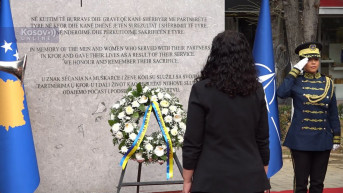
The closure of the doors of the Council of Europe, EU sanctions, and the improvement of Pristina's status within the NATO Parliamentary Assembly have prompted some analysts to shift the focus from Kosovo's European perspective to its Atlantic one. They remind us that NATO is already present in Kosovo through its KFOR mission—only Pristina's entry into the Alliance remains to consummate the relationship, the 25th anniversary of which has been "celebrated" recently.
In the meantime, former NATO General Wesley Clark was honored with the "Ibrahim Rugova" award for his "historical role and contribution to the liberation of Kosovo."
Kosovo's Defense Minister Ejup Maqedonci reiterated recently that Kosovo's main goal is to join NATO.
Love, however, is blind and does not see the flaws of the beloved Alliance. Four out of the five EU member states that do not recognize Kosovo's declared independence are also NATO members.
Furthermore, our interlocutors emphasize that the security and defense issues dealt with by the Alliance are too serious, and from this standpoint, Kosovo is problematic even for the countries that recognize it.
Nevertheless, the fact that the main voice in NATO is America, and that the UK is also there, fuels imagination in Pristina and requires caution in Belgrade, given that it seems breaking established rules has become the only rule respected in international relations.
Despite Pristina's desire to join NATO, this will not happen in the foreseeable future, says Nemanja Starovic, Minister of Labor, Employment, Veterans, and Social Affairs, for Kosovo Online. He points out that membership in the Alliance is not about meeting certain requirements or criteria, as in the case of the Council of Europe, but a fundamental issue of status.
He reminds us that four NATO members do not recognize Kosovo's unilaterally declared independence and that some of them are very firm in this position.
"I would single out Spain, which does not allow even the smallest step to be taken in that direction. Despite Pristina's declared desire and intention to join organizations like the UN and the Council of Europe, which we have witnessed in recent months, I think they are very aware that this is quite far-fetched, even impossible. But their real goal and ambition are to gain recognition from the five EU member states that have not done so yet, four of which are NATO members," Starovic assesses.
He recalls that Pristina adopted an Action Plan for NATO membership some time ago, which defines three steps leading them toward it: the first is gaining full membership in the Adriatic Charter, which prepares candidates or those wishing to become members; the second step is joining the Partnership for Peace program; and the third is full NATO membership.
"However, I must say that for several years now, we have been very effectively preventing any attempt by Pristina to become a full member of the Adriatic Charter. We manage to stop these processes at the first step defined by the government of the provisional institutions of self-government in Pristina," concludes our interlocutor.
Unlike the Council of Europe (CoE), which is an international organization grounded in the European Convention on Human Rights, NATO is something different. Its founding documents, for example, include the obligation of collective defense. These are significant and crucial matters, making it unlikely for states that do not recognize the unilaterally declared independence of Kosovo to make compromises on this issue, concludes Starovic.
The doors to NATO will be hard to open for Pristina unless there is progress in what is fundamental, which is the dialogue between Belgrade and Pristina, says Marko Savkovic, senior advisor at the ISAK Fund, for Kosovo Online.
He does not believe that Kosovo's membership in NATO is possible and reminds us that NATO decisions are made by consensus, with four Alliance members not recognizing Kosovo's independence.
"Similarly, it is not possible to move forward in this accession process now because there are intermediate steps, such as the Membership Action Plan. It might be possible to intensify exercises and provide greater support in the process of defense system reforms or the security sector. However, I do not believe that this will become an 'avenue' for further strengthening Kosovo's statehood or sovereignty," emphasizes Savkovic.
He also believes that Pristina will face the same obstacles for potential NATO membership as it does for entry into the Council of Europe.
"If you look at the statements made by the outgoing NATO Secretary General, he always highlights the importance of achievements or progress in the dialogue. So, I do not think these things are separate or can be separated, just as the stabilization of the situation cannot be separated from the dialogue. We all know that a solution must be sought through dialogue. The alternative is imposed solutions, which can only be imposed by force—let's not go into which side that force might come from—and that is the worst scenario for everyone, including NATO," concludes Savkovic.
He points out that the Alliance itself, which has another major priority and another significant problem—the war in Ukraine—wants to focus on it and does not need another hotspot in its backyard.
The decision on Kosovo's NATO membership depends primarily on the security context and the assessment of Western countries, says Belgzim Kamberi from the Musine Kokalari Institute for Social Policy, for Kosovo Online.
"Regarding NATO, it would have some priority if these states see that, in the security context, there are significant needs and priorities for Kosovo to be a NATO member because the security framework of the Balkan area and Kosovo are somehow at risk," our interlocutor states.
He adds that in this sense, it might be easier for Kosovo to join NATO, but, as he says, it also depends on whether the main EU countries and the USA would have the same approach as they did for the Council of Europe, where they first required Kosovo to do something regarding the establishment of the Community of Serb Municipalities (CSM).
"We have seen regarding the recognition of the Palestinian state by Spain, or some other countries now, that they have some priority political development. This needs to be seen, whether for the USA and the main NATO countries, there is some urgency about including Kosovo in NATO," he believes.
He also assesses that Kosovo is de facto already in NATO due to the KFOR mission being there.
"In one context, Kosovo is de facto in NATO. Whether it will be de jure depends on the security context, and surely the war in Ukraine will have an impact on the European continent and the Balkans," Kamberi emphasizes, adding that this would be "just another step forward, considering that Kosovo has been under NATO influence since 1999."
Former Ambassador to the OSCE Branka Latinovic says for Kosovo Online that she does not expect Kosovo's membership in the Alliance to be put on the agenda in the current circumstances because, as she assesses, Kosovo is problematic even from the standpoint of those who support the formation of its military forces.
She points out that Pristina's aspiration to join the Council of Europe and its potential NATO membership are "different things." Although it is a question of when this issue will be on the table, whether by the end of the year or early next year, the procedure is open for the Council of Europe, unlike NATO.
"I think this thesis, that Kosovo could focus more on NATO membership, is somewhat encouraged by the fact that Kosovo has changed its status within the NATO Parliamentary Assembly; it has been upgraded, and this is seen as a step. No, this is a truly long-term process, and it primarily implies clarification, considering that Kosovo is very problematic even from the standpoint of those who support the formation of its military forces, and very problematic from the standpoint of what the Ahtisaari Plan and Resolution 1244 entail," Latinovic explains.
She emphasizes that these are "very unsustainable conditions in the current circumstances" for such a thing to be put on the agenda.
"Of course, there are those four countries that are NATO members and have not recognized Kosovo's independence, and as we see, Hungary increasingly abstains or votes against, even though it has recognized Kosovo. Here, we can primarily talk about appropriate unilateral measures, that is, individual measures by certain NATO countries to strengthen the security capacity, or military capacity, of the authorities in Pristina," concludes Latinovic.

0 comments