
From “Friend of Serbia” to “Putin’s Trojan Horse”: What Changed for Joe Wilson?

There is something strikingly inconsistent in U.S. Congressman Joe Wilson’s approach to Serbia. Not long ago, he supported cooperation with Belgrade, the U.S.–Serbia Strategic Dialogue and the Open Balkan initiative. Today, he calls Serbia “Putin’s Trojan Horse” and claims that the authorities are already trying to steal the election.
A change of position can, of course, follow new evidence. But Wilson has yet to give the public a convincing explanation of what fundamentally changed in Serbia—or why the initiatives he once supported have now become evidence, in his telling, of a hostile policy.
In December 2022, Wilson met in Washington with Serbia’s then ambassador, Marko Đurić. They discussed bilateral relations, Kosovo and Metohija, and regional cooperation. Serbia’s Ministry of Foreign Affairs reported at the time that Wilson had strongly supported launching a strategic dialogue between Serbia and the United States, as well as the Open Balkan initiative. Together with Congressman Eric Swalwell, Wilson also wrote to President Joe Biden proposing that the United States host an Open Balkan summit.
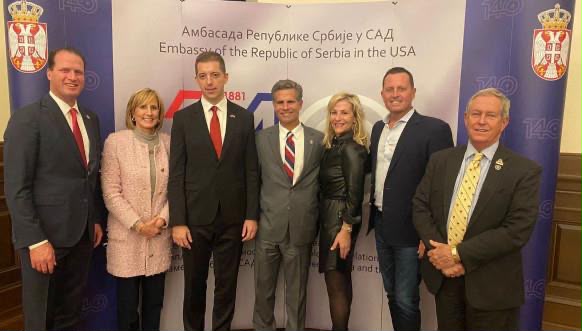
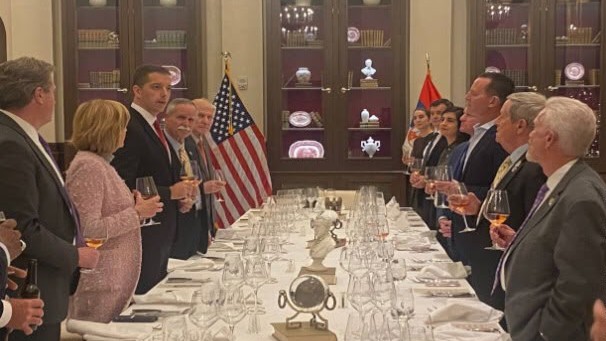


Today, the same congressman describes Serbia as a country supposedly opposed to “Western civilization.” In an opinion piece published on October 7, he claimed that Serbia’s president was trying to “steal” the election and urged supporters of the rule of law around the world to speak out and watch the election closely. Yet only a few weeks earlier, in an interview with N1, Wilson said that the United States did not want to interfere and was not taking sides in Serbia’s election.
If Wilson truly believes Serbia’s election is being rigged, he should present verifiable evidence. Without it, making grave accusations just before an election does not look like a defence of democracy. It looks like political pressure on the voters and institutions of a sovereign country.
It is also notable that Wilson himself explained when he began paying closer attention to Serbia: after Belgrade was selected to host the 2027 session of the OSCE Parliamentary Assembly. At the same time, he has campaigned to move the session to Charleston, in his home state of South Carolina. That fact alone does not prove the motives behind his criticism. It does, however, raise a fair question: are principles the only consideration, or are political interests also at play?
When Serbia was a partner in initiatives Wilson supported, cooperation with Serbian officials did not trouble him. Now that Serbia has failed to meet his expectations—and Belgrade has been chosen to host an event he wanted held in his home state—the harshest labels have followed, along with calls for outsiders to engage politically in Serbia.
That is hypocrisy. Not because Wilson has no right to change his views or criticise Serbia, but because he presents his current accusations as an unwavering defence of principle while his past actions—and his own account of when he began focusing on Serbia—point to a more complicated story.
Serbia does not expect foreign politicians to agree with every decision it makes. But it has the right to expect consistency, evidence and respect. Democracy is not defended by supporting cooperation with Serbia one day and attaching sweeping labels to its people and institutions the next.
Written by: Željko Šajn


comments