
The ban on the import of Serbian press - an attack on the rights of the Serbs to information and to connect with their language and script
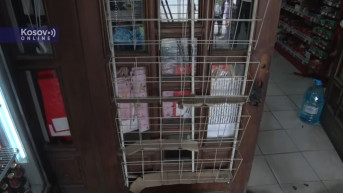
With the ban on the import of Serbian products to Kosovo, which also included the press in the Serbian language, the Serbs, as assessed by the interlocutors of Kosovo Online, were denied not only the right to be informed but also the right to be in touch with their language and script.
Despite the fact that even the elderly are increasingly mastering modern technologies and can read the news on mobile phones, most of them are still informed through the press. And since the middle of June, due to the decision of the Kosovo Government, newspapers printed in Belgrade have not reached kiosks in Serbian areas.
President of the Journalists’ Association of Kosovo and Metohija (DNKiM), Ivana Vanovac, tells Kosovo Online that this is a big blow for the citizens, not only to their right to know but to their sense of security and connection with Serbia. The director of the National Library in Gracanica, Brankica Kostic, points out that with this current situation, we should not forget that years ago at crossings, all printed works, including books, had to go through control and often were stopped at the crossing, while the journalist of RTV Gracanica, Zoran Stankovic, said that the paradox that Serbian press is sold in countries in the region, and that Serbs in Kosovo are forbidden to read newspapers in their native language.
"We are denied almost all rights here. We literally live in a ghetto and the only right we may have had, so to speak, the right to know, the right to read the media in our language, has been denied to us. And we are aware that these rights are not denied anywhere in the world. In the entire region, almost everywhere, I had the opportunity to see that the Serbian press is being sold on kiosks, and here we are, who are a part of that country, we have no right to read the press now," Stankovic told Kosovo Online.
He notes that the majority of the elderly get information through newspapers.
"Younger generations use computers and mobile phones, of course, it's the 21st century, however, when it comes to the elderly, over 65 or 70 years old, they are used to newspapers, to the daily press and they miss that to a great extent," Stankovic says.
He also points to other language barriers in everyday life because there is no information in the Serbian language on product declarations in stores.
"When we buy a product, we cannot read its ingredients and the like, because very often it is only in Albanian and possibly in English, so we are literally denied the right to language in every sense," Stanković pointed out, adding that this was especially problematic when the Serbs found themselves in areas with a majority Albanian population.
Cyrillic, he points out, doesn't bother Kosovo anymore because it's gone.
"It is almost lost, we can no longer see it even in the inscriptions of the places, even the Serbian ones where we live," Stankovic says.
With each new decision, he adds, Pristina tries to cause a new crisis.
"The goal is obviously to lead to even greater tensions. I assume that we will see more of it in the fall. It may be calmer at the moment, but I'm afraid it's the calm before the storm. And the goal is literally to deny us everything, so that we leave these areas sooner, or else, for the situation to deteriorate to such an extent that it would lead to a situation where the Serbs would somehow be 'guilty' again," Stankovic concluded.
The Director of the National Library in Gracanica, Brankica Kostic, points out that it is not just that the Serbs in Kosovo are deprived of printed media in their own language, she recalls that for seven years the import of all printed works, including books, has practically been stopped at the crossings.
"Decades ago, we all warned of the scale to which all this is reaching and that these are flagrant violations of rights without precedent. When they change your toponyms, forbid you to speak Serbian, or say that you only speak the Albanian language, when you are banned from books and the press and when it is selected, such as Vecernje Novosti and Politika, which are in Cyrillic, what else can we say but that the world turns a blind eye to that here in the heart of Europe, a nation is simply kept like it used to be in the Warsaw Ghetto," Kostic says for Kosovo Online.
As she points out, at the crossings, the books have to pass control.
"We are doing all we can to get the book to the reader. Regardless of everything, we still have an enviable fund of literature for all those who like to read, and it is really necessary to read everything possible. And when we have books for personal needs in our bags, it all goes through their control and it is leafed through. I'm sorry that they don't have time to read a little more," Kostic says.
The director of the library claims that it is not clear under what pretext the Kosovo Government does not allow printed works to enter Kosovo.
"Several years ago, these were so-called reciprocity measures, because certain textbooks from Albania could not infiltrate the Serbian education system in the south of Serbia - Presevo, Bujanovac, and Medvedja. But it continues to this day. Those people don't know the difference between textbooks, fiction, reading, history books, and even calendars are often not allowed to pass," Kostic says.
The goal of the Pristina authorities, claims our interlocutor, has always been the same.
"For them to expel us, and for us to say “enough is enough'', and for us to go on that path of no return, unfortunately," Kostic states.
By the way, the current collection of the library in Gracanica is around 30,000 books.
Journalist and writer Zivojin Rakocevic, on the occasion of the blockade preventing Serbian-language press from reaching Kosovo, told Kosovo Online that he thought this was the only European area where newspapers were not printed and where any group that wanted to read them was forbidden to get what it wanted to read.
In the last ten years, he added, there had been a continuum of interference when it came to the press.
"As for all those cases, they are simply trying to throw us out of life by stopping one civilizational achievement, one segment of our life, which is natural. Can you imagine life without newspapers? Newspapers are a symbol of your language, your culture, your need to be informed, your need to learn, your need to have fine daily rituals," Rakocevic stated, with the assessment that the Serbs had been discriminated against on all levels for years, but that something like this it had not even happened during the era of Ottoman control.
President of the Journalists’ Association of Kosovo and Metohija (DNKiM), Ivana Vanovac, tells our portal that it is really a big blow for the citizens that the press that is printed in the area of central Serbia has not arrived for two months.
"First of all, it is an attack, perhaps not so much on information per se, as on the feeling of security and connection with central Serbia. People are now mostly informed via the Internet, even when they are informed via television, they actually use the Internet, and it is my impression that these days, in addition to all the problems we have and in addition to the difficulty of providing information and the difficulty of working in the field of journalists, we also have one potential problem, namely the writings, above all, in the Albanian media about the possibility of contesting the license to work for our mts D.O.O company. I think that this is a big threat to the information of people here if we take into account that it is the largest, perhaps the only serious distributor of Internet and mobile services in this area and that the absolutely entire population in the north depends on their services. It is only a threat for now, but it should be taken seriously because it could be a potential attack on people in this area," Vanovac warns.
Regarding the difficulties with delivering books in the Serbian language, Vanovac says that even five or six years ago, problems were encountered when ordering books from publishers from Belgrade or Novi Sad, who were reluctant to send books because it happened to them that they ended up at the terminal or that they come back.
"Now that we have a problem with the entry of Serbian goods, I wonder what will happen around the first of September, when it will be necessary for textbooks for students in the north of Kosovo and Metohija to arrive. I believe that some modality will be found because I can't even imagine what will happen if someone bans the delivery of textbooks. Children already have huge gaps, if we take into account the corona and the latest struggles. The consequences that will remain with those generations are irreparable.



0 comments