
Bargaining, bribing MPs or Western pressure – How will Kurti reach a majority?
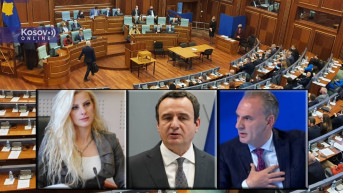
There's a bit of everything—bargaining, attempts to buy votes, and warnings that the West might eventually exert pressure to force parties to constitute the Kosovo parliament and form a new government. For interlocutors of Kosovo Online, this is a clear indication that Albin Kurti still hasn't found a way to reach the magic number of 61 MPs—the number he needs to take the helm.
Written by: Djordje Barovic
"The offer came from those in power. The person who made the request is a doctor from Kosovo, a member of the KLA, whom I deeply respect. I know he's following this and he knows who he is, so out of respect, I won’t say more," said Bosniak community MP Duda Balje a few days ago, after revealing that she was promised a teaching post in Skopje in exchange for voting for Albulena Haxhiu.
This marks the first public admission that the ruling Self-Determination Movement of Albin Kurti is attempting to resolve the institutional crisis through vote buying.
MP Lutfi Haziri from the Democratic League of Kosovo (LDK) previously stated that the ruling coalition had contacted at least two MPs from his party to switch sides.
"In addition to those two, others were also contacted, but the meetings themselves clarified certain issues, meaning the LDK remains united," Haziri said.
When individual persuasion failed, Kurti tried to win over the entire LDK, describing it as the "ideal coalition."
Meanwhile, from the beginning, a possible partnership with Fatmir Limaj’s NISMA party has been in play.
Even though its four MPs are the result of a coalition with Ramush Haradinaj’s AAK, Limaj claims he is "ready to cooperate with Self-Determination on a parliamentary level, but not on forming a government."
"Everything related to that party is in the past," Haradinaj responded somewhat ambiguously when asked directly if Limaj would switch sides.
Kurti himself acknowledged that 61 MPs is the magic number right now. That’s why he is awaiting the Constitutional Court’s decision on whether the secret vote for electing the new Assembly president was legal.
"The Constitutional Court has already dealt with the issue of secret voting, and I hope for a quick response," Kurti stated.
Previously, he had noted that this issue could have been resolved earlier—right after the Serbian List won an overwhelming majority of seats within the Serb quota.
"It was a unique, historic case not to certify the Serbian List," he said.
He explained that the balance in parliament wouldn’t be 9:1 in favor of the Serbian List, but "pluralism."
"Then we wouldn’t be in this political deadlock today. In my view, that was a missed historic opportunity," Kurti added.
Help from Abroad?
Representatives of the international community in Kosovo haven’t commented on the “math” involved here, but they have certainly commented on the institutional crisis.
At the "Kosovo Toward the European Union: The Path to a Solution" conference, they collectively urged political parties in Pristina to form a government as soon as possible—and then fulfill their promises.
"Citizens fulfilled their duty in the February 9 elections. Politicians should now put the state first and party politics second. So I believe it is urgent for Kosovo to form its institutions," said German Ambassador Jorn Rohde.
Dutch Ambassador Karin Boven echoed the call for urgently forming a government, emphasizing that without a functioning executive, the commitment to EU integration cannot be realized.
EU Office Head in Kosovo, Aivo Orav, said the EU "needs a partner to talk to."
"So, we need a partner with whom we can discuss next steps—how to move toward the EU. We hope a government will be formed as soon as possible," he stated.
French Ambassador Olivier Guérot went a step further, saying, "Kosovo is not isolated, unless it isolates itself."
"How do you isolate yourself? By not listening to your friends, by moralizing, by finding excuses not to meet your obligations. So, listen to your friends," said Guérot.
Reflections on Reality
However, for Professor of International Relations from Pristina, Afrim Hoti, it's not realistic to expect international representatives in Pristina to pressure political parties into quickly constituting the Assembly and forming a government.
"I don’t think so. The only thing that can help at this moment is the opinion of the Constitutional Court of Kosovo. Once we have that ruling, I’m confident both camps—government and opposition—will understand the situation and start to deal with reality," Hoti told Kosovo Online.
Asked whether such a request has already been submitted to the Constitutional Court, Hoti is confident that it has and that a response is now awaited.
"I believe a request has been filed with the court and that the parties are now waiting for a decision," Hoti clarified.
“Plan B”
Miloš Pavkovic, an associate at the Center for European Policies in Belgrade, says that the course of the constitutive session of the Kosovo parliament so far reveals attempts to buy votes, but also suggests that Kurti will most likely resort to a "backup plan."
“It’s become clear that vote-buying in Kosovo isn’t a viable solution. We’ve seen that the vote has been repeated 21 times already, and Albulena Haxhiu, Self-Determination’s candidate, has not been elected. Opposition party leaders have clearly confirmed attempts to buy votes, individual party switches, and various offers to get MPs to vote for Self-Determination’s candidate. But they also provided firm guarantees that the opposition is united and that no MPs will cross over,” Pavkovic told Kosovo Online.
He explained that what each MP Kurti has negotiated with demands in exchange for support varies.
“We saw reports confirming that Duda Balje, a Bosniak minority MP, was offered a professorship in Skopje. I assume others may be asking for different positions—perhaps government posts or benefits for their parties... It depends on each MP or their respective party,” Pavkovic pointed out.
He believes the most likely outcome at this point is that Fatmir Limaj’s NISMA party will leave its coalition with Ramush Haradinaj’s AAK, and that its four MPs will side with Self-Determination.
“This has been discussed from the very beginning, and it seems those talks are intensifying now. That may have been Kurti’s backup plan in case he couldn’t secure enough individual MPs. But if an agreement with Limaj fails, we are definitely heading toward new elections,” Pavkovic emphasized.
Should NISMA become Kurti’s new coalition partner, Pavkovic has no doubt that this would also secure Limaj a deputy prime minister post.
“I assume his condition would be entering the government, possibly as a deputy PM, which wouldn’t be Kurti’s ideal scenario, but if he has no other option, it becomes the most realistic one,” the analyst stated.
Asked how much pressure from the West could tip the scales to help constitute the assembly and form a new government, Pavkovic, like Hoti, is skeptical that the Quint countries, the EU, or the US “want to interfere in internal matters and government formation.”
“Albin Kurti’s government hasn’t had good relations with these countries recently, so they neither support nor want to endorse any ‘party-switching’ or attempts to form a new government. So far, they’ve stayed on the sidelines. The West’s only goal is to overcome the crisis—either by forming a new government or holding new elections. I don’t think they have a preference and won’t spend much political capital supporting a ‘Kurti 3’ government,” Pavkovic said.
Past Examples
On the other hand, historian and analyst from Gracanica, Aleksandar Gudzic, says that in the past, the international community has indeed decided who would become prime minister or minister.
“The history of multi-party parliamentarism in Kosovo since 1999 has shown that Western European and US embassy representatives have at times selected candidates and officials for Kosovo institutions. So it’s neither unusual nor impossible that the foreign factor, which has heavily invested in promoting Kosovo’s statehood, ends up deciding who becomes speaker of the parliament, prime minister, or minister,” Gudzic told Kosovo Online.
According to him, Kosovo is currently in a political crisis which he claims is the result of “Albin Kurti’s irresponsible policy, both toward the Serbian community and toward other political parties in Kosovo.”
“The practices and results of post-election negotiations show that Albin Kurti lacks coalition potential. His tactic and intent seem to be to stall and then call snap elections when it suits him. In my opinion, this will happen in the summer, when the diaspora arrives. Kurti enjoys strong support from the Albanian diaspora, but it’s also possible that joint parliamentary and local elections are held in the fall. That’s one of two likely scenarios,” the analyst says.
Commenting on the recent statement by Bosniak MP Duda Balje, who claimed she was offered a professorship in Skopje in exchange for her vote in parliament, Gudzic said that political practice shows vote-buying is possible—but he hopes it won’t happen.
“I want to believe it won’t happen. Political practice in post-communist countries and systems that emerged from the breakup of Yugoslavia has shown that party-switching by MPs isn’t uncommon, and such things are possible. But I want to believe it won’t happen this time,” Gudzic concluded.


comments