
Bektashi state in Tirana – new religious center or new division?
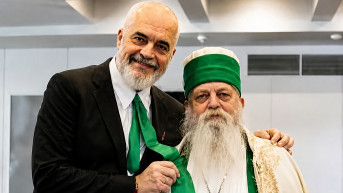
Although foreign media have once again raised the possibility of establishing a Bektashi state in Tirana, there have been almost no official reactions in Albania. While religious communities remain silent, analysts speaking to Kosovo Online interpret the idea differently, from claims that it is merely about strengthening the global center of Bektashism to warnings that the project could create new divisions. Citizens are also skeptical that the creation of a new religious state is realistic.
By: Bledar Kuka
According to reports by the French outlet Intelligence Online, two years after the project was first announced, a Bektashi state will soon be established in Tirana, with the support of France and the United States. Preparations have reportedly entered an intensive phase, with formalization expected in the coming months. Meanwhile, religious communities in Albania have chosen to remain silent. There has been no public reaction or response to Kosovo Online's request for comment from either the World Headquarters of the Bektashi Order in Tirana or its leader, Baba Mondi, nor from the Islamic Community, the Orthodox Church or the Catholic Church regarding reports that the new state could soon be established. Only several analysts have spoken publicly about the issue.
According to Edmond Petraj, an experienced lawyer and leader of Albania's Vlach minority party, the term "state" cannot be used in its full sense in this case.
"In my opinion, we will not have a Bektashi state. For it to exist, international recognition would be necessary, while creating a state within a state would require an international agreement on the matter. It is true that parallels are being drawn with the Vatican, but I do not expect this to be a state like the Vatican, which was established on the basis of an international agreement. I believe we will get a major global center of Bektashism, something like Mecca or another important religious center in Islam, or like the Ecumenical Patriarchate in Istanbul for Orthodox Christians. This global center will operate in accordance with Albania's rules, laws and Constitution. Stories about a real state or even its own currency called the 'Bek' are not realistic. Even the Vatican operates in cooperation with the Italian state, which provides public order and security. I expect a similar model to be established here," Petraj said.
Analyst Ylli Pata has a similar view, saying that he has discussed the issue with Bektashi leaders and lawyers involved in the project.
"I do not believe this will be a state. It will be a religious order, similar to the Order of Malta, which has international legal personality and close ties with the Vatican. It should be kept in mind that the Vatican has been a state since the Middle Ages, after the fall of the Roman Empire. I do not believe this project will receive international recognition as a state, but rather that it will have the status of a religious order, for which there are examples around the world. From a legal standpoint, we still do not know what kind of model this is, but I think claims that it will threaten Albania's sovereignty are exaggerated. Let us wait to see the documents, because no official document has been published so far. However, based on the conversations I have had with Baba Mondi and the lawyers working on this issue, it is clear that this is not a Vatican model," Pata said.
Analyst and translator Ben Andoni links the French media reports to Prime Minister Rama's current difficulties.
"Initially, this news was published by a French media outlet that is almost unknown in Albania. This time it did not generate much interest, unlike two years ago, when the story was published in leading US media and the country's prime minister confirmed it at the United Nations. It seems that the revival of the issue of a Bektashi state is connected with Prime Minister Rama's very difficult situation in Albania, due to protests that have not stopped, although the number of participants has begun to decline. Public opinion is interested in other issues related to the country's progress. Based on what can be seen, the impact of this news has been very limited this time," Andoni notes.
Asked what impact a new state, if created, would have on Albania, whether positive or negative, Petraj says it would be welcomed with "open arms."
"I think it will be good for Albania if we manage to become the world capital of the Bektashis. This is being discussed. If Iran accepts this capital, which it currently does not, if Bektashis around the world, Turkey... accept it, then there are several elements at play, and we will have to see what happens in the coming days. I see it as something positive and beneficial for Albania, which would become the world capital of Bektashism, and as a highly functional coexistence of different religions, something that promotes our values and the values of the community that believes in the Bektashi faith. In Albania, we cannot distinguish where Orthodoxy begins and where Bektashism ends. We are almost the same. We accept one another as we are. I am Orthodox and I have been to the World Headquarters of the Bektashis, which is actually located in Tirana today," Petraj said.
In any case, Pata notes, a Bektashi state would face major obstacles and would not be easy to establish.
"The biggest problem will be recognition of this new state, if it comes into being. A Bektashi state would have to be recognized by entities that already exist in the region. This is because we have numerous attempts by some communities to break away from the Bektashi Community. One of the most important tekkes of this community, the Albanian tekke in the United States, has not accepted this idea. Likewise, Bektashis from Tetovo and Kosovo have not yet joined. It is even said that there is a group within Albania, such as the Elbasan tekke, that has rejected this idea. So there is a kind of internal conflict, and the interests of countries in the region are also involved. It seems clear that Turkey opposes this idea, just as Mustafa Kemal Ataturk opposed it at the outset. We also had a meeting between the Turkish ambassador and the Bektashi leader in Elbasan, so there is an attempt to divide the community," Pata said.
Andoni warns that the opposing stance of other religious communities in Albania toward the project is linked to the significance that some Sufi believers have within Islam, in a country such as Albania, where several different religions coexist.
"It seems that the Albanian state is providing some assistance to the Bektashi community, which is numerically smaller than the other three communities, although it is said that their numbers are not insignificant. There are said to be 150,000 active believers, as well as many others who do not identify as Bektashi. In this sense, this community could take on the significance of the other communities, because it is true that Sunni Muslims, Catholics and Orthodox Christians are much more organized, powerful and direct in demanding their rights. The importance that is being given to the Bektashi community seems to place the other communities in the background and make them less important. These communities have long been trying to reclaim property confiscated from them during the communist era. The importance being given to the Bektashis will lead to the relativization of the other communities in Albania's interreligious mosaic. One of the most natural questions that can be asked is how long it will take to create such a state, or whether this project is only about to be launched or has already been launched," our interlocutor said.
Edmond Petraj has his own prediction. He believes the debate will be very long.
"If the project is ready and presented for discussion, I think there will need to be greater awareness, and this idea will require lobbying efforts in countries and Bektashi centers around the world. I have the impression that Bektashis around the world will accept this project. I think it will take at least five years because, once the project is announced, the Bektashi Center in Tirana will lobby in certain countries where Bektashis live. That will happen. Many doubt that Prime Minister Rama will succeed with this project, which is supported by the Bektashi Center in Tirana," Petraj said.
However, Ben Andoni says that anything could happen in Albania because of the country's religious tradition.
"I do not believe that the Bektashi community is part of the Muslim Community, because it is true that the Muslim Community has tried to keep them at a distance, since some of their rituals are unacceptable to the Muslim Community. Bektashis are extremely liberal Muslims, and their liberalism is not in line with Sunni principles. I must say that, although we are a country with good religious harmony, we have not shown that we are a people with deep religious roots. If we were, I believe that resistance to the 1967 ban on religion would have been greater and that there would not have been such large-scale conversions as occurred after 1991," Andoni said.
While analysts' opinions are often divided, the citizens of Tirana generally agree on one thing: they lack information about the concept, intentions and substance of the proposed state.
"I am absolutely against the creation of such a state. Every piece of information published in Albania has come exclusively from foreign media. In such a situation of uncertainty, when we do not know what this state would be like, how it would be governed or what power it would have, I am against it. The second reason I am against it is related to another fact. In Albania, we take pride in religious tolerance, and I mention this as an argument against it, because there is no reason for one religion to be distinguished from the other religions in Albania. Bektashism is not even the main religion in Albania," a young woman from Tirana told us.
Her fellow citizen agrees with her.
"I do not agree with this idea because it means that a little Vatican would be created within Tirana. I think Tirana, or Albania, should not be divided into several parts. There are Catholics, Muslims, and Bektashis in this country. It makes no sense. Even older people understand that this idea makes no sense at all," an older man told us, while another expressed the opposite opinion.
"I am not Bektashi, I am Orthodox. I support the creation of this state," he said briefly.
Another resident of Tirana was opposed to the idea.
"I think the proposal to create such a state is premature. We have Orthodox Christians and Catholics as well. None of them has created a separate state here. I respect the Bektashi faith, but why should they create a state within a state? That is my opinion. It depends on many other factors," he said.
"I do not want to give my opinion, but I believe this is just a religious division. Nothing more. I do not agree," another passerby said firmly, while another pointed to the lack of transparency.
"I cannot give a precise opinion without clear information about this project. I am against it precisely because there is no transparency. We were informed about everything by foreign media, international media. No details have been published. This makes the situation even less clear, and that is why I am against this Bektashi state project," he said.
There were also those who support the idea.
"I think it would be good to create this Bektashi state, just like the Vatican. I do not know whether it is too late or too early for this idea, but I think that, since the center of the Bektashi religion is in Albania, it would be good to create a state. The religions in Albania get along well with one another," this resident of Tirana said.
0 comments