
The bridge remains as it is for now, what will be the next moves of the Kosovo authorities in the north?
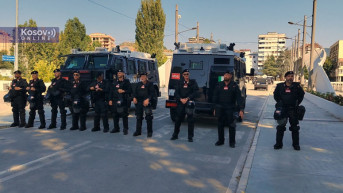
As the deadline for opening the bridge between North and South Mitrovica by the end of the summer passes, the Kosovan government has now shifted its statements to saying the bridge will open by the end of the year. The increased presence of KFOR forces at the bridge may have disrupted the original plans of the Kosovan authorities, but alternative "Plan B" actions are always a possibility. If opening the bridge for road traffic was intended to gain political points ahead of the elections, as analysts suggest, those points might be compensated through other actions in the north. The question remains: how far will they go?
Written by: Dusica Radeka Djorđevic
At the end of last week, the Kosovo Police raided the temporary municipal offices of four Serbian-majority municipalities in the north—Kosovska Mitrovica, Leposavic, Zvecan, and Zubin Potok. The offices were sealed, and computers and certain documents were seized. Ivan Zaporožac, the president of the temporary municipal authority in Kosovska Mitrovica, Milan Radojevic, the former mayor of North Mitrovica, and Igor Simic, a member of the Serb List Presidency, were questioned at the police station. The Kosovo Police explained that they are suspected of forging documents in the buildings of the temporary municipal authorities.
Many interpreted this action as compensation for the fact that the bridge remains closed to traffic.
With parliamentary elections scheduled for February 9, five months remain, filled with uncertainty for Serbs in northern Kosovo. Will Kosovan authorities also target the Serbian University of Pristina with its temporary headquarters in Kosovska Mitrovica, schools, and healthcare institutions? Could this be part of “Plan B”?
Stefan Surlic, an assistant professor at the Faculty of Political Sciences in Belgrade, told Kosovo Online that the main bridge over the Ibar has long symbolized the defiance of the northern region, where Kosovan authorities are keen to assert sovereignty over the entire territory of Kosovo. All the actions taken by Kosovan authorities since the announcement of the bridge opening are seen as compensation to present themselves publicly as dismantling the remaining Serbian institutions in northern Kosovo.
"I don't think this will stop here, and I believe the University will be targeted next, as it has been labeled several times as an illegal institution, despite the fact that even the Ahtisaari plan envisaged its existence. Healthcare and education could also come under fire, but I think it would be too risky for Kurti to shut down primary and secondary schools or hospitals, as that would lead to a mass exodus of people. If we talk about why Serbs still live in Kosovo, it's primarily because of healthcare and education, which are still part of the Serbian system. I assume that international actors, although they have a lenient approach toward Albin Kurti's government, understand that this is a red line that cannot be crossed, and they will likely take a different tone when discussing this issue with him," stated Surlic.
According to Dragisa Mijacic, coordinator of the Working Group of the National Convention on the EU for Chapter 35, the Kosovo government will continue to focus on the issue of opening the main bridge on the Ibar. He expressed concern that the biggest fear regarding unilateral actions is the potential closure of the University, a highly important institution for the Serbian community and its students.
The issue of the University has been raised multiple times during the dialogue process, and any attempt to close it would be yet another act that has not been agreed upon with international partners.
"This is also an appeal to the international community to act preventively. We've seen multiple occasions where they have reacted to actions taken by the Kosovo government, but nowhere have we seen preventive measures. A group of civil society organizations and activists from northern Kosovo recently issued a statement calling for KFOR to be deployed in front of all key institutions for the functioning of the Serbian community in the north, in the form of mobile checkpoints and control points. This would be one way to prevent further escalation and dissatisfaction among the Serbian population, with KFOR stationed in front of all important institutions, especially the University," Mijacic said in an interview with Kosovo Online.
He added that there is currently no intention to close healthcare and educational institutions, primarily because they are recognized by the Kosovo constitution. However, there will certainly be pressures to hinder their operations.
"We have seen several instances where Kosovo political forces have entered the hospital complex in Kosovska Mitrovica. I believe there will be pressure on the functioning of healthcare institutions, in terms of the delivery of medications, patient transportation, and the overall operational capability of those institutions," Mijacic emphasized.
Mijacic points out that every year in September, after people from the diaspora leave, the Kosovo government organizes unilateral actions that are not coordinated with any international institution but rather attempts to impose changes on the ground independently.
"This is happening these days as well, with the abolition of the Temporary Municipal Authorities in northern Kosovska Mitrovica and other northern municipalities. We can expect such measures in the coming period," Mijacic believes.
The University is seen as the next possible "target" of Albin Kurti's government by Milos Pavkovic, a collaborator at the Center for European Policy. Pavkovic thinks Kurti will not stop with his unilateral actions. He notes that Kurti is taking advantage of the vacuum in Brussels due to the absence of a newly elected European Commission and administration, which is why he expects Kurti to continue with such actions.
"So far, there are no indications that Kurti will stop. This campaign of unilateral moves started with the ban on the use of the dinar, followed by the closure of the Postal Savings Bank and post offices, and has now continued with the raid on the Temporary Municipal Authorities, the hospital in Mitrovica, and some cultural institutions. The only remaining institutions that could be potential targets are education and healthcare in Kosovo and Metohija. I believe the next target will be the University of Pristina, temporarily based in Kosovska Mitrovica, which is a thorn in the side of the government in Pristina and will likely be the next target on their list," Pavkovic told the portal.
Regarding the government's intention to open the bridge for road traffic, lawyer and former Chief Inspector of the Kosovo Intelligence Agency (KIA), Shkelzen Sopjani, stated to Kosovo Online that he doesn't believe there is a real possibility of changing the status of the bridge. He also questions why it should be opened for road traffic, aside from the symbolism and "a bit of populism" in the context of the pre-election campaign.
"I don't even know what is meant by 'opening' the bridge since it's already open. You can cross it. I have crossed it several times, and there are other bridges that cars can use to go to northern Kosovo. I don't see why this bridge should be opened for vehicles, except for the symbolism behind it and perhaps a bit of populism, especially in the context of the pre-election campaign. It is also very convenient for the current government to divert people's attention from the real problems and failures they have faced in other areas," Sopjani concluded.




0 comments