
Can direct Trump–Putin negotiations on Ukraine expand to other global hotspots, including Kosovo?
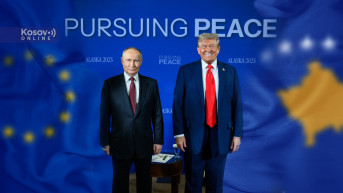
If Donald Trump succeeds with Ukraine, could the “Alaska recipe” — an agreement between the U.S. president and Russia’s Vladimir Putin — be replicated in other global conflict zones, including Kosovo? For analysts speaking to Kosovo Online, this is not an impossible scenario, but major powers are driven by major interests, and the Belgrade–Pristina issue is not currently at the top of their agenda. Most also believe Brussels will not easily give up on resolving a problem “in its own backyard.”
Written by: Djordje Barovic
According to reports, the likely U.S. president has “in some way” already arranged a meeting between Russian leader Vladimir Putin and Ukrainian President Volodymyr Zelensky. Speculation is rife about a possible venue, with Switzerland currently seen as the most likely.
Swiss Foreign Minister Ignazio Cassis stated that Switzerland is ready to host Putin for peace talks on Ukraine despite the arrest warrant issued against him by the International Criminal Court (ICC).
Still, the location of the talks is secondary. What matters is how Russia and Ukraine might reach a sustainable peace agreement.
Middle East political analyst and Kosovo Online columnist Habib al Hadi warns that although EU leaders were excluded from the Trump–Putin talks in Alaska, they continue to insist that “international borders cannot be changed by force.”
“In doing so, they conveniently forget former Yugoslavia, not to mention the undeniable military, political, and financial support for the territorial dismemberment of Serbia and the recognition of what remains to this day a merely ‘self-proclaimed state of Kosovo.’ Such ‘principledness’ will certainly come at a cost. Macron, Meloni, Scholz, Starmer, Stubb, Tusk, Costa, and von der Leyen all know this. If they ever ask themselves what destroyed a united Europe, they will at least have a clear answer: it was ‘Kosovo,’ nurtured by them and their predecessors,” he argues.
Frustrations and “fields of rivalry”
Former Yugoslav ambassador to Germany Zoran Jeremic believes the Alaska meeting between Trump and Putin on Ukraine demonstrates the two powers’ desire to resolve key global issues on their own, which is a frustrating moment for Europe.
Speaking to Kosovo Online, Jeremic emphasizes that Kosovo is not currently in the focus of major powers, but could become their “field of rivalry.”
“Europeans are already extremely frustrated about being pushed off the table in these talks and into a corner. If any initiative arises, they will seize it with both hands in order to be present and to play an important role in resolving any problem, especially one in Europe that they consider to be their exclusive or primary responsibility,” Jeremic said.
He stresses that the very issue of “jurisdiction” regarding Kosovo is the most dangerous.
“It will become a field of rivalry between the U.S. and Europe, where they will compete over who proposes solutions first, sometimes to our detriment, sometimes to our benefit, depending on how events unfold. In any case, Europe will seek to be an independent actor if it comes to that,” he noted.
Jeremic interprets the Alaska meeting, along with subsequent statements from Washington and Moscow, as a sign that the U.S. and Russia intend to decide future global questions by themselves.
“They are already doing this. I am convinced that negotiations are quite advanced on Gaza and the Middle East, as well as with Iran. We see that the situation with China and the South China Sea is becoming more complicated. The three great powers will attempt to resolve that triangularly, but where bilateral solutions are possible, the U.S. and Russia will try to proceed that way,” Jeremic believes.
Asked whether the “Alaska model” could be applied to Kosovo, Jeremic is skeptical, saying it depends on how the situation develops.
“I don’t believe this will be in their focus now, firstly because they are preoccupied with many other issues, and secondly because they have no concrete, visible strategic interests here. Kosovo could become a ‘bargaining chip’ between Russia and the U.S. the moment it suits them,” he said.
“For now, the U.S. and the West have achieved their strategic interests in Kosovo. Russia has not, and it will only bring it into the trade-off with the U.S. when it suits Moscow and Trump. Whether it will take the form of ‘we settle this ourselves — take it or leave it,’ or whether they will try to involve us more directly, since this concerns us, remains to be seen. But at this point, there is no indication that they intend to resolve Kosovo in this way in the near future,” Jeremic concluded.
A “new Yalta” and Russia’s interests
Pristina-based political analyst Shkëlzen Maliqi argues that direct Trump–Putin talks suggest both sides want a “new Yalta,” a peace conference of great powers similar to the one held at the end of World War II. But he stresses it is unrealistic to expect that Ukraine — or Kosovo — could be settled without agreement with the EU.
“Although the EU was not at the Alaska meeting, they held a separate gathering with Zelensky in London. Europe is interested in Ukraine because it is primarily a European issue. But Trump’s ‘cowboy politics’ do not account for this, which is why in some ways he has better relations with Putin than with the EU. But I think this is temporary,” Maliqi said.
Unlike in 1945, when the U.S., USSR, and UK met in Yalta, Maliqi notes the list of today’s global actors would be broader:
“This meeting is a kind of Yalta, or a prelude to Yalta, between two great powers, but now there are others too. China was not in Yalta, but now it should be, along with Europe. Europe is still an economic giant, though not politically or militarily. There must be balance, compromise on Ukraine, and that is what is being worked on now — what kind of compromise it will be remains to be seen,” he said.
On how much Kosovo interests the major powers, Maliqi stressed:
“Kosovo is always there in the background. Putin has been invoking Kosovo for a decade, linking it to Crimea and other territories reclaimed by force, like Abkhazia in Georgia. Such is the policy of great powers — to ‘return’ territories. One period was ‘no’ to the UN, ‘no’ to the international order, and now things are shifting back. Likely, a new world order will have to be established — but how, no one knows,” he said.
Spheres of influence and a “no man’s land”
A very different view comes from the U.S.
Dalibor Rohac, senior fellow at the American Enterprise Institute (AEI) and expert on Central and Eastern Europe, warns that a rapprochement between Washington and Moscow could produce a situation where Russia demands a sphere of influence in the Balkans.
This, he told Kosovo Online, could destabilize the region and worsen the situation in Kosovo.
“I fear that a rapprochement between Washington and Moscow could create a situation where Russia demands influence in the Balkans. We could expect Russia to help Serbia destabilize various countries across the Western Balkans, and clearly worsen the situation in Kosovo. Would this prompt U.S. engagement? I’m not sure. Kosovo resonates far less with the American public than Ukraine does, or even European issues,” Rohac said.
“It is quite possible that Kosovo would be left as ‘no man’s land,’ beyond Western influence. Whether the EU would withdraw under those circumstances is an open question. I believe the EU will be preoccupied with supporting Ukraine in the coming years as it faces Russian aggression and pressure from Washington,” Rohac concluded.
Trump’s peace initiatives
Dimitrije Milic, program director of the New Third Way organization, also doubts Kosovo will make it onto the Trump–Putin agenda.
More likely, he told Kosovo Online, is that Trump might include Kosovo in one of his wider peace initiatives, similar to his recent mediation between Azerbaijan and Armenia.
“When it comes to Kosovo, it is hard to expect such a model to be applied, since Russia has long ceased to be an actor in the dialogue. The dialogue is under EU mediation, with U.S. influence on the other side,” Milic said.
He recalls that Russia has not been directly involved in the Belgrade–Pristina dialogue since the issue was removed from the UN framework.
“On this particular issue, Moscow has little influence on the ground — the EU and U.S. do. The only question is whether they will act jointly, as under President Biden, or separately, as during Trump’s first term,” he added.
Milic further noted that Kosovo is not a top priority for major powers right now:
“Ukraine, the Gaza war, U.S. domestic politics, and EU internal issues are drawing too much attention. The current situation does not suggest Kosovo will rise high on the agenda,” he said.
Asked whether Trump’s repeated claims that he prevented a war between Serbia and Kosovo imply he will prioritize the Balkans, Milic is skeptical:
“Although Trump has said several times that he prevented war between the two sides, that doesn’t mean Kosovo will feature prominently alongside these global issues. But it could come up in the context of Trump’s broader peace initiatives,” he explained.
He recalled the U.S. role in brokering a peace settlement between Azerbaijan and Armenia, and suggested something similar could happen with Kosovo — but again, without Russia’s involvement.
“We might expect a direct U.S. initiative from Trump, but much less likely a format involving talks with Russia on this issue,” Milic concluded.


comments