
Can lifting tariffs soften Trump and “thaw” relations between Pristina and Washington?
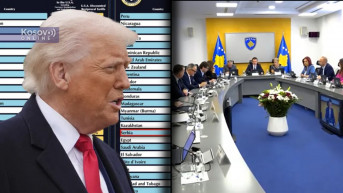
While the world is focused on negotiating reductions to the new, draconian U.S. import tariffs, Kosovo has chosen a different approach — it lifted all customs duties on American products. A clear and strong political message, agree Kosovo Online’s interviewees. The only debate is whether the move came too late and how much it will actually impact future relations between Pristina and Washington.
Written by: Djordje Barovic
On August 1st, Kosovo’s caretaker government removed customs duties on U.S. goods, a decision announced by Albin Kurti on his X (formerly Twitter) account.
“From now on, a zero tariff will be applied to goods produced in the U.S. entering Kosovo. This decision marks another important milestone in our strong partnership, following the recent renewal of the MCC compact program,” Kurti wrote.
New U.S. tariffs have been in effect since April 9, but the American administration has amended them multiple times since.
The latest amendment takes effect on August 7 — seven days after President Donald Trump decided that the EU, Japan, and South Korea will be subject to a 15% import tariff into the U.S.
Previously announced tariff rates include 35% for Serbia, 30% for Bosnia and Herzegovina, 25% for India, 15% for Turkey and Israel, and 39% for Switzerland.
Kosovo still faces a 10% tariff on exports to the U.S.
Kosovo President Vjosa Osmani was the first to propose, on April 3 (just one day after Trump’s announcement), that the government suspend the 10% import duties on all American products, stating that this would send a clear signal.
That initiative was later supported by various business associations and entrepreneurs in Kosovo.
According to the Albanian-German Business Union, Kosovo recorded a significant trade deficit with the U.S. last year, accompanied by a “dramatic” rise in imports and low export levels.
Kosovo’s highest export to the U.S. in 2024 was in January — around €8.8 million, while the lowest was in June — only €1.7 million.
“Total exports to the U.S. in 2024 amounted to €39,597,000, which is a notable decline compared to previous years. Meanwhile, total imports from the U.S. reached €106,629,000. This was even before the 10% tariffs on Kosovan products were imposed. It remains to be seen how this tariff will impact the already declining export trend to the U.S.,” the Union stated.
Politics and Economics
Petar Ivic of the Pupin Initiative says Kosovo has achieved a “small symbolic victory” with this move, but it will not resolve strained relations with the U.S., since Donald Trump “views politics and economics as two separate spheres.”
“This decision was clearly aimed at currying favor with Trump and the U.S., but the issue is that Trump separates political and economic relations,” Ivic told Kosovo Online.
He cited Japan, South Korea, and Canada — traditional U.S. allies — as examples, all of which Trump has targeted with high tariffs on exports to the U.S.
“By that logic, Kosovo’s decision might lead to a temporary stabilization or small symbolic gain, but it does not address the major issues in Kosovo-U.S. relations in recent years, nor does it tackle the deeply rooted problems in Kosovo’s economy,” Ivic added.
He pointed out core challenges such as a weak industrial base, high unemployment, underdeveloped infrastructure, and overreliance on remittances, which make up 15% of GDP.
He emphasized that corruption is the main factor behind the current economic difficulties.
“Albin Kurti’s party came to power as an anti-establishment movement promising reforms in these areas, but it has failed to deliver. Instead, it has relied on populist and nationalist narratives at the expense of progress and economic reform,” Ivic concluded.
Too Little, Too Late?
Agim Shahini, President of the Kosovo Business Alliance, believes that while lifting tariffs on U.S. goods was a good move, it came too late.
“The Kosovo government was late in lifting tariffs on American producers. We asked them to do this back in early April because we export most of our goods to the U.S. market. However, the government failed to act in time,” Shahini told Kosovo Online.
He reminded that President Trump announced on April 2 that new import tariffs on Kosovo goods would be 10% — the same as what Kosovo had imposed on U.S. goods.
“Now we’ve lifted the tariffs on their goods. That means we’re behind,” Shahini claimed.
Despite the delay, he still considers the move positive.
“It’s a good step. Regardless of the timing, we can now aim for higher-quality goods and better relations with the U.S. through economic cooperation,” he clarified.
Shahini is confident that this decision also sends a strong political message to Washington.
“Kosovo had the best relations with the U.S. among all foreign states. However, recently — at least publicly — those relations have not seemed as close. With this move, Pristina seems to be seeking greater cooperation with the U.S. By removing the 10% tariff, they’re signaling goodwill toward American products,” he said.
Still, he reminded that Kosovo will continue to pay a 10% tariff on its exports to the U.S.
“We don’t know how the White House and Trump will respond,” he noted.
Shahini underlined that Kosovo is facing numerous fundamental problems.
“The biggest one is low consumer purchasing power, which is the hardest obstacle to economic development. We also have domestic producers who haven’t reached the needed standards — partly because Kosovo still treats this as a political, rather than competitive, market issue,” he said, adding that electricity is the most expensive in the region.
He also pointed to the ongoing institutional crisis, stressing that Kosovo hasn’t had a functioning government for nearly six months.
No Thawing in Sight
Miloš Pavkovic, a fellow at the European Policy Center in Belgrade, believes that Kosovo’s caretaker government lifting tariffs on U.S. goods will not result in a thaw in relations with Washington.
“It doesn’t seem like a strong political message to me — rather, the only message the caretaker government has left. Fundamentally, the relationship between the leadership in Pristina and the White House is so damaged that this will not help improve it. Especially considering that trade volume is statistically negligible,” Pavkovic told Kosovo Online.
Asked whether this gesture might change how the new U.S. administration views Albin Kurti, Pavkovic was skeptical.
“I don’t expect this to influence U.S. policy toward Kosovo in any way — especially not toward Kurti and his caretaker government,” he said.
He argued that Kosovo faces a severe political and economic crisis that far outweighs concerns over U.S. tariffs.
“The constitutional crisis, the inability to constitute a parliament and form a government is the first issue. After more than six months and over 50 failed attempts, we still don’t have a functioning parliament, and most likely we’re heading into new parliamentary elections — which are once again uncertain and could trigger a new political crisis,” Pavkovic said.
He cited the economic situation as the second major issue.
“The economy isn’t progressing, unemployment is high, and there’s no industry to drive growth. When you add the cooling of relations with key allies — especially the U.S., but also France and Germany — the outlook for Kosovo is bleak,” he explained.
Additional problems include Kosovo’s inability to join international organizations, lack of new diplomatic recognitions, and strained relations with Serbia.
“These are all issues currently weighing heavily on Kosovo,” Pavkovic concluded.



0 comments