
Can memories be whitewashed: Which murals are (un)acceptable in Kosovo?
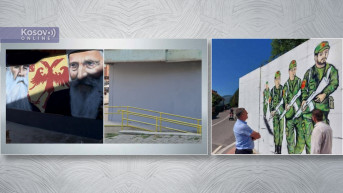
The news that a mural dedicated to KLA members was painted in Decani might have gone unnoticed had a series of murals depicting Serbs not first been whitewashed in northern Kosovo. Any symbols with a Serbian character in public space have long been undesirable for the authorities in Pristina, but the effect of layering paint over these seals of time may turn out differently than expected, interviewees told Kosovo Online. What is directed against memory only strengthens it, they point out, and the whitewashed murals may well reappear elsewhere.
Written by: Dusica Radeka Djordjevic
The wall in the center of North Mitrovica that once bore portraits of Patriarch Pavle and Metropolitan Amfilohije is now gray. In the municipality of Leposavic, gray paint has also covered the likenesses of Jovan Milanovic, a young man who died of cancer, and Djordje Lukovic, who perished in a traffic accident.
With police assistance, the repainting of murals in North Mitrovica some ten days ago was organized by the municipality led by Albanian mayor Erden Atic. A graffiti reading “Because from here there is no going back” was also painted over.
Kosovo’s Minister of Local Government in a technical mandate, Elbert Krasniqi, explained that the action in the north was aimed at “tidying up public spaces” and removing messages that called for violations of Kosovo’s legal and constitutional order, citing as examples the graffiti “When the army returns” and a mural of Ratko Mladic in Zvecan. He declared that Kosovo would not allow messages encouraging division and intolerance between communities.
A few days after this explanation, videos appeared on social media showing a new mural in Decani, depicting four members of the former KLA.
According to historian Luka Jovanovic, the repainting of numerous murals in majority-Serb municipalities in northern Kosovo, coupled with the announcement of a new mural in Decani, sends the message that Pristina wants to turn the north into a sterile environment—without memory, culture, or public life—something that would make life there extremely difficult.
He argues that the latest KLA mural in Decani was not accidental, since such murals have been painted daily in Albanian communities for years, and often even in Serbian areas where they carry a negative connotation for the local Serb population.
“The message is that Serbian graffiti as a social phenomenon has no place in the north, but does in the south. The message is also that Albanians live freely, while Serbs are a people in a ghetto—and that this ghetto is legitimate,” Jovanovic told Kosovo Online.
“No Place for Serbian Memory”
He added that the central authorities in Pristina always send the message that there are uncompromising historical themes in Kosovo, and these concern the KLA, its leaders, and the Albanian past.
“On the other hand, themes relating to Serbian history and Serbian figures—even those who rendered service to the Albanian people—have no place in the public sphere in Kosovo and Metohija,” he stressed.
He reminded that for nearly three decades there has been a trend of erasing Serbian memory in Kosovo, especially evident in the last five years.
“There is an assault on everything bearing a Serbian monumental mark, regardless of the period from which the monument comes—whether the early Middle Ages, the late Middle Ages, or modern times,” the historian said.
The latest events in the north, particularly in North Mitrovica, once again, in his view, send the message that murals—or monuments—cannot have their place, even when they carry a reconciliatory message.
“The murals depicted historical figures, Patriarch Pavle and Metropolitan Amfilohije, who in Kosovo and Metohija—even among Albanians—are remembered for their goodness, never for anything bad. I recall the famous story Patriarch Pavle himself told about candies: that for every stone thrown at him by Albanians, he responded by handing out candies to Albanian children. To whitewash such a mural is to send a harmful message to Serbs from Pristina, but also a double-edged message that could be dangerous for both Serbs and Albanians. The message to Serbs is that their memory and past have no place in the so-called Albanian state, and that even the good deeds done toward Albanians are dismissed and easily forgotten,” Jovanovic warned.
Everything directed against memory, however, he stressed, “only makes memory grow stronger.”
“With this act, Serbs have only been reminded of the good deeds of Patriarch Pavle and Amfilohije, of many historical figures, and of their fellow citizens whose faces and messages Mitrovica and Zvecan residents placed in public view for all citizens of every nationality,” he concluded.
“As if Someone Whitewashed Altamira”
Speaking about the role of murals in society, painter and retired professor at the Faculty of Applied Arts in Belgrade, Miroslav Lazovic, said they are a kind of seal of time, and he described the repainting of the one in North Mitrovica, depicting Patriarch Pavle and Metropolitan Amfilohije, as a catastrophic act, “as if someone had whitewashed the Altamira cave.”
In his view, having Amfilohije and Patriarch Pavle on a mural is not provocative, while the painting of the KLA mural in Decani, coming so soon after the whitewashing of murals in the north, was intentional.
“The figures of Patriarch Pavle and Amfilohije on murals are important for our Serbian being because they are probably future saints and because they dedicated their lives to the Church and perhaps most of all to Kosovo. They are an integral part of the being and identity of Serbs, who are fewer and fewer in number and who cling to symbols of their roots and foundations. Furthermore, Kosovo is known for its many monasteries and medieval art, so it is a logical sequence that modern times should also leave something behind,” said Lazovic, himself the author of numerous murals, in an interview with Kosovo Online.
A mural, he added, does not always represent daily politics but is more tied to universal matters.
“But these church figures of ours have also become universal—as symbols of our faith. I always told my students not to paint daily or ordinary things, but to make the figure on the mural universal, a bit stylized, abstracted. These are general values that convey monumentality in expression,” the painter explained.
Lazovic sees last week’s repainting of numerous murals in Serb municipalities in northern Kosovo as a harmful act that, he said, will negatively affect the attitudes of the people living there.
“I think the eye will look for the mural, and it will probably reappear elsewhere,” he speculated.
He recalled that he once painted murals in Essen, a mining region in Germany, where he depicted miners as symbols of that area.
“They are the reason the region is wealthy. Every child will know who created the Ruhr area. And what are the symbols of Kosovo? When I think of Kosovo, I often first recall Patriarch Pavle and Amfilohije, who devoted his entire life to Kosovo and its people. Perhaps the act of destroying the murals is catastrophic—like if someone were to whitewash the Altamira cave, where we can see what people did, what they hunted, what animals existed 30,000 years ago, or however long ago,” he noted.
“Witnesses Who Disturb”
Regarding the mural dedicated to KLA members, historian Aleksandar Gudžic said that for the past 25 years Kosovo’s political elites have been “building identity and statehood on the heroic struggle of the KLA for Kosovo’s independence and statehood.” That, he said, is legitimate, but the whitewashing of murals of Amfilohije Radovic and Patriarch Pavle, in his view, is perhaps the clearest example of the double standards in Kosovo, where Serbs, as he noted, have lived for 26 years.
These figures, Gudzic emphasized in a statement to Kosovo Online, never by word or deed offended the national feelings of Albanians or did anything to harm them.
“Amfilohije Radovic was someone who, in 1999 and the 2000s, bore witness to the suffering of Serbs, especially in the post-war months. He is important as a symbol. And in that context, one should consider why officials of Kosovo’s institutions decided to whitewash the mural of Amfilohije Radovic and Patriarch Pavle, who are witnesses to Albanian misdeeds and crimes against Serbs in Kosovo. I assume that is why they are objectionable to Kosovo officials,” the historian observed.


0 comments