
Changes in Washington: The Serb List in the State Department; Kosovo government under embargo
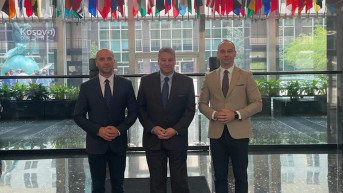
Since the outbreak of the crisis in the north of Kosovo, caused by the moves of the authorities in Pristina, the attitude of official Washington towards the representatives of the Kosovo authorities is noticeably "colder", and apart from warning Albin Kurti that he will suffer the consequences for refusing to de-escalate the situation, the US administration is demonstrating its seriousness in action.
Punitive measures were introduced against the government in Pristina, and Kurti and his closest associates were put "on ice". At the same time, political representatives of the Serbs from the north of Kosovo, in front of the Serb List, are in Washington these days, where they are talking with prominent officials of the State Department.
The Serbian side did not have many opportunities, in the period after the bombing and the unilateral declaration of Kosovo's independence, to communicate directly with representatives of the USA. Pristina's position on all current issues was mostly respected. That's why the current departure of people from the Serb List to Washington is a huge opportunity to present the facts on the spot and make the necessary contact so that tensions can be calmed down and normalized on the ground, according to Kosovo Online's interlocutors.
They indicate that relations between Serbia and the USA have been improving for years; that Belgrade's constructive approach to solving key problems in the region, including Kosovo, as well as increased Serbian diplomacy in Washington, contributed to this.
The former head of Kosovo's diplomacy, Petrit Selimi, pointed out a few days ago that Serbia had hired a reputable lobbying house in the US close to the Democrats, and that the Kosovo Government had hired "sycophants in the diaspora", thus reacting to the news that the Kosovo Ministry of Foreign Affairs had concluded contracts with companies that were not even registered in the US for lobbying, and behind which were Albanians who were linked to corruption.
Lawyer and human rights expert, Milan Antonijevic, points out for Kosovo Online that the visit of the Serb List delegation to Washington is another indicator of the establishment of different relations between the USA and Serbia.
"Those relations are getting better, especially when we talk about the security of the Serbian community in Kosovo. And it is not surprising that the administration in Washington wants to send a message in this way, on the one hand, and on the other hand to listen to the representatives of the Serbs in Kosovo, to talk about those obligations for which the US also advocates, and which are in Pristina - the formation of the Community of Serb-majority Municipalities, security, mobility, protection of human rights and everything that has been negotiated in Brussels for more than a decade. All of these are indicators of a small U.S. turnaround. But also much more opening of that part of relations, those relations between Serbia and the US were quite dynamic, the USA has always, as shown by the statements of its officials and actions on the ground, advocated for the protection of minority rights of the Serbs in Kosovo and their stay there. Maybe it was a little far from our public, which was not sufficiently informed about what the US is doing to protect the minority rights of the Serbs in Kosovo. It is now becoming much more open and we can look at this visit of representatives of the Serb List in that way," Antonijevic believes.
He adds that the good relations between Serbia and the USA should not be neglected either, which, he points out, "is especially evident from the departure of Marko Djuric as Ambassador to the USA".
"Djuric improved the already good relations. It seems to me that this visit of the Serb List can also be a product of his work and the improvement of relations and indeed a broad approach to the administration in Washington, the State Department, and all those who professionally monitor the situation on the ground and help the Serbs feel that level of security that everyone living in Europe should feel," our interlocutor points out.
He continues that it is important that the views and problems of the Serbs from Kosovo are heard in Washington.
"When we look at the policy of the USA towards the Balkans from the 1980s to today, it is evident that there are no 'favorites', but there are those who are constructive, who want to improve the region, they always have the support of the USA. At the moment when it was Serbia, it had such support while it had been working on the peace agreement in Dayton. The US sees its interest in a stable Balkans that is capable of implementing the values that the US stands for, above all the respect for human rights. At the moment, constructive tones are not coming from Pristina and it is to be expected that a message will be sent by the meetings of the Serb List representatives in Washington in this way, above all to the Serbian community that perseveres in Kosovo and despite all the incidents does not react with violence, rather to be guided by some kind of Gandhian policy as a response to violence. This is a change and from it, we need to learn how to deal with great powers. It is important to have an open relationship, however acrimonious and difficult it may have been in the past, you do not have to have the same views on all issues, but you must be open to those who are showing themselves as partners to Serbia and the entire Western Balkans, including Kosovo," Antonijevic says.
He adds that the economic and military cooperation between Serbia and the USA should not be neglected either, which, he says, shows that the US values its partners and those who are open, and constructive and do not want an escalation of violence.
And the analyst of the Center for Social Stability, Predrag Rajic, tells Kosovo Online that it is evident that the relations between Serbia and the USA are improving from year to year.
"The United States of America is the world's only superpower, and it is in Serbia's best interest to strengthen our partnership with Washington and use every opportunity to build mutual trust, which at some point could reach the levels of our common past, which is full of exploits and bright pages. The departure of the representatives of the Serbs from Kosovo and Metohija is an expression of a continuous, wise policy, which aims to present arguments before the most important foreign factor in our southern province and our region," Rajic says.
He points out that the President of Serbia, Aleksandar Vucic, did something that seemed impossible in 2012.
"He created an environment in which relations between Belgrade and Washington are getting better, and relations between Pristina and Washington are getting worse," he notes.
He also indicates that lobbying achieves a lot in the USA.
"Serbia, after decades of inaction in Washington, is finally engaged in this activity. Our positions are getting better and we just need to continue in that direction," Rajic points out.
For Dragan Djukanovic, a Professor from the Faculty of Political Sciences, the departure of the representatives of the Serb List to Washington is another indicator that the USA is determined to somehow implement everything that was previously achieved during the dialogue, especially within the framework of the agreements in Brussels and Ohrid.
"The key obstacle to this is what the authorities in Pristina are doing at the moment, not accepting the plan for complete de-escalation in the north of Kosovo. We saw that some officials from Pristina did not get US visas, which is also a kind of more than a clear message," Djukanovic says.
He sees the fact that Serbian representatives can reach key people in the US administration more easily than Albanian leaders from Kosovo, who were "favorites" of the USA for many years, as a result of increased Serbian diplomacy in the USA, but also as a consequence of Pristina's non-cooperation.
"A clear message is being sent from the USA that there is an obvious non-cooperation of Pristina and that the USA will not go over it lightly," Djukanovic points out.


0 comments