
Coming of age of Kosovo’s Declaration of Independence: What is the outlook for Serbs behind the backdrop of a multiethnic society?
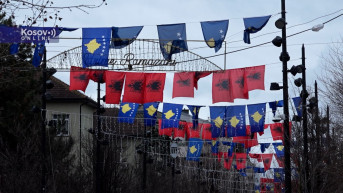
Eighteen years after Kosovo’s independence was unilaterally declared in Pristina, it is seen by some as an irreversible reality, and by others as a provisional arrangement. Interlocutors interviewed by Kosovo Online point to two parallel realities: one in which Albanians are satisfied with Kosovo’s development since 2008, and another in which Serbs live under constant pressure and their rights are not respected. They note that it is in Pristina’s interest for there to be as few Serbs in Kosovo as possible in the long term.
Written by: Dusica Radeka Djordjevic
Adorned with Kosovo and Albanian flags, Pristina is today marking 18 years since the Declaration of Independence was adopted in the Kosovo Assembly.
An expected décor, historians might say—particularly those who believe that a distinct Kosovar identity is still far from fully formed.
The notion of Kosovo as a multiethnic society has long been described as little more than a backdrop.
This issue was also touched upon by the United Kingdom’s Ambassador to Kosovo, Jonathan Hargreaves, who congratulated citizens on the 18th anniversary of independence.
“We remain firmly confident in the importance of the commitment made by Kosovo’s leaders to build a democratic, secular and multiethnic republic, whose leaders will promote the rights and participation of all communities in Kosovo,” Hargreaves stated.
Kosovo’s Constitution, said Kosovo Prime Minister Albin Kurti today, “recognizes all other communities, except Albanians.” He also asserted that citizens of Kosovo today enjoy greater freedom and democracy.
“All That’s Missing Is Recognition by Serbia”
One Pristina resident, Mirsad Krasniqi, told Kosovo Online reporters that Kosovo lacks a certain degree of development and more jobs, but that its independence is strengthening year by year. While it has stagnated in terms of membership in international organizations, he remains optimistic that this will happen gradually.
“Nothing is missing for Kosovo except recognition by Serbia. Serbia should recognize it and move forward,” said Ajvaz Rama.
He believes citizens have never lived better, yet no one is fully satisfied, as everyone feels something is lacking.
A contrasting reality was highlighted today by the Office for Kosovo and Metohija of the Government of Serbia, which stated that the human rights of Serbs in Kosovo are so severely endangered that, without hesitation, they can be described as the most endangered people in contemporary Europe.
“The unilateral declaration of independence in Pristina 18 years ago represents nothing but a major defeat from the standpoint of international law, as well as a defeat for all those who hoped for the establishment of a normal and orderly peacetime society in Kosovo and Metohija,” the Office stated.
Although Kosovo has built its own institutions over the past 18 years, the United Nations Interim Administration Mission in Kosovo (UNMIK) remains present, operating under the mandate of UN Security Council Resolution 1244. Within the same framework, the European Union Rule of Law Mission in Kosovo (EULEX), launched in 2008, and KFOR, NATO’s mission, continue to operate.
Serb Rights Remained on Paper
Reflecting on 2008, Aleksandar Sljuka of the NGO New Social Initiative says that international partners who supported Kosovo’s independence did so because Kosovo’s Albanian leaders guaranteed an extensive set of rights for the non-majority Serb community, but that these were not particularly respected in practice.
He notes that they guaranteed that, if assisted in declaring independence, Serbs would be enabled to live on equal footing with other citizens and enjoy a high level of rights.
“The Ahtisaari Plan guaranteed local autonomy and certain power-sharing models. Over the years, we have seen that many things looked very good on paper, and that the broad scope of rights guaranteed to the Serb community was not particularly respected in practice. We have witnessed numerous instances of institutional discrimination in the context of what was guaranteed, as well as various forms of extra-institutional pressure on the Serb community, which Kosovo’s institutions did not consider it necessary to address,” Sljuka told Kosovo Online.
Looking at what was guaranteed and what the international community expected of Kosovo, he says, it can be concluded that these expectations were not met and that the situation for the Serb community has dramatically worsened in recent years.
“There are two parallel realities: in one, Albanians are probably very satisfied with how Kosovo has developed and how far it has come; in the other, members of the Serb community would describe a completely different reality if asked how they have been treated over these 18 years and whether anyone has consulted them at all,” Sljuka said.
Sovereignty Not Fully Consolidated
Of the 193 UN member states, fewer than 90 recognize Kosovo. Since 2017, 28 countries have withdrawn their recognition.
Sljuka assesses that Kosovo did not achieve full sovereignty and international recognition within the short timeframe it expected in 2008.
“If the goal was to affirm Kosovo by joining all major international organizations, that has not happened. Kosovo is not a member of key organizations it sought to join, such as the United Nations, the EU, or NATO. In that sense, its success is partial,” Sljuka concludes.
Internal sovereignty is also not fully consolidated, he adds, given the ongoing EU-mediated dialogue between Belgrade and Pristina and the many unresolved issues.
“Even after the campaign to shut down Serbian institutions, they are still present, albeit under pressure. Healthcare and education institutions continue to function and have not been integrated into the Kosovo system. We cannot say that internal sovereignty has been fully consolidated,” he notes.
At the same time, he says, the picture looks different if one considers that in 2008 Kosovo effectively started from scratch—an idea supported by traditional partners, with an uncertain trajectory.
For half of the UN member states, Kosovo is a fact and a reality on the ground, regardless of how others, including official Belgrade, view it.
“They have established many institutions and achieved a level of independence compared to 1999, when UNMIK administered everything. Today, international organizations on the ground have almost no effective role, as Kosovo’s institutions carry out those functions,” Sljuka points out.
Much Work Ahead
Pristina-based analyst Blerim Burjani told Kosovo Online that Kosovo still has much work to do in all directions in order to achieve economic development.
“More must be done to ensure economic stability, implement reforms in education and public administration, provide health insurance for citizens, and reform the pension system and human rights protection,” he said.
He identified EU integration as a key area in which Kosovo must progress in the coming years.
“Significant additional efforts are also needed to ensure stable defense,” Burjani added.
Since 2008, Kosovo has become a member of the World Bank, the International Monetary Fund, the European Bank for Reconstruction and Development, the World Customs Organization, CEFTA, the International Olympic Committee, and an associate member of the NATO Parliamentary Assembly. In January this year, it joined U.S. President Donald Trump’s Peace Committee.
Kosovo is not a member of the United Nations, the Council of Europe, the OSCE, or Interpol. In 2022, Pristina formally applied for EU membership, but four years later has yet to obtain candidate status.
No UN Membership Without Belgrade’s Consent
Stefan Surlic, Assistant Professor at the Faculty of Political Sciences in Belgrade, says that since the unilateral declaration of independence in 2008, the international community has enabled Kosovo to function as a separate political system with executive, legislative, and judicial branches, but that it has made little progress in foreign policy terms.
“Membership in key international organizations has not been achieved. It is certain that without Belgrade’s consent there will be no UN membership, so Kosovo’s international legal subjectivity remains permanently disputed and unchanged over these 18 years,” Surlic said.
According to him, Pristina’s political success lies in establishing full control over Kosovo’s entire territory and maintaining continuous pressure on Serbs, who are viewed as an extension of Belgrade rather than as citizens entitled to full rights and recognition of their distinct identity.
“Albin Kurti’s government has established absolute authority throughout Kosovo. Its focus has been on Serb-majority areas, resulting in what can be described as forced integration. Most Serbs now hold documents issued by Pristina, work in institutions under its system, and have accepted this form of integration—from license plates to administrative registration. Unfortunately, this has not led to greater social stability or mutual understanding between Serbs and Albanians,” Surlic assesses.
Asked how satisfied Kosovo’s citizens might be with developments over the past 18 years, Surlic says it depends on the reference point.
“If we compare Kosovo to other post-conflict societies worldwide, it is often presented as a positive example. President Donald Trump’s invitation to Vjosa Osmani to participate in the Peace Committee sends a message: this is what we achieved in Kosovo, and we aim to replicate it elsewhere. Most Western countries view Kosovo as a success story. However, institutional development has not reversed negative trends such as mass migration, emigration, and high unemployment, particularly among youth,” Surlic notes.
These trends persist, though from Belgrade it may sometimes appear that Kosovo is frozen in 1999. In reality, he says, it is a society that is evolving and functioning within its own institutions.
“More than 90 percent of Kosovo’s population today are Albanians, and they are overwhelmingly loyal to these institutions. Unlike in some other post-conflict societies, there is no widespread dissatisfaction with the political and institutional framework itself. While economic dissatisfaction exists, the majority of Albanians demonstrate strong loyalty to the post-war institutions,” he explains.
As for where Kosovo will be in another 18 years, Surlic says it depends entirely on an agreement between Belgrade and Pristina. He remains highly pessimistic about lasting normalization.
“The only real opportunity to secure a normal life and guaranteed autonomy for the Serb community was through the Association of Serb-majority Municipalities. It is now clear that Pristina does not intend to implement it and that its long-term interest is to reduce the number of Serbs in Kosovo. Therefore, I view the coming years—and especially the next 18—with considerable pessimism for the Serb community, and with equally limited political will in Belgrade to make any concessions to Pristina,” Surlic concludes.


0 comments