
Controversial Nikola Xhufka – A self-proclaimed cleric as Pristina's Trump card against the Serbian Orthodox Church?
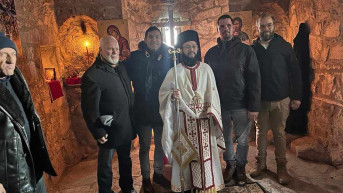
Nikola Xhufka, an Albanian citizen who presents himself as the Orthodox Bishop of Kosovo, once again leveled accusations against the Serbian Orthodox Church (SOC) several days ago. Speaking to Kosovo Online, analysts described him as a "forger," a "fraudster," and an "impostor" who enjoys Pristina's backing, with the ultimate aim of driving the Serbian Orthodox Church out of Kosovo.
Written by: Zoran Mirkovic
Several days ago, Xhufka claimed that the so-called Orthodox Church of Kosovo had won a court case against the Serbian Orthodox Church and that Orthodox Albanians could now register with that church. He also alleged that the Serbian Orthodox Church had "turned religion into a political party," calling on "the state and the police to declare the Serbian Patriarch persona non grata" in Kosovo.
The Diocese of Raska and Prizren immediately rejected those claims, stating that they were false, that Xhufka had won no court case, and that he neither is nor has ever been a priest of the Serbian Orthodox Church, the Autocephalous Orthodox Church of Albania, or any canonical Orthodox Church. The Diocese also called on Kosovo's police and judicial authorities to protect the Serbian Orthodox Church.
These statements are merely the latest in Xhufka's long-standing campaign against the Serbian Orthodox Church. He has become known to the broader public over the years through attempts to appropriate and forcibly enter Serbian Orthodox shrines in Kosovo.
As early as February 2023, the Visoki Decani Monastery announced that Xhufka had been prevented from filming a provocative nationalist video inside the monastery and that KFOR had been informed of the incident, rejecting his claim that he had been expelled from the monastery simply because he was Albanian.
In November of the same year, accompanied by a small group of followers, Xhufka broke into the Church of St. Archangel Michael in the village of Rakitnica near Podujevo in order to perform what he described as a "religious ceremony."
The Diocese of Raska and Prizren responded by warning that the incident constituted a serious attack on its property intended to incite ethnic and religious hatred and instability in Kosovo, while seeking to seize the Serbian Orthodox Church's cultural heritage through its attempted "Albanianization" or "Kosovarization." The Diocese subsequently filed several criminal complaints against him.
In April last year, on Orthodox Easter, Xhufka led the opening ceremony of what he described as the "first Kosovo Albanian Orthodox Metropolitanate" in Pristina. At the time, he declared that the event marked "a new chapter for the country and for the Albanian Autocephalous Church in Kosovo," adding that "it is important for Kosovo to have its own Albanian Orthodox Autocephalous Church."
Several years earlier, Xhufka was also recorded outside the Church of St. George in Prizren—the seat of the Bishop of Prizren—calling on Albin Kurti to have the "state" assume control of Serbian Orthodox holy sites in Kosovo because, as he claimed, "the Serbian Orthodox Church is terrorist and genocidal."
However, the Orthodox Autocephalous Church of Albania distanced itself from Xhufka long ago. In a public statement issued in November 2022, it unequivocally stated that he represents only himself and "has neither a church nor a community of believers, despite the grandiose statements he periodically makes in the media."
"He improvised what he calls a 'church' in the basement of his house, deliberately misleading the media by presenting it as a 'paleo-Christian church – a catacomb.' He has also falsely claimed in the media that he completed theological studies, which he did not. In reality, he graduated from a vocational secondary school for food technology in Elbasan and even repeated his final year," the Albanian Orthodox Church stated at the time.
A Forger Not Worth Mentioning
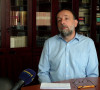
Writer Zivojin Rakocevic described Xhufka as "a regional-level forger" whose name, he said, should scarcely be mentioned at all.
"This man does not receive negative publicity. Mentioning his name, whether in a positive or negative context, merely promotes him. That is why this small group of troublemakers, fraudsters and forgers should simply be called a sect that seeks to enter the system, become part of it, and gain recognition so that political power in Kosovo can eventually be directed toward them," Rakocevic told Kosovo Online.
He said Xhufka and his small circle of followers exist in complete terminological, ecclesiastical, and spiritual confusion.
"That confusion reached its peak in their latest statement referring to an 'Albanian Church of Kosovo.' The essence of the matter is that they are trying to associate themselves with Albanian national identity, which for some Albanians is almost synonymous with religion. Albanian identity as a religion is one of the driving ideas behind this fraudster and forger, who is trying to gather as many followers as possible. The danger lies in the fact that emerging entities often seek to create their own so-called spiritual organizations. It is not the first time that such sects have been registered in police stations or other institutions, only to be activated, supported and eventually transformed by certain authorities into projects that could later become quasi-official institutions. However, in this particular case we are dealing with entirely marginal individuals and a marginal phenomenon," Rakocevic said.
He also questioned what "registration of believers" could even mean, noting that believers belong to a church through faith and religious affiliation—they are not registered.
"Everything contained in that statement and in this entire performance is fabricated. Just as fabricated is the claim that the Church of St. Archangel Michael in Rakitnica belongs to Albanians and was usurped by Serbs. Even before the war, Albanians referred to that church as 'Lazar's Church,' because tradition—and perhaps historical fact—holds that the body of Prince Lazar rested there for one night after the Battle of Kosovo. It is a beautiful church in the hills above Podujevo. Today we live in ghettos and enclaves, while our holy sites remain far away from us, but we have neither lost them nor abandoned them. They are organically connected to us, they belong to us, and they have remained our property continuously from the moment they were built until today. That cannot be falsified," Rakocevic said.
He concluded that such groups remain a danger as long as they continue to receive public attention, even in a negative context.
"It is a group trying to evolve into a sect and then combine political, ideological, and national agendas into a source of power. There is nothing more to it than that," Rakocevic concluded.
A Self-Proclaimed Cleric Backed by Pristina's Institutions
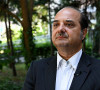
Historian Aleksandar Rakovic said he had no doubt that Xhufka enjoys the support of Pristina's institutions and argued that the intention of what he described as "Albanian separatists in Kosovo" is to permanently expel the Serbian Orthodox Church.
Rakovic said Pristina, together with certain external actors, had devised a multi-pronged strategy aimed at destabilizing the Serbian Orthodox Church in Kosovo, with Nikola Xhufka—whom he described as an "impostor"—representing one element of that strategy.
"When you have institutional support, you can do almost anything, particularly because the Serbian population in Kosovo and Metohija no longer has the numbers it once had in Montenegro, where it was able to defend our holy sites. As a result, the Serbian people in Kosovo and Metohija depend on Western support, and the question remains how willing Western countries will be to stop the intentions of the separatists in Pristina," Rakovic told Kosovo Online.
According to him, another avenue of pressure comes from the Albanian Roman Catholic Church in Kosovo, which he described as an even more formidable challenge.
"This is probably being done to serve its own interests, because it is precisely those circles that are most eager to appropriate our medieval shrines in Kosovo and Metohija. There is an entire range of developments threatening to destabilize the region, while Serbia has little choice but to respond through diplomatic and political means. That creates considerable uncertainty among the Serbs in Kosovo and Metohija, because they find themselves dependent on others and on their goodwill—a goodwill that has unfortunately rarely been demonstrated," Rakovic said.
He added that any hasty move by the Serbian authorities could further complicate the situation.
"Not because of any fault on Belgrade's part, but because people are looking for any mistake by Serbian institutions that could then be used against the Serbs in Kosovo and Metohija. The intention of Pristina—or, as I would say, of Albanian separatists in Kosovo and Metohija—is to permanently drive out the Serbian Orthodox Church," Rakovic said.
He also recalled previous attempts to appropriate Serbian Orthodox heritage in Kosovo.
"The well-known example was the 2015 UNESCO vote, which they lost by two votes. They have not raised the issue again because they know they no longer have a majority. But as we can see, through various forms of institutional pressure they continue trying to make life more difficult for Serbs in Kosovo and Metohija, encouraging people to leave for other parts of Serbia so that fewer Serbs remain. That would make it easier to seize church property and to force Serbs out of Kosovo and Metohija—or even bring about a repetition of 1998, 1999, or 2004, meaning armed conflict and widespread violence against the Serbian people," Rakovic concluded.
0 comments