
Simic: 2027 budget monoethnic, Serb-majority municipalities completely excluded
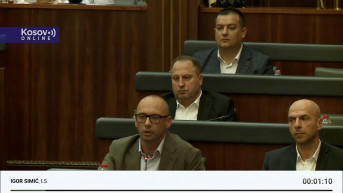
Serb List parliamentary group leader Igor Simic said today in the Kosovo Assembly that the proposed budget for next year was monoethnic and completely excluded Serb-majority municipalities. He said Serb List MPs would not support it and called on the majority to adopt amendments that would benefit all citizens.
“When you look at the document—and we have analyzed it carefully—you literally ask yourself: where are the Serbs? I do not mean in the statistics and tables, but in terms of development projects for Serbs. When you look more closely, there is not a single capital project intended for Serbs in the ten Serb-majority municipalities. Even the few that are listed concern our Albanian neighbors with whom we live. Why have you proposed a monoethnic budget? Why have you drawn ethnic lines and divided citizens along ethnic lines?” Simic asked.
He noted that he assumed the response would be that they could submit amendments to improve the proposed legislation, but recalled that not a single Serb List amendment had been adopted last year.
“Out of nearly €4.3 billion allocated in the budget, there is not a single capital project intended for Serbs. In North Mitrovica, you are planning the €200,000 renovation of the monument to miners who fell in the fight against fascism, and that is it,” Simic said.
He also asked where the money paid by Serbs was going, given that they also paid taxes, and why some of that money could not be allocated for their benefit.
“This is not a budget for all citizens. Out of nearly €1 billion in capital investment, zero is allocated to the ten Serb-majority municipalities out of a total of 38 municipalities. I have noticed that other municipalities led by mayors from different political parties have not fared much better, but at least there are some projects there. Our children deserve renovated parks too,” Simic said.
He again pointed to the poor condition of roads in the northern municipalities.
“The corridor connecting North Mitrovica, Zvecan and Leposavic—and, if you travel south, Vucitrn, Obilic and Pristina—looks terrible. You need to know that. Perhaps the announcement of plans to establish an airline really is the solution, because the road is in such a condition that it would be best to fly over it. Otherwise, even police vehicles sometimes end up leaving the road when they hit a pothole,” Simic said.
He also mentioned the Pristina-Urosevac road, the road toward Gnjilane through Gracanica, the Pristina-South Mitrovica-Zubin Potok route toward Brnjak, as well as the center at Brezovica.
Simic noted that some might argue this was because Serbs did not have a legitimate representative in the Government, adding that if they did, such a representative would have opposed a budget of this kind and asked where the money was.
He also said that for years there had been talk about building a multiethnic society, but that the proposed budget did not reflect such statements.
“Where are the major road, water-supply, healthcare or any other infrastructure projects? We keep hearing that there will be investment, and then we find that a road is built only if there is a police base at the end of it. And these roads are mostly built through forests and back roads, to the point where even the police officers you sent there must be wondering what they are doing there. When you look at the roads in which millions of euros have been invested, almost nobody uses them today,” Simic said.
He stressed that the Serb List was not asking for money to be taken away from any other community and given to Serbs, but rather for an appropriate percentage of funds to be allocated to projects benefiting them.
“So that we can finally begin implementing the Gracanica bypass project in order to protect the medieval Serbian Gracanica Monastery and allow traffic to flow without endangering safety,” Simic added.
He also referred to the Ministry for Communities and Returns, saying that nearly €25 million had been spent over the past four years and asking where those funds had gone.
“We have had elections, so we will also raise this issue through the Assembly committees, because 140 houses, you will agree, is not much considering that €18 million in capital investment was spent. So we will ask where those funds were spent, particularly when the budget contains an item called ‘project for communities.’ Which project? What is being done and where? Once we receive all the answers, we can discuss the matter further,” Simic said.
On the other hand, he said that even that Ministry, “such as it is,” had one of the smallest budgets, amounting to slightly more than €7 million.
“Between 2023 and 2025, the equivalent of three local-government budgets was spent in the four northern municipalities. Go and see what it was spent on. At the meeting with the mayors in the north, you were given a list of things that needed to be done. Yet you did nothing and invested nothing,” Simic stressed.
He added that this was not criticism for the sake of criticism and that meetings should provide an opportunity to reach concrete solutions for all citizens.
“In this way, you have not punished only the Serb List or Serbs, but all citizens who live, work or travel through those municipalities. That is the Government’s responsibility, because those capital projects require enormous funds that local budgets can only dream of,” Simic said.
He added that, not as a politician or parliamentary group leader but simply as a person, he would be ashamed to propose a budget in which one community was completely excluded.
“We will vote against it, but I call on you to adopt amendments that benefit all citizens and demonstrate that everything I have said is untrue and that you want to approach our position differently,” Simic concluded.
Minister Nenad Rasic responded to Simic’s remarks, saying that he “never believed this could happen, but even the Serb List is participating in the work, if it can be called that, even if in its own backwards way.”
“There are rare moments when I can be a little proud of you, and this is one of them,” Rasic said. He said he had no objection to scrutiny of the work carried out by his Ministry.
“We invested €17 million over four years and built 140 houses in a year and a half, but you do not know about the 80 houses built in the years before that, or about approximately 1,100 projects ranging from house construction to the allocation of tractors and agricultural machinery,” Rasic said.
Referring to the Serb List, he described it as “the most destructive element in the history of Serbs—not only in Kosovo or Serbia, but probably throughout the Balkans and beyond.”
“You were accomplices in the worst acts committed against Serbs, from harassment and intimidation to dismissals from jobs... You effectively contributed to and succeeded in bringing about a forced withdrawal from the Kosovo system. You were the ones who left people in northern Kosovo without immediate security protection because all members of the security forces left their jobs after your president there—I believe he is still your president—said, ‘Get out, everyone is leaving the institutions,’” Rasic said.
Regarding the budget, Rasic said that it was indeed insufficient and that he had told Kurti so.
“I told the Prime Minister that it was not enough. Last week, I sent a letter to all mayors of municipalities with non-majority Albanian populations, namely Serb- and Turkish-majority municipalities, inviting them to apply for infrastructure projects,” Rasic said.
Simic replied that Rasic should indeed be proud of the people from the Serb List because of everything they had done and because, he said, they had preserved the Serbian people.
“Unfortunately, I cannot say the same about you,” Simic stressed.
He added that Rasic would see them and hear their proposals much more often if he were at his workplace in the Assembly more frequently.
“You could also draw your MP’s attention to not using his mobile phone for gambling during Assembly sessions, as the media have reported,” Simic added.
Regarding Rasic’s treatment of Serbs, Simic alleged that during the election campaign Rasic had distributed subsidies accompanied by contracts and a ballot paper.
“No member of the Serb List who held any position in the Kosovo system has ever done anything like that. On the other hand, you are the man who remained silent during a Government session over the unlawful seizure of Serbian land in Leposavic and Zubin Potok. You have never called people from the Serbian community who were arrested without grounds,” Simic said.
Regarding the ballot papers mentioned by Simic, Rasic said that he was “a man who respects law and order, something he could not say about the Serb List.”
“Our doors are open to you, regardless of our relations, if you want to find out everything the Ministry is doing. I even encourage you to do so,” Rasic said.
Minister Elbert Krasniqi also joined the discussion, telling Simic that he “appreciated the constructive approach they were once again showing in the Assembly of the Republic of Kosovo, as well as their concern for citizens, including citizens of Serbian ethnicity.”
“It is true that I have had many opportunities to visit the municipalities in the north and see what was invested in those municipalities over the years and what has been invested over the past three or four years. Certainly, the public investments of the Republic of Kosovo cannot be compared with those made previously,” Krasniqi said.
Like Kurti earlier in the session, he called on Serb List MPs to “use their influence on the mayors so that they begin to understand that they need to meet with ministers.”
“They constantly referred to Vucic. Now Vucic is gone, so perhaps they can come and meet with us. We will, of course, listen to their problems and concerns and consider how we can help them,” Krasniqi said.
Environment Minister Fitore Pacolli said that the budget had not been allocated on the basis of cities, ethnicity or the projects submitted by municipalities.
“The projects specifically named in the budget—and I am referring to the Ministry of Environment and Spatial Planning, namely projects bearing the names of particular rivers or other areas—are old projects that already existed,” Pacolli said.
Simic responded to Krasniqi by saying that he should first try replying to an email from one of the northern mayors, after which they might meet with him.
“You do not reply to them. Or perhaps, after a year, you could finally issue the decisions that you demand municipalities comply with but fail to provide to them. You do not even respond to emails from the EU Office,” Simic said.
Addressing Rasic, he said that the extent to which the Serbian people valued and respected Rasic’s work was demonstrated by the fact that he had secured his seat in the Assembly with votes from areas where, unfortunately, no Serbs had lived for decades.
“And in the elections, citizens showed whom they trust—the Serb List MPs to defend their interests. Everything you have said here, all the allegations against the Serb List, take them to the courts, the prosecution and the police, because if you remain silent, then you are also responsible. But these are empty stories. Serbs left the institutions because the situation had become unbearable, in order to draw attention to it. But for you, that resulted in a mandate you never received from the citizens,” Simic said.

comments