
Cooperation between KSF and Albanian Armed Forces: Is there cause for concern in the Region?
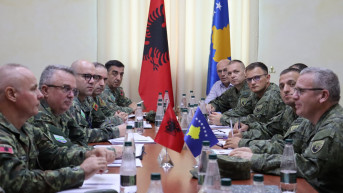
Training of KSF members in Tirana, joint exercises between the Albanian Armed Forces and the KSF, the drafting of a cooperation plan through 2028... Albania, according to messages from Tirana, is “fully committed to supporting the needs of the KSF.” The exercises conducted jointly are said to be in line with NATO standards—which is especially beneficial for the KSF—but, as experts told Kosovo Online, such activities would become problematic for the region if they were to include simulations of offensive operations and territorial occupation.
Written by: Dusica Radeka Djordjevic
Last week, five KSF cadets graduated from the Albanian Armed Forces Academy and will now serve as officers within the KSF. Present at the graduation ceremony was Kosovo’s acting Minister of Defense Ejup Maqedonci, at the invitation of Albanian Minister of Defense Niko Peleshi.
In mid-July, also in Tirana, work began on a bilateral cooperation plan between the General Staff of the Albanian Armed Forces and the KSF for the period 2025–2028. Lieutenant General Arben Kingji, Chief of the Albanian General Staff, praised the KSF's progress in transformation, modernization, and performance in bilateral and multilateral exercises.
Kingji emphasized the important role of the KSF in the security of both Kosovo and the region and underlined Albania’s full commitment to supporting the KSF’s needs in areas such as education, training, and knowledge exchange.
Although the KSF cooperates with many countries, security expert Hysen Gecaj from Pristina notes that military cooperation with Albania is especially significant and unique due to the shared language, which facilitates communication, and because of the proximity of training grounds, which reduces costs. The cooperation mainly focuses on joint exercises and cadet education.
“The KSF currently has several cadets studying at the Albanian Military Academy, and they could also bring their cadets here to gain new experiences and insights into how things operate in Kosovo,” Gecaj told Kosovo Online.
As for training grounds, he explained that Kosovo can use the Babaj Boks range near Djakovica, while Albania offers larger ranges with more space for artillery and other purposes.
The goal of the cooperation, he says, is to harmonize operations, command structures, and officer training—from basic staff levels to the highest ranks.
“This facilitates potential cooperation between the two armies on the battlefield, should it come to that,” he noted.
All joint exercises and scientific insights gained from this cooperation, he stressed, are aligned with NATO standards. This gives the KSF an advantage from working with the Albanian army, which is a NATO member and more familiar with these standards.
“In recent times, the KSF has reached an impressive level. NCOs, officers, and soldiers have adopted these standards and now carry out their daily duties in the same manner as NATO armies, including those of European NATO members and the U.S.,” this security expert stated.
Kosovo, he added, does not cooperate solely with Albania; it also maintains close military cooperation with the U.S., Germany, and the UK. To a lesser extent, it cooperates with North Macedonia, which also trains some of Kosovo’s cadets, as well as with Turkey and several other countries.
As long as it is not explicitly directed against any party, the cooperation between the Albanian Armed Forces and the KSF does not, in the opinion of ISAC Fund senior adviser Marko Savkovic, raise serious concerns. However, he adds that both parties’ capacities are somewhat limited.
“Albania does not possess the kind of resources it could transfer to Pristina or use to arm it. It can provide training, and I assume their cooperation mainly involves intelligence sharing, joint training and exercises, planning for military drill participation, and patrolling what they consider a mutual border. This should not be a major cause for concern in Belgrade,” Savkovic told Kosovo Online.
In principle, he sees nothing controversial in cooperation focused on joint training and the fulfillment of basic military missions, noting that Kosovo and Albania consider themselves neighbors—and neighbors cooperate.
However, he warns, a concerning signal for Belgrade and the region would be any joint exercise simulating large-scale military operations, including offensive actions and territorial conquest.
“That said, I don’t see Kosovo and Albania—even together—as having that capacity. It’s true that we’ve moved past the era in which war was completely unthinkable. That’s a significant shift, since today we can once again imagine conflict. But I also believe that there is still enough reason and restraint in the region. Conflict right now serves no one’s interest—except perhaps that of the Kosovar Prime Minister. But I believe all other actors are fully aware of how delicate the regional balance is, and how every move could further erode already heavily depleted trust,” Savkovic noted.
It’s worth recalling that in March this year, Kosovo and Albania signed a Military Alliance Declaration together with Croatia.
That agreement drew particular attention and concern in Belgrade, though Savkovic believes that the KSF–Albanian army cooperation plan for the next three years would have been signed regardless of the declaration. What should concern everyone, in his view, is the ongoing arms race in the region and the rising defense expenditures.
“This is a trend happening across Europe and it’s spilling over into our region. But here, it’s coupled with the steadily decreasing trust between actors. Belgrade has reason to be concerned in that sense, but it must also ask whether there’s a path to restoring trust—if it ever truly existed. We used to have fairly advanced regional cooperation in the field of security and defense, up until about ten years ago. At one point, even intelligence services were cooperating. Now it feels as though we’re going backward—and that should concern us all,” he warned.
Political analyst and editor at the daily Tema in Tirana, Ily Pata, stated that the Albanian Armed Forces and the KSF have long had close relations, mostly in logistics and during humanitarian missions. The recent meeting between their general staff representatives to draft a new three-year cooperation plan, he says, is not a new example of military collaboration between the two.
“The KSF has come to Albania during earthquakes and other natural disasters. We also have an agreement between Albania, Kosovo, and Croatia on military cooperation, which in a way reflects NATO obligations—since Albania contributes troops to KFOR in Kosovo, as does Croatia. Kosovo has hosted NATO forces since 2001. Although smaller in number than before, those troops still have essential military duties, such as guarding Kosovo’s borders,” Pata explained.
He believes that the cooperation between the Albanian Armed Forces and the KSF does not have a negative effect on the region. Still, he emphasizes that Albania, as a NATO member, must understand that regional security and stability are more important to NATO than bilateral military ties between Albania and Kosovo—which, in his view, should not be interpreted as “warmongering.”
“The KSF and Albanian army are not heavily armed compared to Balkan militaries like Croatia’s or Serbia’s, both of which have significantly expanded their procurement and armament in recent years. This cooperation cannot be seen as negative—it merely supports what we would call interactive cooperation, whether military or political, among regional actors,” he stated.
He also pointed out that the region has various forms of military cooperation, citing examples such as Albania–Croatia and Albania–Montenegro partnerships within NATO.
“We also have the example of the ‘Defender 2025’ military exercise, which involved several regional armies, as well as cooperation between Serbia and Hungary. There are also inter-army agreements on border protection. Hungary is a NATO member and maintains strong ties with Serbia, Bosnia and Herzegovina, and even North Macedonia,” Pata concluded.



0 comments