
Diplomatic offensive by Osmani: For Kosovo or against Kurti?
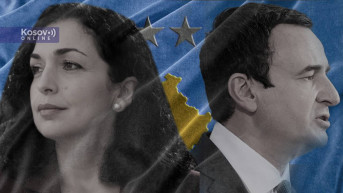
In the past month alone, Kosovo's President Vjosa Osmani has held discussions with dozens of world officials. At the same time, Prime Minister Albin Kurti has limited his meetings to the Quint ambassadors and the EU in Pristina. Analysts interpret Osmani's diplomatic offensive in two ways, seeing it as both a strong promotion for Kosovo and a stance against Kurti's policies.
Written by: Arsenije Vuckovic
The NATO Summit in Washington was a sort of culmination of President Osmani's diplomatic activities. In just a few days, she met with numerous officials from both the US and the EU.
"Unlike President Osmani, who is actively engaged in international diplomacy, Prime Minister Kurti's government appears increasingly isolated on the global stage. This disparity in activities and dedication points to a disturbing disconnect within Kosovo's leadership," warned former President and Foreign Minister Behgjet Pacolli.
Similar reactions followed after Osmani attended the European Political Community Summit in the United Kingdom.
"We are witnessing a gradual isolation between Prime Minister Kurti and the citizens of Kosovo. The citizens of Kosovo continue to suffer sanctions. The non-invitation of the Prime Minister is not just a sign but also a message to Kurti that he is being punished. We can call this de facto sanctions," believes former Ambassador to Italy Albert Prenkaj.
The tension between coalition partners—President and Prime Minister—became evident in May when Foreign Minister Donika Gërvalla, ahead of the Council of Europe Ministers' meeting on May 16, sent a letter informing that the government was working on a draft Statute for the Community of Serb Municipalities (CSM) and that it would be submitted to the Constitutional Court in exchange for membership.
President Osmani sharply reacted, stating not only that she was not informed about this letter, but also that it falls under her jurisdiction, not that of the executive branch.
"I never send private letters because I send those to friends. I send letters within my legally defined powers. Within those powers, I offered to facilitate for some of our partners who empathized with such an idea," responded Gërvalla.
Demo Berisha, President of the Albanian National Council in Serbia, stated to Kosovo Online that the conflict between Kosovo's Prime Minister Albin Kurti and President Vjosa Osmani has been ongoing for some time and culminated with the letter to the Council of Europe.
Osmani does not hide this.
Speaking about the attitude of US officials towards Kosovo's Prime Minister Albin Kurti, she confirmed that there were differences in their approaches to "certain situations" and emphasized that actions that surprise allies are not in Kosovo's interest.
Strategies and Goals
Researcher Petar Rankovic from the Institute for European Studies told Kosovo Online that the relationship between the President and the Prime Minister of Kosovo is evidently strained. He interprets Vjosa Osmani's "diplomatic offensive" not only as her commitment to further Euro-Atlantic integration of Kosovo but also as "skillfully leveraging" the West's disapproval of Albin Kurti's unilateral actions.
"In recent months, we have seen a certain level of distrust and even avoidance of official meetings with Albin Kurti. On the other hand, President Osmani skillfully uses this to criticize the official policy being conducted in Pristina. However, we must be fair and emphasize that their policies, regarding the formation of the Community of Serb Municipalities, the rights of Serbs in Kosovo and Metohija, the protection of the cultural heritage of the Serbian Orthodox Church, and the use of the dinar, are entirely identical. So, the differences are only of a technical nature regarding how certain things should be implemented. Essentially, when we talk about goals and some final solutions, they are entirely the same," says Rankovic.
According to him, it is noticeable that the relationship between the President and the Prime Minister is evidently strained, but this is also apparent regarding relationships within the government.
"There are talks about relationships between the ministers within the government, considering that we now actually see different statements suggesting that Kosovo is no longer a reliable partner for the EU and the US. Officials, especially those from opposition political parties, are competing in making these statements, but representatives of the non-governmental sector also claim that Kosovo is no longer a reliable and stable partner for the US," says Rankovic.
He recalls that this is also evidenced by the increasingly frequent statements from the ambassadors of France, the United Kingdom, and the US in Pristina, who assert that such foreign and domestic policies are not good for the citizens of Kosovo.
"These pressures are becoming stronger, but I am not sure they will bear fruit and lead to a change in the official course of the Kosovo government on all these issues," Rankovic emphasizes.
He particularly highlights the recent warning from US Ambassador Jeffrey Hovenier that Albin Kurti's policies are not literally consistent with the interests of the US and the European Union.
"The main problem is the non-signing and non-implementation of the Community of Serb Municipalities (CSM) on one hand, and on the other hand, the institutional vacuum that arose after the ban on the use of the dinar and the inability of people to receive salaries, pensions, and function normally. This led to the escalation of the situation and the fact that Western partners now perceive Kurti differently," Rankovic underscores.
He adds that the key question is whether a new Kosovo government could offer better solutions, given that according to all surveys, Kurti's popularity has never been higher, raising the question of what might change with potential elections.
"It is predicted that not only would he retain the number of mandates in parliament, but the number of deputies would also increase. So, the question is how this entire situation would be resolved. What is certain is that President Osmani wants to impose her own agenda in some way. However, considering that the institutions and political system are such that it is actually the government that leads the policy, she cannot do much about implementing the already achieved solutions in the Brussels and Ohrid agreements. It is the government that deals with this, and the fact is that there is no will in the government, specifically in its Prime Minister, to deal with all the obligations that so-called Kosovo has from the Brussels dialogue and the dialogue continued in Ohrid," Rankovic concludes.
Ideological Differences
Professor of Constitutional Law at the University of Pristina, Mazlum Baraliu, believes that different views on political issues do not necessarily mean there is a conflict between the President and the Prime Minister.
"They decided together to form the government and coalition because it was in the interest of the country, or rather, in the interest of their political parties at that moment. This does not mean that they agree on everything. And they have not done so," Baraliu explains to Kosovo Online.
He adds that Osmani and Kurti have different approaches to problems.
"The Prime Minister has certain stances that appear to be firmer towards the international community. Some things he cannot swallow. The President is more tolerant, has more political experience because she comes from the political party DSK, which is known to be more tolerant, more inclined towards international cooperation and relations. The Prime Minister's party is not of that nature. However, this government is, for the first time, completing a full four-year term very stably, despite obstacles: from the pandemic to the energy crisis and other economic problems due to the war in Ukraine. There were many problems and obstacles, but it has worked stably, and I think it is completing its mandate stably. How it will be in the future, we will see after the new elections," Baraliu told Kosovo Online.
The disagreements became publicly visible after mid-May when Foreign Minister Donika Gërvalla Schwarz, on behalf of the government and in collaboration with the Prime Minister, sent a letter to the Council of Europe.
"Osmani publicly reacted to this. There were other instances, and those of us who follow this both scientifically and professionally, see that her tone was different. Of course, she did not oppose it outright, because that would mean the collapse of the coalition, but she often had a different opinion on certain issues through appropriate nuances," Baraliu emphasizes.
However, he does not consider such dissonant tones to be a serious disruption of relations.
"Despite mutual disagreements, they have managed to overcome them and bridge their differences. That's why they are together and will remain so until the end of the mandate. So, I don't see a serious situation. Differences exist. But differences exist even in a family, let alone in a government. Especially for us, who are under international community pressure and have certain sanctions that negatively impact us economically, politically, and in every other way," Baraliu explains.
He recalls that differences also stem from the fact that Osmani comes from the right political spectrum, while Kurti comes from the left, making it logical that they do not share the same ideological views, and their duties are different.
"They have separate duties and tasks. The Prime Minister has responsibilities and executive power, while the President, according to Article 84 of the Kosovo Constitution, has precisely 30 different powers, including those related to international and foreign policies. Separate duties and responsibilities, as well as different orientations," Baraliu concludes.
Perception of Defiance
Political scientist Ognjen Gogic assesses that the crisis in the relations between the President and the Prime Minister results from Albin Kurti's defiance towards the West, which Vjosa Osmani skillfully uses through her "diplomatic offensive."
In an interview with Kosovo Online, Gogic emphasizes that the intensified diplomatic activity of President Osmani is a "symptom" of a crisis in their relationship, but also recalls that it is a result of Kurti not enjoying the trust of the West even when he was in opposition. Upon taking office, he did not feel the need to prove himself or change this perception, but rather worsened it.
"He defied the West, primarily the Americans. This really led to the situation where even when there was a change in administration, when Biden took over the White House, it was expected that relations between Kurti and Biden would be better than those between Kurti and Trump. However, this did not happen. Kurti remained someone whom the Americans did not particularly respect or trust, which Osmani managed to use to present herself as a better interlocutor. So, this is a mutual animosity that exists. Kurti's unilateral actions and defiance further exacerbate this," says Gogic.
Asked whether this perspective should also be applied to Osmani's recent "European and American tour," especially her presence at the NATO Summit in Washington, this political scientist says that the visit is more indicative of how interested the US is in Kosovo.
"I would remind that Osmani went to the United States at the invitation of Blinken, as noted. Her office did not arrange these visits; she was invited to come there. So, it is more about a diplomatic offensive towards Kosovo, rather than the other way around. Of course, she used this opportunity to lobby for Kosovo's positions, but this should primarily suggest to us that the US actually counts on Kosovo and has certain expectations and plans regarding Kosovo," Gogic explains.
He says that the invitation to President Osmani came because she is seen by the US as "more cooperative" and someone "they view as a partner in Kosovo for their goals."
"The real message we should take from this is that the US counts on Kosovo and wants to continue developing relations with it. But they have chosen a partner who is more receptive to their suggestions. Of course, Osmani used the opportunity to reiterate Kosovo's positions, to lobby for some of Kosovo's stances, primarily in dialogue and relations with Belgrade, regarding the Community of Serb Municipalities, and the agreement from last year. But, naturally, there is also the component of isolating Kurti," Gogic believes.
He recalls that evidence supporting this claim is the fact that Kurti has never been invited to attend such events, and during his visits to the US, meetings with significant representatives of the American administration were also absent.
"This actually shows that they do not see Kurti as a partner, but it also shows that Osmani does not hesitate to fill that vacuum," Gogic concludes.



0 comments