
Kurti-Abdixhiku negotiations: Will the CSM end up in the LDK's hands?
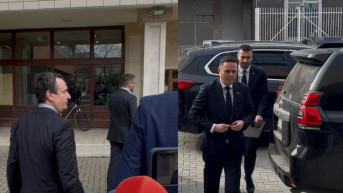
Following their latest meeting, Self-Determination and the LDK appear to have moved somewhat closer to reaching common ground on the election of the President of Kosovo. A potential agreement would, however, raise the question of how responsibility would be divided for the difficult decisions awaiting the future government, including the establishment of the Community of Serb-majority Municipalities. Kosovo Online's interlocutors have no doubt that Albin Kurti will not change his position on the CSM, but they are divided over whether he might attempt to shift responsibility for implementing this obligation onto the LDK as a potential coalition partner.
Written by: Milena Maksimovic
Following the latest meeting between Albin Kurti and Lumir Abdixhiku, the two sides appear to have moved somewhat closer to reaching common ground, given the Self-Determination leader's statement that there was "a willingness" to resolve the issue and the LDK leader's expression of hope that concrete names for President of Kosovo would be discussed at their next meeting. Analysts are not convinced that the two sides will ultimately find common ground and suspect that Kurti may be using the LDK to advance his own interests.
Although Abdixhiku has announced that the LDK has dropped its demands for posts in a potential coalition government, Kosovo's political landscape is highly unpredictable, meaning that further reversals would hardly come as a major surprise. This may also be because the new government is expected to take steps that Kurti would be reluctant to take himself and for which, as a skilled politician, he could seek to shift responsibility onto a coalition partner.
One such step is the establishment of the Community of Serb-majority Municipalities, which Kurti has for years explicitly rejected as a monoethnic association, insisting that such an arrangement is incompatible with the Kosovo Constitution. He subsequently set out six conditions before the Assembly in Pristina under which the issue of the CSM could potentially be considered, one of them being mutual recognition.
Abdixhiku, on the other hand, has repeatedly accused Kurti of having accepted "unprecedented, full autonomy," while also stating that the CSM must be established, that this is an obligation for Kosovo, and that a team should be formed to draft the CSM Statute.
Passing the hot potato to the opposition?
Milos Pavkovic, Strategy Director at the European Policy Centre, believes that, given Kurti's efforts to avoid establishing the CSM, a coalition partner in a potential coalition government could be put in charge of the Dialogue and consequently bear responsibility for implementing agreements that Kurti himself has sought to avoid.
"It is no secret that Kurti is a staunch opponent of this arrangement, which was agreed back in 2013, then revisited in 2015, and most recently reaffirmed through the 2023 agreement on normalization. Ever since he entered the political arena, he has strongly opposed all these arrangements. Since coming to power, he has tried in every possible way to avoid this obligation," Pavkovic told Kosovo Online.
He noted that although recent visits by international officials such as Marta Kos and Antonio Costa had indicated that the future Kosovo government would face considerable pressure once implementation of this obligation came onto the agenda, Kurti was maneuvering tactically and delaying the constitution of the Assembly because remaining in a caretaker capacity suited him.
In the event of a coalition government, Pavkovic explained, responsibility for the chief negotiator's portfolio and the Dialogue with Belgrade could be transferred to Self-Determination's coalition partner.
"The coalition partner would then bear responsibility for everything that happens, while Kurti could, in a way, wash his hands of it and preserve the political ground he has built around his opposition to the establishment of the CSM, while blaming his coalition partners for it in a future government," Pavkovic concluded.
No division of responsibility
On the other hand, constitutional law professor Mazlum Baraliu said that a potential agreement between Self-Determination and the LDK would not automatically mean that responsibility for establishing the Community of Serb-majority Municipalities (CSM) would be divided between them, because Albin Kurti's position on the issue was clear.
Baraliu explained that, in a potential coalition government, the LDK's participation under any arrangement would be "asymmetrical," meaning that the party could receive three ministries and the post of Deputy Prime Minister, as it had already been offered, or at most four or five portfolios.
"But that is not enough. The government has 19 or 20 ministries. I think Kurti has been loud and clear in that regard. He has said that he will not implement any Association, although at other times he says he will implement something else that has been agreed. We will see when the time comes; that remains unknown," Baraliu told Kosovo Online.
Baraliu also believes that the LDK is seeking a greater share of power than its election result would warrant, adding that any division of responsibility should be a matter of agreement between the two sides.

0 comments