
Does it make sense to start the topic of an international conference on Kosovo?
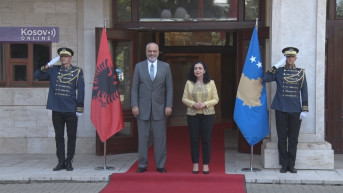
Several times in recent years, the idea of organizing an international conference to address the future status of Kosovo and the relations between Belgrade and Pristina has been raised. Albanian Prime Minister Edi Rama recently revived this discussion following the tragic events in Banjska. There are opposing opinions about the potential success of such an international endeavor, and interlocutors of Kosovo Online from Belgrade, Pristina, and Gracanica believe that this is not the right time for this proposal, especially given the high tensions on the ground.
This is not the first time that Rama has called for an international conference for Kosovo and Serbia. He did so after a meeting with the EU's chief diplomat, Josep Borrell, at the end of June when he proposed holding a meeting of Belgrade and Pristina leaders together with EU and US officials, ensuring that they "do not leave without an agreement."
Now, after the events in Banjska, he is repeating the same call, aiming to secure peace in the region with the involvement of KFOR before the crisis spirals out of control.
"The convening of an emergency peace conference, under the supervision and with guarantees from the EU and the US, and at the same time, taking all emergency measures with KFOR to prevent further escalation of the situation, are a strategic necessity not only for order and security in Kosovo today but also for tomorrow's peace and the future of the region before the extended crisis in northern Kosovo spirals out of control and becomes a destabilizing fire for the entire region," Rama stated.
Journalist Bosko Jaksic assessed for Kosovo Online that Rama's initiative for an international conference had come too early due to the situation in Kosovo.
"Albanian Prime Minister's initiative is undoubtedly noble but premature. International conferences are usually held when problems are harmonized, and such gatherings serve a ceremonial purpose," Jaksic says.
He adds that the Kosovo problem is far from being resolved.
"It is far from any international conference. There is a long way to that, and there is a great challenge primarily before the European Union and the US, which created the Brussels and Ohrid agreements, but we can see that they are not functioning at all," he notes.
Jaksic explains that it will take much more time and pressure to reach a solution.
"It will probably take much more pressure on both Belgrade and Pristina to move this matter from a standstill, and I fear that the status quo suits many," he concludes.
After the conflict in Banjska, Albanian Prime Minister Edi Rama stated that the format of the dialogue should be elevated to the "conference level," with the representation of the EU and the Euro-Atlantic community at the highest level, including France and Germany, with their presidents and chancellors.
"The current format where two people meet has nothing more to offer," Rama believes.
Journalist and writer Zivojin Rakocevic also believes that there is no sense in organizing an international peace conference regarding the Kosovo issue, saying that such conferences have already taken place and been exhausted, and there is currently neither consensus nor conditions for them.
"Here, perfect European and world laws exist but are not applied. Everything that the world had to offer here has been squandered, attempts were made for implementation, but it did not happen, and now we see that here, the only law is chaos, the only law is force, and whenever things go wrong for the Albanians somewhere in the Balkans, some force is found to rescue them, to correct their policies, and bring them to some institutional solutions that are injustice and disadvantage for everyone else," Rakocevic stated for Kosovo Online.
He emphasizes that there is currently no consensus or conditions for organizing an international conference.
"Peace conferences have already taken place, and they have already been exhausted. The only possible genuine progress and hope we believe in is our potential to endure and our creative ability to survive extreme nationalism, survive extreme aggression, survive the absence of institutions, and wait for the moment when the system that constantly produces chaos goes down in history," Rakocevic stated.
Political analyst from Pristina, Leart Hoxha, expressed doubt that there was an international willingness to organize a peace conference to resolve the situation in Kosovo. He reminded in his statement to Kosovo Online that the ongoing dialogue had begun with a decision by the United Nations and had then been transferred to the EU. A conference could only be organized if it was concluded that the negotiations had failed.
Albanian Prime Minister Edi Rama proposes the organization of an international peace conference to address the situation in the north, while former Kosovo Prime Minister Isa Mustafa claims that this is not a good idea for Kosovo.
"We need to start from the basic point, which is that the current dialogue began with the decision of the United Nations, so it must be concluded in the United Nations that this dialogue has failed, and then a peace conference should be organized. It should be known whether this is again under the auspices of the United Nations, which would mean the possible involvement of Russia and China in the entire process, but the Russians are currently a bit busy with other matters in the East, so I doubt there is an international willingness to move in that direction," Hoxha emphasized.
He believes that efforts should be focused on the existing dialogue, increasing pressure on both sides and, if necessary, involving higher diplomatic levels.
"A peace conference, if that were the way forward, should have been held 20 years ago, not in 2024," Hoxha argued.
People who believe in this idea, according to Hoxha, think it is easier to "bypass" the European Union, and the decisive factor may be the elections in Slovakia, which, as he points out, could return the Special Representative for the Dialogue, Miroslav Lajcak, to his homeland, and that his place as a mediator could be taken by someone else.
"I think that as long as there is no official assessment that this dialogue has failed, I doubt that something else can be done under the auspices of the United Nations, and if it is not done under the UN auspices, then it is something else, and I doubt it can be done quickly," Hoxha claims.
He referred to the Dayton Agreement, which, he says, stopped the war but, he claims, Bosnia and Herzegovina is still a dysfunctional state after so many years.
"Kosovo functions much better as a state than Bosnia and Herzegovina, and this can be easily seen not only on the ground but also if you read international reports. So, if there are other proposals, they should be elaborated in detail and should be quite deep so that people know that something unpredictable will not happen again in about 20-25 years, which would paralyze the state. This has already been done in Bosnia, and I think that scenarios that are unpredictable and offer quick, instant solutions simply do not work in the Balkans," Hoxha said.
Igor Novakovic from the Center for International and Security Affairs also believes that an international peace conference on the Kosovo issue is currently unfeasible. He suggests giving new impetus to the dialogue between Belgrade and Pristina, conducted under the auspices of the EU.
"The situation is quite escalatory, but I don't think we've reached the point that would lead to such a drastic move as organizing an international conference. However, within the framework of the ongoing dialogue, there is room that provides a sufficient framework for a new initiative, primarily emanating from the Quint member states, which might lead to a faster resolution of open issues," Novakovic concludes for Kosovo Online.
According to his opinion, the EU should continue to lead the dialogue, but with certain modifications to the process.
"The dialogue has certainly been transferred from the UN to the European Union, and the EU can continue to be the official sponsor of that project, but a new initiative should be packaged within that format," Novakovic believes.


0 comments