
Does Lajcak have a real reason for optimism regarding tomorrow's meeting in Brussels?
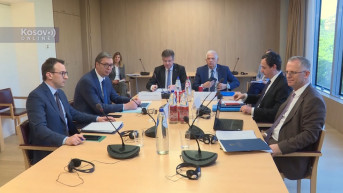
The European Envoy for the Dialogue between Belgrade and Pristina, Miroslav Lajcak, expressed optimism in the past few days before tomorrow's high-level round in Brussels, but the situation on the ground does not support his predictions about a positive outcome of the talks, and especially the messages that arrive before the meeting from the leaders of Kosovo authorities, according to Kosovo Online interlocutors from Belgrade and Pristina.
They agree that the upcoming meetings could be decisive when it comes to whether they will go towards calming tensions or further escalation, and they see steps towards de-escalation, new elections in the north, and the implementation of the achieved agreements as key topics that should be urgently addressed at the Brussels table, primarily regarding the Community of Serb-majority Municipalities.
Lajcak said that the preparations for the meeting were going "at full speed" and that they were working on "positive outcomes".
However, the messages of Kosovo's Prime Minister Albin Kurti arrived as a "cold shower". Instead of talking about Pristina's readiness to take steps towards de-escalation, he called for the introduction of sanctions and the cancellation of visa liberalization for Serbia. He was also clear about what he expects from tomorrow's dialogue - that things return to the "right track", that is, the implementation of the agreement "which has at its center the 'de facto' recognition of Kosovo, and not the Community of Serb-majority Municipalities".
Belgrade's view on the topics of the meeting is drastically different. The President of Serbia, Aleksandar Vucic, announced that, among other things, he would raise the issue of the security of the Serbs in Kosovo, given the terror they had suffered since the arrival of Kurti, the arrests on unclear charges and the unreasonable long detention. Before the dialogue, the house of the returnee Janackovic family was set on fire, and a young Serb from Gracanica was beaten by three unknown Albanians.
The US envoy for the Western Balkans, Gabriel Escobar, also admitted that the Kosovo Prime Minister was not coming to Brussels in good faith, and said that he had not received assurances from Kurti, with whom he had spoken on the phone, about his commitment to normalization. He reminded of the obligation to form the CSM, which had not been fulfilled yet, and said that for new elections in the north, the resignation of the mayors would be better than a petition.
"Basically, what he committed himself to was to attend the meetings in Brussels and nothing more than that," Escobar was open.
The coordinator of the National Convention on the EU for Chapter 35 Dragisa Mijacic indicates that there are numerous topics for discussion between Vucic, Kurti, and European mediators - from the withdrawal of the Kosovo Police from and around the municipal buildings in the north, new local elections, through the formation of the CSM, to energy and the issue of missing persons.
"The meeting between Vucic and Kurti is one of the most important meetings in this phase of the dialogue - it comes after the summer break and all the unpleasant events that we saw in May, but also before that. After this meeting, it will be clear whether, in the following period, we will move towards further normalization of relations or things will escalate, especially in the north of Kosovo," Mijacic told Kosovo Online.
When asked whether there could be progress, given that the Prime Minister of Kosovo was not only taking steps that lead to escalation, but also proposing to impose sanctions on Serbia in the form of stopping investments and canceling visa liberalization, and persistently refused to form the Community of Serb-majority Municipalities, Mijacic emphasized that it did not depend on Kurti whether any punitive measures would be introduced to Serbia.
"What should be the focus of the Government in Pristina is exactly that, fulfilling the three-point plan, in order to normalize the situation in the north, organize new elections, and begin the formation of the CSM, and these are all conditions for the lifting of sanctions against Kosovo," Mijacic emphasizes.
Mijacic clarifies that what was achieved at those talks in Bratislava is not a mistake, but he also points out that it is not an agreement, but rather an "agreement and a bilateral promise of Kosovo" that during the summer months, the presence of the police in the north of Kosovo would be reduced.
"That does not mean much in the European and dialogue frameworks; it is clear what is required of Kosovo - the withdrawal of police forces from administrative facilities, de-escalation in the north, and the organization of new elections. The Bratislava Agreement is one type of mechanism by which Kurti wanted to appease the domestic public during the summer. The summer has passed, so that agreement has no significance," Mijacic pointed out.
He assesses that Brussels is the main address for the issue of relations between Belgrade and Pristina and emphasizes that the EU is there to conduct dialogue, which it does, and conducts it, he assesses, according to the principle of "still waters run deep", which does not imply radical and immediate measures to lead Kurti or any party to an agreement. However, he warns, that due to "disobedience" and lack of agreement, the entire region may have consequences.
That is why, says Mijacic, it is important for the parties to evaluate what they want - peaceful coexistence or solving problems with weapons.
"The key question here is, do we want peace and prosperity in this area, peaceful coexistence, and normal life, or do we want to solve this issue with the power of arms? And we know that in the past no one succeeded, because problems were not solved with arms in these areas. So I don't think that will happen now either. The European Union is there to present that process, but politicians from one side and the other must know what they want to get out of all this," Mijacic concluded.
Political analyst from Pristina, Visar Ymeri, believes that at tomorrow's meeting in Brussels, two things will be discussed - the elections in the north, that is, de-escalation and the implementation of the agreement from Brussels and Ohrid.
"The exact agenda of that meeting between Prime Minister Kurti and President Vucic is not yet known. I think there will be two key topics. The first will be the situation in the north of Kosovo, de-escalation, and how we will get to the elections in the four municipalities, and the second is the implementation of the agreement from Brussels and Ohrid. I think there will be some combination of these two topics, but I think the focus will be on de-escalation and elections in the north," Ymeri says for Kosovo Online.
Political scientist Dimitrije Milic expects that at the high-level meeting in Brussels as a part of the dialogue between Belgrade and Pristina, which will be held tomorrow, there will be progress when it comes to new extraordinary elections in four municipalities in the north of Kosovo.
"It is more likely that there will be progress, because, on the one hand, the western countries are closer to the positions of the Serbs from the north on this issue, and less so on the side of Pristina. As long as the issue of the north is unresolved, in a way, although it does not suit the Serbs from the north corresponds to the position of Serbia, because the policy implemented by the authorities in Pristina is definitely not something that Western countries could support. Even those parts of Western societies that have sympathy for Albin Kurti cannot openly support such a policy, because it encounters resistance in the political ' mainstream'," Milic said.
Analyst Selatin Kllokoqi from Democracy Plus is not very optimistic when it comes to the results of the new round of dialogue, especially, he adds, bearing in mind everything that has happened in recent months.
"I think the meeting is not prepared in such a way that it will give any result; it will be more of another meeting and when it ends everyone will say their own thing. I am not an optimist. I expect everyone to tell their own story because it seems that they are not talking to each other, everyone wants to express his view of the situation, and what should be discussed is the normalization of relations between Kosovo and Serbia. That is the only way, it should be discussed how to achieve normal relations between Kosovo and Serbia." Kllokqi reports for Kosovo Online.
Political science professor Afrim Hoti told Kosovo Online that it depended solely on the European Union and the USA whether progress would be made in the dialogue between Belgrade and Pristina, which continued tomorrow in Brussels with a meeting at the highest level.
"If they really want to solve the problem, we can expect some agreement. If they are only looking at how to buy time until the war in Ukraine ends, then the problems will only continue and there will be no agreement," Hoti says.

0 comments