
Election of the Serbian Vice President of the Kosovo Assembly: Constitutional or political machination?
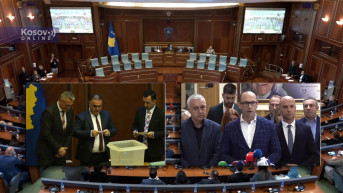
Instead of being a mere formality to end months of institutional crisis, the election of a Serbian vice president of the Kosovo Assembly has turned into a complete political machination. For the interlocutors of Kosovo Online, there is no doubt that this represents a gross violation of all possible rights of the Serbian community and its legitimately elected representatives.
Written by: Djordje Barovic
Over the past two days in the Kosovo Assembly, the only thing missing was Suzana Mancic — one of the most popular “lotto girls” of former Yugoslavia. The election of the fourth vice president of parliament from the Serbian community turned into a kind of “lottery draw” in which the opposition refused to participate, while the ruling Self Determination Movement and MP Nenad Rasic of the “Freedom, Justice and Survival” party tried everything to get him elected.
“I was the only one outside the Serb List, and I nominated myself because there was no one else to nominate me,” Rasic explained how he ended up in a plastic box from which the “draw” was supposed to pick the future vice president.
Earlier, the majority of MPs had refused to vote for the Serb List’s proposal that Slavko Simic, who had already served as vice president of the Kosovo Assembly, take up the post again.
In the first two “draws,” Rasic did not secure enough votes, receiving support only from Self Determination MPs.
The new Speaker of the Assembly, Dimal Basha, held an extraordinary press conference before yesterday’s session, openly calling for a vote in favor of Rasic.
When his name was drawn a few hours later, he surprised everyone by inviting all MPs — even those “in the buffet” — to enter the chamber.
“It is my pleasure to present Nenad Rasic as the candidate for vice president of the Assembly. I ask MPs to state who is in favor of Nenad Rasic,” said Basha.
However, Rasic received 56 out of the required 61 votes, after which Basha immediately suspended the session.
“Rasic is the only MP from the Serbian community who has received the most votes ‘in favor.’ I believe that in the next continuation of the session he can secure enough votes,” explained Basha.
The Serb List announced that they would appeal to the Constitutional Court.
“We will file a complaint with the Constitutional Court. I call on all MPs from other Albanian parties and other non-majority communities not to vote for unconstitutional decisions and attempts to bring Rasic at all costs to the position of vice president of parliament — a position that does not belong to him, just as he was pushed into parliament without votes,” said Igor Simic, vice president of the Serb List.
He explained that they were forced to take this step because the rights of the Serbian people were not being respected in the Kosovo parliament.
“The Rules of Procedure clearly state that the vice president from the Serbian community must have the support of the majority of Serbian MPs, which in this case is Slavko Simic, who won a legitimate mandate. Unfortunately, both the Rules and the Constitution are being violated in order to impose Nenad Rasic in that position with the support of the ruling party, contrary to all rules. It should also be noted that he has neither the support of Serbian MPs nor of the Serbian people, since he won five times fewer votes than Slavko Simic,” Simic explained.
From the EU came the message that they are “encouraged” by the election of the Assembly’s speaker but expect the election of the vice president to be “in accordance with the letter and spirit of the Constitution.”
By tomorrow, everything should be much clearer.
MPs will have up to six rounds of voting to elect one of the remaining three candidates from the Serbian community. Still in play are two Serb List MPs — Igor Simic and Miljana Nikolic — as well as Nenad Rasic.
(Un)Desirable Political Actors
Milos Pavkovic, Strategic Director at the Center for European Policy, has no doubt that the refusal to elect a Serb List representative as vice president of the Kosovo Assembly is “just one in a series of events” confirming that the Serb List is not considered a desirable partner or political actor in Kosovo.
“The refusal to elect a Serb List representative as vice president of the Assembly is just one in a series of events that confirm the thesis that the Serb List is not a desirable partner and not a desirable political actor in Kosovo,” Pavkovic told Kosovo Online.
According to him, Self Determination’s goal is to install a “suitable” candidate from the Serbian community — namely Nenad Rasic, whose election as an MP was itself questionable.
Pavkovic recalled that the Serb List accused Rasic of entering parliament thanks to Albanian votes, while at the same time he cannot be proposed for vice president because that right, like the election of the Speaker of the Assembly, belongs to the party that won the most votes.
“It is obvious that Self Determination is trying to choose someone closer to them. Nenad Rasic was also a minister in the previous government, with good cooperation with Self Determination and Albin Kurti. This undesirability of the Serb List is the main reason why Slavko Simic was not elected and why they tried with Nenad Rasic — which is questionable both constitutionally and legally, and the Serb List will certainly appeal such a decision if their representative is not elected vice president,” Pavkovic said.
He added that it is difficult to predict whether the Serb List’s announced appeal to the Constitutional Court could prevent Rasic’s election.
“The question is how quickly the Constitutional Court will react and whether someone else might be elected in the meantime. I see room here for manipulation, because it seems to me the Constitutional Court cannot decide so quickly — not faster than the time it might take to elect Nenad Rasic or someone else,” the analyst noted.
He further added that the Serb List has not been considered a “desirable political factor” for quite some time.
“The Serb List has not been a desirable political factor for quite some time. From the events in Banjska, to attempts to bar them from parliamentary elections last year, and now with open sabotage of their participation in local elections — it is clear that the Serb List is not a partner viewed favorably in Kosovo, and everything is being done to constrain them,” Pavkovic concluded.
Unconstitutional Decisions
Albanian legal experts also agree that the current process of electing a Serbian community vice president of the Kosovo Assembly represents “a new scenario of Assembly blockade,” while being entirely contrary to the Constitutional Court’s ruling and parliamentary practice to date.
They warn that if the case goes before the Constitutional Court, “there is a well-founded expectation” that this manner of election will be declared unconstitutional.
Gezim Shala, researcher at the Kosovo Law Institute, stressed that this situation shows “a new scenario for blocking” the Assembly, and that if the majority elects Nenad Rasic, the case could “easily end up before the Constitutional Court.”
“This is a case of violating the Constitution, the Assembly Rules of Procedure, a Constitutional Court ruling, and parliamentary practice. This shows that there is a new scenario for blocking the Assembly of Kosovo,” Shala told Kosova Press.
He explained that the voting process must be conducted “as a package,” which means that the election of Emilija Rexhepi is also unconstitutional.
“We have a double violation of the Constitution — both in the election of Ms. Rexhepi from the non-Serb community and in denying the Serbian community the right to be represented in the Assembly Presidency… If the case goes before the Constitutional Court, based on the Constitution and past parliamentary practice, there is a well-founded expectation that this election will be declared unconstitutional,” Shala emphasized.
Lawyer Ardijan Bajraktari also told Kosova Press that the election of vice presidents from non-majority communities “must be carried out as a package,” and that the proposal for Nenad Rasic must come from the Serbian party itself.
“The attempt to deviate from established practice is contrary to the Constitutional Court’s ruling, especially the most recent one, which obliges MPs in paragraph 156 to elect the Speaker and members of the Presidency as soon as possible, and no later than 30 days from the publication of the judgment,” Bajraktari stated.
He maintained that deviating from established practice is unconstitutional:
“Any attempt to deviate from or change the established practice is contrary to the ruling, and therefore to the Constitution. Moreover, any intent to propose or elect someone who does not represent the majority of the community is, in my opinion, contrary to the very principles on which our state is founded and functions. In addition, it is contrary to the Assembly’s Rules of Procedure, as Article 12, paragraph 6 clearly stipulates that the representative from the Serbian community must be proposed by the majority of MPs representing that community,” Bajraktari stressed.
Institutional Erosion
For Aleksandar Sljuka, associate of the NGO “New Social Initiative,” the refusal to elect a Serb List vice president demonstrates “degradation and destruction of institutions.”
He believes this is part of Self Determination’s strategy, which “is not prepared for new elections.”
“There was hope that everything would be resolved with the election of the Speaker, but now we have a problem with the election of a Serbian vice president. I think this shows that Self Determination essentially does not want new elections, because they probably fear that once the Assembly is constituted, the government formation process would begin — for which they do not have support and likely will not gain it. There are strict deadlines, and if they are not met, new elections must be held, which they are not ready for,” Sljuka told Kosovo Online.
Sljuka said the election process from the Serbian community was flawed from the outset and demonstrated “degradation and destruction of institutions.”
“This has shown the degradation and destruction of institutions, above all the Assembly as one of the most important institutions in the system, by violating and acting against both the Constitution and the Rules of Procedure. We have seen the Assembly treated in a completely nonsensical manner,” Sljuka stated.
He explained that the way Serbian community representatives were proposed and voted on was not in accordance with the rules.
“These proposals should have been submitted in writing, and traditionally voting was conducted as a package — both for the vice president from the Serbian community and from other non-majority communities. This did not happen. We even saw ‘lottery draws’ conducted at the discretion of the Speaker, which is also irregular. Numerous rules were broken, all to obstruct the process of electing a Serbian vice president of the Assembly,” Sljuka said.
He also pointed out that the process has not resolved anything:
“We will see what happens in the coming days, but if Self Determination and other opposition parties continue this approach to electing the vice president, I believe we will face yet another crisis in the Assembly,” he concluded.


0 comments