
Four parties have had prime ministers since 2008; which ones have been in coalitions?
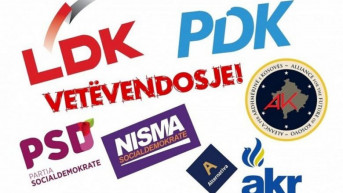
Whichever government emerges from interparty negotiations following the elections held on February 9 will not be unfamiliar to the public. Since Kosovo unilaterally declared independence, all major Albanian parties have been part of ruling coalitions. Familiar alliances have already included PDK and LDK, PDK and AAK, AAK and PDK, LDK and AAK, and Self-Determination and LDK.
Some governments were formed quickly based on pre-election agreements, while others, like Isa Mustafa’s government in 2014, took six months to materialize.
PDK and LDK
Kosovo’s independence was declared during the government led by Hashim Thaci, elected on January 9, 2008. Besides the Democratic Party of Kosovo (PDK), the ruling coalition included the Democratic League of Kosovo (LDK), which secured the presidency for Fatmir Sejdiu. Thaci’s cabinet was formed in less than two months after the elections held on November 17, 2007.
PDK and AKR
Thaci’s government faced a vote of no confidence after less than three years, leading to early elections on December 12, 2010. Two months later, on February 22, 2011, Hashim Thaci was re-elected as prime minister with the support of 65 MPs. This time, the coalition was formed between PDK and the New Kosovo Alliance (AKR), resulting in Behgjet Pacolli being elected President of Kosovo.
LDK and PDK
The next elections were held on June 8, 2014, but the new government was not formed until December 9, 2014, following six months of political crisis. The ruling coalition was once again between PDK and LDK, with Isa Mustafa as prime minister and Hashim Thaci as deputy prime minister and foreign minister. As part of the coalition deal, LDK agreed to support Thaci’s bid for the Kosovo presidency in 2016.
AAK, PDK, Nisma, and AKR
In May 2017, Mustafa’s government was voted out through a no-confidence motion, leading to elections on June 11. On September 9, 2017, Ramush Haradinaj (AAK) was elected prime minister. His government was approved in parliament with 61 votes. Before the elections, AAK had formed a pre-election coalition with PDK and Fatmir Limaj’s Nisma (Initiative for Kosovo). Additionally, support came from Behgjet Pacolli’s AKR, with Pacolli taking the role of first deputy prime minister and foreign minister. Haradinaj resigned on July 19, 2019, after being summoned as a suspect by the Special Court in The Hague.
Self-Determination and LDK
Following early elections on October 6, 2019, Self-Determination leader Albin Kurti became prime minister on February 3, 2020, with the support of 66 MPs. The coalition included LDK, which conditioned its participation on having Vjosa Osmani (then an LDK member) elected as Speaker of the Assembly. However, this government had a record-short tenure, as it was voted out in a no-confidence motion on March 25, lasting only 52 days, with 82 MPs voting in favor of its removal.
LDK, AAK, and Nisma
Without holding new elections, Avdullah Hoti (LDK) was elected prime minister on June 3, 2020, with 61 votes. The ruling coalition consisted of LDK, AAK, and Fatmir Limaj’s Nisma.
The government was formed after the Constitutional Court ruled that the decree issued by Kosovo’s President Hashim Thaci, appointing Hoti from the second-place party in the October 6, 2019 elections as the new prime minister-designate, was constitutional. Deputies from Self-Determination contested this decree, arguing that new elections should be held following the dissolution of the government.
Self-Determination
For the second time, Albin Kurti became prime minister following elections on February 14, 2021. The "Kurti 2" government was approved on March 22, 2021, with 67 MPs voting in favor. Besides Self-Determination MPs, representatives of non-Serb minority parties also supported the government.

0 comments