
Geopolitics, nationalism and influence over the North – Why is a victory in South Mitrovica so important to Kurti?
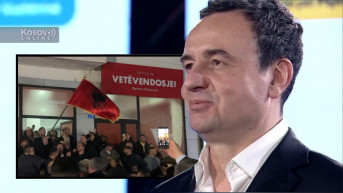
The Appeals and Complaints Panel on Thursday officially put an end to the central battleground of the Albanian parties in the recently concluded local elections in Kosovo. The Self-Determination Movement came to power in South Mitrovica, and analysts are unequivocal that Albin Kurti’s success is a clear consequence of his actions in the north. They tell Kosovo Online that this victory was important to him because South Mitrovica represents a “geopolitical stronghold” from which not only Albanian nationalism is generated, but from which the rest of Kosovo is controlled.
Written by: Petar Rosic
One of the most uncertain mayoral races was held in South Mitrovica. Faton Peci of Self-Determination won the first round with only 28 votes more than Arian Tahiri of the PDK.
In the second round, Kurti intensified the campaign and visited South Mitrovica twice to support Peci. He also made sure to open a park in North Mitrovica, where he stated that the Constitution and laws of Kosovo would apply to everyone, regardless of which mayors “come and go.”
After the polls closed, when Self-Determination’s victory was already becoming apparent, the PDK accused Kurti of using every possible resource to “manufacture” the result in South Mitrovica, after ballots with irregular serial numbers were found at polling stations. According to analysts, suspicions of manipulation were further fueled by the fact that this was the only municipality where turnout in the second round was higher than in the first.
Nevertheless, Peci declared victory, and the PDK filed a complaint with the Election Complaints and Appeals Panel, which was rejected. The Supreme Court closed the case on Thursday, finding no legal basis to conclude that any essential violations occurred that could affect the integrity of the electoral process or the final outcome.
Strange Circumstances
Aleksandar Rapajic, Program Director of the NGO Center for the Advancement of Democratic Culture from North Mitrovica, said that the second round demonstrates just how determined Self-Determination was to take over South Mitrovica.
“In the second round in the south, some very strange things happened, to put it mildly. It is the only municipality where turnout was higher in the second round than in the first, and all of that increased turnout went to Self-Determination. That is quite odd, considering it means more than a 10 percent increase in votes for Self-Determination. I don’t want to use harsh words, but I find it very unusual for an electoral process, because everywhere in the world turnout in the second round decreases, not increases,” he told Kosovo Online.
Commenting on the post-election developments and the disputed ballots with incorrect serial numbers, Rapajic said that, from the outside, the entire second round appears questionable.
“As for the ballots, it may be just a technical mistake, as they claim. I have no evidence, but the result is so unusual that it suggests it was not simply the will of the people turning out in higher numbers in the second round,” our interlocutor said.
On the other hand, he added, Albin Kurti expected support for Self-Determination to grow in South Mitrovica following the actions he carried out in North Mitrovica, believing that the Albanians living there would see him as the one who ‘opened North Mitrovica and unified the city.’
“That is why it was extremely important for him to win in South Mitrovica, and I believe that is why these things happened in the elections in that municipality,” Rapajic said.
He assessed that Self-Determination’s victory, that is, the election of Faton Peci as mayor of South Mitrovica, will inevitably affect the Serbs living in North Mitrovica.
“After the Serb List’s victory, I think cooperation between north and south will become much more difficult, because Self-Determination has shown that it does not want any contact with the Serb List. Therefore, the municipal organization of North Mitrovica and everything that must be coordinated between the two municipalities will be much more complex. The situation in North Mitrovica is already complicated due to employment issues, institutions that have been taken over… all of that will be much harder to resolve with Self-Determination in control of the south,” he said.
Pressures Will Continue
He believes that pressure on the Serbian community in the north will continue, but that much will depend on the future government.
“It depends on what happens in the parliamentary elections, what happens in Pristina, and who forms the government. If Self-Determination forms the government again, it is inevitable that pressures on the Serbian community will continue, along with what I would even call anti-Serb actions throughout Kosovo. If another political group forms the government, things may be slightly easier, although I am not very optimistic even then,” Rapajic concluded.
On the other hand, political analyst Nexhmedin Spahiu believes that Self-Determination’s victory in South Mitrovica will not by itself have an impact on the north, where Serbs are the majority.
“Relations between the mayors of North and South Mitrovica were normal only when the mayor of South Mitrovica was Agim Bahtiri from Pacolli’s party, and on the northern side Goran Rakic. During the PDK administration, when Bedri Hamza was mayor, there was not a single contact between the two municipalities. I hope the new mayor will be wiser and establish relations with the northern municipality, because it is in the interest of both sides for the mayors to cooperate,” Spahiu told Kosovo Online.
However, he emphasized the importance of Mitrovica in a geostrategic and geopolitical sense, saying, “Whoever controls this city controls all of Kosovo.”
“Mitrovica is Kosovo’s natural capital. The two largest rivers—Ibar and Sitnica—meet precisely in Mitrovica, and there are two additional rivers, four in total. That is why this city is the most strategically and geopolitically important in Kosovo. Whoever controls Mitrovica controls all of Kosovo,” Spahiu said.
More Important than Pristina
He added that a victory in South Mitrovica is not important only to Albin Kurti, stressing that having control over Mitrovica is more important than having control over Pristina.
“It wasn’t important only to Kurti—Hashim Thaçi also wanted, at any cost, to secure control over Mitrovica when he was prime minister. It is perfectly clear why this city is so important. Controlling Mitrovica is more important than controlling Pristina,” he said.
Security studies researcher Nikola Vujinovic also assessed that winning the local elections in South Mitrovica was extremely important to Kurti. However, he considers that Kurti sought this victory to validate his entire policy toward northern Kosovo, starting from North Mitrovica.
“In other words, through political pressure on the Serbian community in northern Kosovo and Metohija, he tried to win South Mitrovica, and with this victory he justified that behavior,” Vujinovic told Kosovo Online.
He added that South Mitrovica is a key point from which Albanian nationalism in Kosovo is generated.
“Citizens of Pristina primarily vote on economic issues, because their mayor, Rama, a technocrat from Western Europe, works for the benefit of the city and does not focus on national issues. Meanwhile, South Mitrovica is the front line from which nationalism is generated—nationalism that fuels Self-Determination’s political power and support throughout Kosovo and Metohija,” Vujinovic explained.
In conclusion, he said he expects new pressures on northern Kosovo, especially ahead of the upcoming extraordinary elections.
“I expect tensions in the campaign to escalate, particularly because local governments in Kosovo and Metohija do not have sufficient autonomy,” he said.
He explained that without the central government nothing can be implemented, and the government can overturn all decisions made by North Mitrovica.
“In such a case, South Mitrovica will serve as an excellent ‘witness’ to say: ‘Yes, that should not be done; we are south of the Ibar River, and we don’t need that.’ This will keep the tension alive, as it has been for decades throughout Kosovo and Metohija—and it will remain so as long as that so-called independent state of Kosovo exists on the ground,” Vujinovic concluded.


0 comments