
Has Kosovo met the conditions for lifting EU sanctions?
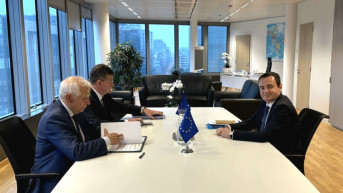
Representatives of the authorities in Pristina are intensively lobbying for the removal of sanctions imposed on Kosovo by the European Union last June, believing that the conditions set before them have been met, including the held referendums for the removal of four mayors in the north. However, interlocutors at Kosovo Online believe that the conditions have not been met at all, and they are under the impression that EU punitive measures have not been visible over the past year.
EU spokesperson Peter Stano said earlier this week that the report by EU High Representative Josep Borrell on Kosovo is nearing completion and that the lifting or intensification of measures imposed on Kosovo will depend on him and the member states.
According to some media reports, there is no consensus within the EU on whether the lifting should be done all at once or gradually.
Sanctions or "measures," as termed by Brussels, were imposed at the end of June 2023 because Pristina did not take necessary steps to de-escalate the situation in northern Kosovo. The Kosovo authorities were expected to halt police operations near municipal buildings in northern Kosovo, to have mayors in the four municipalities temporarily perform duties from alternative locations, and to call new elections in the four municipalities as soon as possible. The measures relate to halting visits and contacts with Kosovo officials and to the EU's financial cooperation with Kosovo.
Political scientist Ognjen Gogic tells Kosovo Online that none of the EU conditions have been met.
"The withdrawal of special police from municipal buildings did not happen. This was evident now during the voting in the north for the removal of mayors in four municipalities, when all those buildings were surrounded by special police. It was supposed to allow citizens to exercise their democratic right and vote, but there was special police actually meant to deter them from approaching these buildings at all. There were claims that Kosovo was gradually withdrawing the special police, however, it is really unknown to what extent this was realistically done, and the impression is that the special police remained there," says Gogic.
Regarding the second requirement - that the mayors work from alternative locations, our interlocutor notes that this too has not been met, as the mayors of North Mitrovica and Leposavic worked from the municipal buildings throughout, while the mayors from Zvečan and Zubin Potok spent some time outside the municipal buildings before returning to them.
"The most important condition was that elections be held in northern Kosovo, and that did not happen. Referendums were held, but those are not elections. Therefore, nothing has been accomplished and the conditions have not been met, so Borell in his report cannot state that they have," emphasizes Gogic.
He adds that before discussing the lifting of sanctions, one should question whether they were ever applied. As he reminds, the measures entailed two things – suspension of high-level meetings, both bilateral and multilateral, and suspension of funding for projects by the European Union, but he says that neither of these measures was ever applied.
“There is not a single example that anything was suspended or canceled because someone cited these sanctions and said 'due to these EU sanctions, Kurti or Osmani are not called to some meeting'," says Gogic. Economists from Pristina believe that Kosovo suffers significant financial losses due to EU sanctions and their estimates of the damage over these 11 months range from 300 to 600 million euros, in terms of unrealized projects. Gogic, however, says that there is no example of a project in Kosovo funded by the EU that was canceled due to sanctions.
"As far as I know, projects funded by the EU are still ongoing and Kosovo can apply for various projects and funds. The introduction of sanctions was a mere formality and a rhetorical action so lifting them would also be merely formal," he points out.
The government in Pristina, he adds, would certainly like to be able to declare that the sanctions have been lifted because it would be a political score for them at a time when Kosovo is preparing for elections.
And diplomat Srecko Djukic says that the EU punitive measures are more rhetorical than actual political and economic sanctions.
"I don't even know what they consist of. They are waved around to coax Kurti into constructive dialogue, however, he is stubborn and no sanctions or threats of sanctions help him. It seems the only thing that helps is when the Americans remove him from power and force him into new elections," Djukic tells Kosovo Online.
As he adds, the announcements that sanctions could be lifted suit Kurti because it means he does not need to change his stance.
"First, here is the problem: what to lift from him, and second, if they lift the measures, then it is a reward for him, because he has done nothing in the meantime. The report must contain what Pristina and Kurti have specifically done, for example on the plan of the CSM, dinar, security issues... The report cannot be at all positive and should lead someone to lift non-existent sanctions," says Djukic.
"This is a weak blackmail for something significant that he must do, and for him, the establishment of the CSM (Community of Serb Municipalities) is an exceptionally significant matter. It's a cat-and-mouse game and I don't believe that it will be decisive for the Council of Europe and CSM and for all other moves that are pending while Kurti is directly warned in the way he should be and can be by the great powers and the Quint. So, his path must be clearly drawn: if he does not form the CSM or do other things, he will have nothing from the Council of Europe and the trust of the international community and he will have to go to elections," emphasizes Djukic.
The situation with the sanctions is viewed somewhat differently by Mazlum Baraliu, a professor of Constitutional Law at the University of Pristina, who points out that it would be good for them to be lifted because they affect citizens, not politicians.
"Great powers should be careful when imposing sanctions to ensure they affect citizens, specifically the poorest layer, not governments. Governments survive and will not abandon some of the policies they are leading, whether they are wrong or not, that is another question," says Baraliu for our portal.
However, he is not optimistic that there is readiness in the European Union for this step. To lift the measures, he emphasizes, there must be a consensus of all countries, but, he says, it does not exist.
"The Kosovo government should not rely much on promises from certain countries about lifting sanctions. Considering current trends and the atmosphere, unfortunately, I do not think the sanctions will be easily and quickly lifted. It is obvious that Germany and France are not ready for it, and America is indecisive, so of the five Quint countries, three are either against lifting the sanctions or are abstaining," states Baraliu.

0 comments