
Has Pristina already “played out“ the end of the dialogue mediated by Miroslav Lajcak?
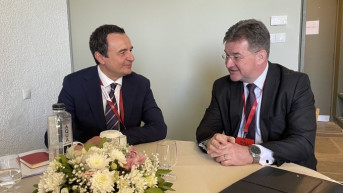
Criticism from Kosovar officials towards Miroslav Lajcak, the European mediator in the dialogue with Belgrade, is not new, but statements expressing a lack of trust in the process he leads, coupled with trust in the US, Germany, and Great Britain, raise the question: Has Pristina “played out“ the end of the dialogue under the auspices of the EU before the end of this mediator's mandate? Will issues from the dialogue favorable to Kosovo be resolved through "side" channels with those they trust, while matters significant to the Serbian side remain on the sidelines?
Throughout last year, representatives of the authorities in Pristina attributed bias to Lajcak, labeling him as one-sided and accusing him of having the wrong approach to the dialogue. Recently, Foreign Minister Donika Gervalla bluntly stated that Lajcak was just an EU official on a fixed-term salary who would leave, and someone else would come.
President of the Assembly, Gljauk Konjufca, also hinted at Kosovo's preference for other mediators over Lajcak. According to him, Gabriel Escobar, the US Special Envoy for the Western Balkans, supports the concept of the EU representative for dialogue, Miroslav Lajcak, who is "biased towards the Serbian side," but the British stance is different.
As Lajcak's mandate is scheduled to end in August 2024, it remains to be seen whether Kosovo representatives will attend the upcoming rounds in Brussels merely as a formality.
In this regard, analyst Afrim Hoti says for Kosovo Online that from the very beginning, it was clear that Lajcak's position was not what Kosovo had expected. However, he emphasized that the issue here was not Lajcak himself, as he represented the EU.
"It should be taken into account that the EU does not behave like a state and that some of its members do not recognize Kosovo. This means that Lajcak must also represent their views," Hoti says for Kosovo Online.
As he adds, Kosovo prefers to communicate with countries that have recognized it and that speak openly about the relations between Serbia and Kosovo as relations between two countries.
When asked whether, in these circumstances, the dialogue will be "frozen" until the new European Commission and EU negotiator are elected, Hoti says he does not think this process will stop and that Lajcak will continue his activities.
"It will be up to the new institutions formed after the elections to make the dialogue more productive. But this will depend on the results of not only the EU elections but also the upcoming elections in the United States. The negotiation process is ongoing, and there is a need for both sides and above all Western powers, to find a solution," Hoti says.
Stefan Surlic, an assistant professor at the Faculty of Political Sciences, sees this as preparation for the political landscape for the upcoming parliamentary elections in Kosovo. He says that the Pristina side has in a way already suspended the dialogue because it does not accept any agreement or compromise and constantly works on discriminatory and escalatory measures on the ground.
"They repeat their well-known stance because they have denounced Miroslav Lajcak from the beginning, first because he comes from a country that has not recognized independent Kosovo, and secondly, they claimed that he is on the side of Belgrade and that he constantly demands that Pristina fulfill Belgrade's conditions. His mandate is nearing its end, European elections are expected, and these voices are now becoming more frequent. It is clear that this is preparation for the parliamentary elections in Kosovo, where they would campaign on how they have won over the north of Kosovo and that the dialogue has not yielded any results," Surlic says for Kosovo Online.
Considering that Kosovo officials favor the United Kingdom, Germany, and the United States over the EU mediator in the dialogue, Surlic says that the dialogue has been "parallel" from the very beginning.
"There is mediator Lajcak formally, but there are also German, British, and American channels... Sometimes they are in agreement, and sometimes they have a completely different position on how to proceed. However, there is no doubt that with the expiration of Lajcak's mandate, the dialogue will be conducted at a bilateral level and that Albin Kurti will seek key allies in European countries as before," Surlic believes.
Researcher at the Center for European Policy, Milos Pavkovic, says that both Belgrade and Pristina are waiting for political changes that could potentially occur after the elections in the European Union and the United States, and therefore they do not want to engage more actively in the dialogue and the implementation of agreements because they hope that these changes would strengthen their position and thus change something in the dialogue and the balance of power between Serbia and Kosovo.
“After the breakthrough with the Ohrid Agreement, which was a step in the right direction in terms of normalizing relations, we have had more than a year of constant crises, tensions, and unilateral moves by both sides, which fundamentally jeopardize the implementation of the agreement itself and its fate. We had the example of the Washington Agreement from 2020, which faded into the background, and it seems that now there is a danger that the Ohrid Agreement will also remain a dead letter. I think that is the main concern of the EU and Miroslav Lajcak – that although they managed to bring the two sides to an agreement, it will remain just a piece of paper. It seems to me that the goal of the dialogue rounds held this and last month was for the EU to save the agreement that was reached and to prevent its oblivion," Pavkovic says.
He adds that this will be a difficult task that will depend on geopolitical changes on the ground and on the political will of Belgrade and Pristina to seriously engage in dialogue.
"Miroslav Lajcak's mandate expires at the end of August, and at the beginning of June, we have elections for the European Parliament, the administration in Brussels is slowly dissolving and entering the campaign and technical mandate, their hands are tied, and they will not want to and will not have the legitimacy to deal with major issues. Accordingly, the dialogue between Belgrade and Pristina is on standby," Pavkovic says.
Otherwise, Petar Petkovic, Belgrade's chief negotiator, said after the latest round of dialogue in Brussels focusing on the issue of the ban on the dinar in Kosovo, that the European Union either did not have or did not want to reach a solution.
"Things are so simple, the European Union either does not have or does not want to reach a solution, there is no third option. In any case, we are committed to dialogue, and we will do everything to find a solution, with our experts, to try to enable the continued operation of the Postal Savings Bank in Kosovo and Metohija so that our people can freely receive their salaries, pensions, and social benefits, and that is the essence of our proposal. For us, compromise is not a bad or ugly word. But on the other hand, you have an interlocutor who clearly wants, together with their mentors, to impose solutions. We will see if they will be able to do so," Petkovic said.

0 comments