
How much will the British reinforcement of KFOR contribute to the objective calming of tensions in northern Kosovo?
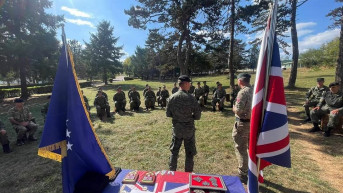
In the crisis in Kosovo in recent months, as well as in previous years, official London has noticeably sided with Pristina or, at the very least, unlike the EU and the US, has been very cautious in criticizing the Kosovo authorities and Albin Kurti for their refusal to de-escalate the situation. Concurrently, significant logistical and other assistance in equipping and training the Kosovo Security Forces has been coming from Great Britain for years, which raises the logical question of how much British reinforcement of KFOR will contribute to the objective calming of tensions after the events in Banjska.
Following the tragic events of September 24th, during which three Serbs and an Albanian police officer lost their lives, NATO announced an increased KFOR presence in Kosovo, with the first contingent of 200 additional soldiers arriving from Britain.
Just three days before the events in Banjska, Colonel Paul Morris, the Commander of the British Military Advisory and Training Team, visited Jezerce near Urosevac to observe the training of Kosovo Security Forces conducted as a part of a multi-year agreement with this team.
The President of the Foreign Affairs Committee in the British Parliament, Alicia Kearns, also pointed out that Britain had a special interest and responsibility to contribute to Kosovo's success after Banjska. She called for an additional 4,500 KFOR troops to be deployed in Kosovo to help maintain peace. According to her, Great Britain, as a member of the Quint, should take an active role in the dialogue between Kosovo and Serbia. Kearns has previously made accusations against the Serbian Orthodox Church and is known for her open support of Kurti's policies.
Historian Aleksandar Rastovic believes that caution is needed when it comes to the presence of British soldiers within KFOR in Kosovo, adding that the Serbs have not had particularly positive experiences with them in the past. Milovan Drecun, the Chairman of the Parliamentary Committee for Kosovo and Metohija, believes that additional forces, following the events in Banjska, will be concentrated mainly along the administrative boundary.
Rastovic points out that the international community's obligation, as per UN Security Council Resolution 1244, is to ensure peace and security for the Serbs in Kosovo. He comments on the announced reinforcement of KFOR with British soldiers but expresses skepticism regarding the objectivity of these troops, given their previous bias in favor of Albanians.
Rastovic emphasizes for Kosovo Online that it is the international community's duty to ensure peace and security for the Serbs and all other citizens living in Kosovo. He notes that KFOR, in the past few days, as well as the EULEX Mission, remained completely on the sidelines during all the events in Banjska since September 24th.
While acknowledging that it is generally good to strengthen KFOR, Rastovic expresses concern, given the role of Britain in the Yugoslav crisis of the 1990s and its presence in the Balkans over the last 150-200 years.
"The bias of those units was evident in 1999 when the Yugoslav army and police withdrew from Kosovo and Metohija following the Kumanovo Agreement and the British contingent was deployed in the Pristina sector. Instead of ensuring objectivity towards all citizens, they acted with bias, favoring the Albanians over the Serbs, who subsequently began to emigrate massively," Rastovic said.
As he says, he is skeptical and fears that the entire escalation of conflicts in the Kosovo region over the past few weeks is a result of NATO's failure in Ukraine.
"It's clear that things are not going well for them there, at least not as they envisioned, and they need to justify the failure of some action to both the domestic and international public, and there's always a kind of scapegoat. I'm afraid that in this situation, the Balkans is precisely where those old conflicts and misunderstandings can flare up again, creating a new crisis situation," he notes.
Rastovic points out that Serbia is interested in peace, as demonstrated in the past weeks, months, and years.
As he says, if anyone is interested in peace, it's Serbia, just as it is in Serbia's interest for the situation in Kosovo to return to some degree of normalcy and for negotiations to resume instead of the war drums being beaten by Kosovo authorities and Kosovo Prime Minister Albin Kurti in recent weeks and months.
"Peace is in the interest of both the Serbs and the Albanians, and the Serbian side knows this well because we have experienced war situations, such as the bombardment in 1999, and we know what war and sanctions are. It would be good if they were objective, but looking at the situation over the past years, decades, and even centuries and the role of Great Britain in the Balkans, I express great skepticism about the objectivity of those British troops that will be deployed in Kosovo," Rastovic concluded.
Milovan Drecun, the Chairman of the Parliamentary Committee for Kosovo and Metohija, assessed that the reinforcement of KFOR forces would be directed towards the administrative boundary and that KFOR had not been satisfied with this decision because it meant that they would take over the tasks that the Kosovo Police had been performing in the north until now.
Regarding the announcement that a new contingent of British and German KFOR troops will be deployed in Kosovo, he told Kosovo Online that this had been a request from Belgrade.
"Belgrade itself requested an increase in the number of KFOR personnel in northern Kosovo and that KFOR should take over the tasks currently carried out by specialized, militarized units in the north, which exclusively terrorize the Serbs," Drecun said.
He reminded that KFOR did not respond to Belgrade's request.
"Of course, the KFOR command is not satisfied with Belgrade's requests to take over the tasks currently performed by the so-called Kosovo Police. However, it is evident that a decision has been made at the NATO headquarters to increase the number of KFOR personnel due to the current situation, with certain countries providing additional forces that have been prepared in reserve as required. Given that the political West, namely NATO, and hence the KFOR command, consider the tragic events in Banjska to be a kind of terrorist act, unfortunately, they increasingly point fingers at official Belgrade, even though we have the confession of the person who organized and entered with that group, and it was stated that the state of Serbia had no connection to it. In NATO, they believe that they should strengthen their presence, especially along the administrative line, to close all possible routes for the potential infiltration of new such groups," Drecun says.
He emphasizes that the reinforcement that is arriving will primarily be directed toward securing the administrative boundary.
"So, the reinforcement that is arriving will primarily be directed towards securing the administrative boundary, while all these other police-related activities will be left to the so-called Kosovo Police, categorizing themselves as a third security ring in Kosovo and Metohija. Britain was the first to decide to send a part of the battalion of 200 personnel to strengthen their presence. We see that Germany is opening the possibility to send additional forces, and I believe that preparations are underway for additional forces from other countries, such as Turkey and some others," Drecun says.
According to him, NATO will now use the situation to increase KFOR's presence along the administrative line to prevent, as they say, attempts at new destabilization.
"This will be a kind of protection for Albin Kurti and his militarized police units to carry out terror without hindrance under the pretext of conducting some kind of counter-terrorism action, as he declared throughout the entire north of Kosovo," Drecun emphasized.
As retired French Colonel Jacques Hogard stated in an interview for Kosovo Online, it was in NATO's interest for KFOR to take security control over northern Kosovo, and he said that the fact that Great Britain had already sent an additional contingent of 200 soldiers meant "nothing has changed."
"NATO is the armed arm of US interests, and Great Britain is a loyal vassal of its former colony, America," Hogard believes.



0 comments