
(Il)legal decisions of the Kosovo Government: Could the Supreme Court ruling also topple the bridges on the Ibar?
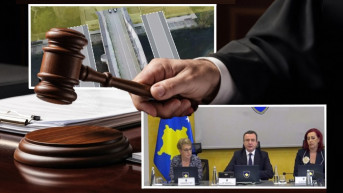
The decision of the Supreme Court of Kosovo, which annulled the regulation on fiscal cash registers because it was signed by Hekuran Murati—who simultaneously served as both minister and MP—has raised questions about the legality of other acts passed by the Kosovo Government while operating in a technical mandate. Experts interviewed by Kosovo Online suggest this sets a precedent with far-reaching legal and political consequences, including for the Serbian community.
Written by: Petar Rosic
The Supreme Court ruling regarding an administrative instruction from the Ministry of Finance signed by Hekuran Murati may represent a turning point in Kosovo's institutional crisis. The court found that Murati was acting as an MP and cannot simultaneously hold both offices.
“According to Article 71 of the Constitution, holding the positions of MP and minister simultaneously is prohibited. Therefore, the issuance of an administrative instruction by someone performing both roles is illegal and constitutes a violation of constitutional provisions,” the ruling states.
The Kosovo Government has announced it will appeal the decision, claiming it is politically motivated and based on a biased and arbitrary interpretation of the law.
On the other hand, the Democratic League of Kosovo (LDK) has called on the prosecution to act urgently and investigate the possible responsibility of government members. Since May, they have submitted 17 criminal complaints to the Special Prosecutor’s Office against Albin Kurti and members of his cabinet. Following the Supreme Court ruling, they submitted an 18th. LDK member Alban Zogaj told the press that all government decisions made after the certification of elections are unlawful.
The scope and consequences of the Supreme Court ruling, and its potential to resolve another political crisis in Kosovo, are subject to different interpretations. Former High Court judge in Kosovska Mitrovica, Nikola Kabasic, believes the ruling is critically important and addresses both legal and political dimensions of Kosovo’s institutional crisis.
“The Supreme Court clearly stated that from the moment MPs are appointed, their ministerial function ceases, and they can no longer issue decisions, regulations, or laws,” Kabasic told Kosovo Online.
While the ruling pertains to a specific case, Kabasic argues it has wider implications and applies to other government acts.
“For instance, the decision to build two new bridges connecting North and South Mitrovica must be annulled. It should share the same fate as the administrative instruction. Construction must stop immediately. No proper procedure was followed—there was no expropriation decision, no declaration of public interest, and no consultation with landowners. Private property of two individuals was destroyed without explanation, notice, or any guidance on compensation or legal remedy,” he said.
Although he considers the government’s actions completely unlawful, Kabasic doubts any changes will occur, given Self-Determination Movement’s past behavior toward court decisions.
“Many of their members face criminal proceedings—Albulena Haxhiu, Xhelal Sveçla, Glauk Konjufca… They’ve thrown smoke bombs in parliament, flipped cars on the streets, and for ten years have avoided court summons hoping for cases to expire. Albin Kurti himself refused to appear in court as a witness,” the former judge recalled.
“They openly attack courts and prosecutors when decisions don’t align with their political agenda—naming and shaming judges, posting graffiti in Pristina. This shows their attitude toward the rule of law,” Kabasic added.
He emphasized that Self-Determination has been ruling without political legitimacy for four months, which severely affects stability and legal certainty, especially for the Serbian community.
“All decisions by ministers or the Government should be annulled and considered null and void, with no legal effect. However, as you can see, there is a disconnect in Kosovo between court rulings and what happens on the ground. Kurti simply ignores these rulings—as far as he’s concerned, they don’t exist. That’s why I think the current practice will continue and there will be no positive changes for Serbs, at least as long as this political group remains in power,” he warned.
Constitutional law professor Mazlum Baraliu also sees the Supreme Court ruling as an important precedent, but argues it has no broad legal effect since it applies to a specific case.
“This is a specific case. When asked whether it will affect other decisions—the answer is no. There has always been debate, even among former opposition parties and civil society, about whether the role of MP is compatible with being a minister or even prime minister,” Baraliu told Kosovo Online.
However, he stressed that others affected by similar government decisions can seek redress in court.
“The Supreme Court ruling pertains strictly to the system of fiscal declarations and economic operators, and not to other matters. But if other parties are affected by decisions from the Ministry of Finance and Transfers, they too can bring administrative cases. Since a precedent now exists, the court could render similar rulings. Still, for now, the ruling applies only to this specific matter,” he explained.
In contrast, political analyst Ognjen Gogic believes the Supreme Court’s ruling will result in the annulment of certain recent government decisions, including those affecting the Serbian community—such as revocations of citizenship and bridge construction over the Ibar.
Gogic told Kosovo Online the ruling showed that the main opposition to Self-Determination is not political parties—but the judiciary.
“The judiciary has stepped in to resolve this political crisis. On one hand, we have the Constitutional Court that may finally end the stalemate in parliament. Then there’s the Special Prosecutor, investigating the bridge projects. And now the Supreme Court has questioned the legality of secondary legislation passed by ministers in a technical mandate,” said Gogic.
He pointed out the core issue: Kosovo’s government operates in a caretaker role, and some ministers are also MPs—unconstitutional under Kosovo’s legal framework.
“The Supreme Court will likely invalidate a range of sub-legal acts adopted by such ministers. These acts will lose legal effect. That’s the first legal consequence,” Gogic said.
He noted that in recent weeks, caretaker ministers who are also MPs issued many decisions affecting the Serbian community—some of which may be annulled.
“All decisions made while officials held incompatible roles must be reversed. This could cover many decisions. For example, Minister Sveçla issued decisions revoking citizenships. Those are legally questionable and likely to be overturned. The bridge construction project over the Ibar, backed by the Ministry of Planning and Infrastructure, may also be invalidated,” Gogic explained.
He emphasized that this situation represents a clash between the executive and judiciary, which has drawn criticism from the international community.
“Heavy accusations have been directed at the judiciary by government officials—this has been condemned by the international community as an attack on the rule of law. Kosovo is now in a tense climate—between Albanians and their parties, between the executive and judiciary, and between the government and international actors,” Gogic concluded.
He believes this legal entanglement will likely end in favor of the judiciary.
“The judiciary will probably play a key role in resolving this situation, leading Kosovo to early elections and annulling a number of controversial decisions made during this period,” Gogic concluded.



0 comments