
The impact and risks of social media: How virtual networks shape reality in the region
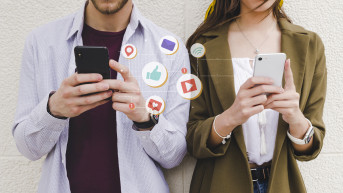
Almost two-thirds of the global population uses social media in some form. With an estimated five billion people having accounts on various platforms, social media has become the primary channel for connection and expression in the 21st century, but it also brings numerous risks. The political and social influence is immeasurable, particularly among the youth, prompting experts from the entire region to warn about the dangers of information manipulation. One of the most significant security concerns highlighted is the misuse of personal data because, as noted by Kosovo Online, social media often knows more about us than we do ourselves.
Written by: Petar Rosic
The social network with the most users currently is Facebook, which has about 3.07 billion monthly users. It is followed by YouTube, WhatsApp, and Instagram, each boasting over two billion users.
Among the most famous are also the "X" platform, Pinterest, Snapchat, Viber...
However, the short-lived ban of TikTok in the USA placed this digital platform, which has about 1.2 billion monthly users, at the center of global attention in January.
The ban was imposed over concerns that the app misuses its users' data. However, after Donald Trump assumed the presidency of the USA, he postponed the enforcement of this law for 75 days and announced that Microsoft was in negotiations to acquire the company.
Yet, TikTok has stirred up more than just the public in the USA.
Romanian authorities accused Russia of influencing the presidential election results through cyber-attacks and this social network to the extent that the Constitutional Court of that country was compelled to annul them.
In Albania, from January 1 this year, TikTok has even been banned, but not due to political interference, rather to protect children from the negative effects of social media.
Prime Minister Edi Rama pointed out that TikTok is a serious source of danger, and that the youth are the most vulnerable category of society.
"TikTok is a serious source of danger, but the politics of slander and lies are more dangerous. The youth are the weakest link. The government will close the doors to TikTok for a year," he emphasized.
TikTok challenges have not bypassed Kosovo, where this social network was banned in public institutions last summer. The government made this decision to eliminate cyber security risks, and the Committee for Security and Defense initiated the question of a complete shutdown at the end of last year.
Psychologist Ilir Havoli from Pristina explains that social networks, especially TikTok, are often used for propaganda purposes, for political influence, and manipulation of public opinion.
"In addition, there is a risk of compromising cyber security, including collecting personal data and external interference in public debates. Because of this, institutions around the world are considering measures to regulate their impact," Havoli states for Kosovo Online.
He adds that these digital platforms have a significant impact on shaping the behavior, attitudes, and values of the youth in Kosovo.
"Through viral content, young people are exposed to global trends, social issues, and political discussions, but also to phenomena that can be problematic. On one hand, TikTok provides a space for young people to express their creativity and share new ideas. On the other hand, it can encourage impulsive behavior due to viral challenges and spread unverified information, affecting how they perceive social and economic realities," Havoli notes.
He explains that styles often promoted on social networks are not in line with the local context, which can create unstable expectations among the youth.
He assesses that in many cases, the ban or restriction of social networks is justified by the need to protect national security, children, or to fight misinformation. However, he adds, these measures often raise concerns about freedom of expression.
"Limiting access to platforms can affect opportunities for debate and civic activism. Moreover, bans can lead to increased censorship, switching to alternative platforms, loss of economic opportunities as many young people and entrepreneurs rely on TikTok for promotion and revenue, impacting the digital marketing sector," the interviewee mentions.
Communication expert from Skopje, Bojan Kordalov for Kosovo Online, assesses that a complete ban on TikTok because of children, as is the case in Albania, will not solve abuses, but that regulations need to be implemented and put into function of democracy and freedom.
Kordalov states that when discussing the influence of social media, there are two separate issues that should not be mixed.
"The most problematic is when we mix things up, which means that if we talk about responsibility on social media among children, we are not talking about responsibility in politics and vice versa. These are two separate issues. We as users have the responsibility to be protected and institutions have the responsibility to protect us with their regulations," says our interviewee.
When it comes to children, more emphasis is needed on education, community involvement, and networking within society, or finding positive practices to engage in online rather than fostering fear and bans.
He emphasizes that instead of panicking, it is crucial to establish regulations and align them with the principles of democracy and freedom.
"I must remind you at the outset that social networks are merely a channel, an empty space, but a powerful one, which if unregulated can spiral out of control. Just like with artificial intelligence. Therefore, it is crucial that instead of panicking, we create regulations and align them with the principles of democracy and freedom. On the other hand, we have many examples in recent history where social networks have been misused by individuals and groups for certain types of propaganda, and this is a big problem that must not be allowed," warns Kordalov.
He recalls instances worldwide where foreign influence was detected through social networks, even during elections in the USA, and suggests that lessons should be drawn and measures taken.
"However, social networks in themselves, if they do not break the rules, bring advantages in political communication. Now, we must decide whether we will create a good regulation and leave room for a good political campaign, or let impunity prevail and continuously discuss the misuse of free will, which is unacceptable," says the communications expert from Skopje. Commenting on social media bans, he notes that there are examples of good user experiences, but, on the other hand, misuse for populist goals.
"Sometimes it's about concrete contributions, like in Western Europe, where the ban is aimed at ensuring a good user experience or protecting the security system, for example, the NATO alliance, the EU, and all of us as democracies. But there are cases like Albania, which seem more populist-oriented. It's easiest when you say you'll ban networks because of children. That means you're actually trying to prevent and extinguish a fire. But when it's done because of the security of people and data, so that everyone can exercise their democratic will, then you care about freedom. And for that, you need support in a democratic procedure," concludes Kordalov.
Agreeing with him is analyst from Tirana and editor at News 24, Dritan Lachi. He commented for Kosovo Online on the recent decisions of the Albanian government regarding the ban of the TikTok app, expressing skepticism about the real reason for this initiative.
Lachi points out that bans are not new in world history and recalls similar measures in the past. He compares the ban on TikTok to the closure of coffeehouses during the Ottoman Empire.
"Bans are known throughout the history of the world. There was also a ban during the Ottoman Empire when coffeehouses called 'medjlis' were closed. Prohibition existed in the 1930s in the USA, when alcohol was banned. What's happening in Albania with TikTok is also a ban, but of a different kind. So, the goal is to close the 'medjlis' where people gather and discuss," says the editor from Tirana.
He notes that there has been an increase in criminal activities associated with TikTok but expresses skepticism about the government's motives for banning this network.
"Skepticism or doubt arises from the fact that the prime minister of this country has indeed concluded that TikTok is precisely the cause of problems for Albanians. In this regard, we view this initiative with suspicion. Also, there is another reason - because we are in the pre-election period, before the elections," states Lachi.
He adds that TikTok indeed had an impact on children or youth like "poisoned food," but it was also massively used by young politicians, who achieved significant influence and became well-known there.
"At a time when the government or majority has almost complete influence on traditional media, and I'm talking about television, these young politicians have found TikTok to express their thoughts and gain their followers. For this reason, we view with skepticism what the prime minister is seeking. The question arises whether the real purpose of shutting down TikTok is because of a murder that happened among teenagers, or because of competition that threatens his power. We are dubious about this," Lachi is explicit.
Editor and journalist at Radio Television Serbia, Zoran Stanojevic, says for Kosovo Online that social media, both in the world and in Serbia, are dominant among the youth, who almost do not follow traditional information sources.
"I think that young people follow no other media except social media. This includes communication apps like WhatsApp, Viber, Telegram... All information that reaches them comes from someone, meaning through some filter, someone from their environment who sent it to them and they tend to really believe it. Since it arrived from a safe hand, it must be true," states Stanojevic.
He highlights that there is a positive side to this phenomenon, but this way of conveying information primarily carries a huge potential for manipulation.
"The possibility of manipulation in such a way is enormous, as is the possibility of preventing some information from being heard just as huge. On one hand, we have this good thing, you can no longer prevent news. If something happened, it will reach people. But what is dangerous, you can't prevent incorrect or partial information which will also form an opinion, especially if the news travels together with some attitude that should put that news in context," warns our interlocutor.
He adds that political manipulations on social networks are nothing new.
"The political risks are, of course, if someone skillfully uses them for political influence. These can even be legal campaigns. Specifically, in America, it is known that there are legal campaigns that candidates have and use social networks, and here everything is above board. What is bad is when some other agent, let's call it, who intends to push their own agenda by influencing people, convinces them that they are reading something that is correct," Stanojevic explains.
From a security perspective, he warns of a serious problem, which is the collection of personal data.
"The biggest security risk is the collection of our information that we leave behind when we connect to networks, the possibility that they can track where we move, observe our habits, and then use them either for commercial purposes, to sell us something based on our behavior, or for other purposes, to deduce where we are vulnerable targets and hit us there whenever they want to achieve any goal," he emphasizes.
Commenting on the attempt to ban TikTok in America, he notes that it was motivated purely by national security concerns.
"That is, the belief that another country, China, is massively collecting data on American citizens and that this will give them a certain advantage, while social networks in China, like Facebook and Twitter, are under heavy control and cannot be used. Thus, there is no reciprocity, and that's why there's a need to ban TikTok," he says.
However, he expresses doubt that bans are feasible because, as he assesses, there will likely be various legal analyses on how to avoid them while ensuring that data does not go where it shouldn't.
He also warns that social media platforms that are legally registered in America collect data on users worldwide.
"That means us too. Therefore, someone in America, at Meta, namely Facebook or Twitter or Google through Instagram..., they already know much, much more about us than any local service. That means they simply know things about us that we don't even know ourselves. That is a definite danger that I think governments around the world, and Serbia is no exception, have naively handed over to social media," says Stanojevic.




0 comments