
An increasing number of workers are leaving Kosovo: Is it a consequence of visa privileges or fleeing poverty?
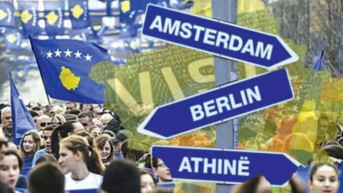
President of the Independent Union of the Private Sector, Jusuf Azemi, claims that in the first six weeks after the liberalization of the visa regime, around 150,000 workers from the private sector left Kosovo. While the government denies these figures, Kosovo Online interlocutors insist that without a serious and clear strategy, it is impossible to prevent the mass exodus of the workforce.
Since January 1st, when the EU visa liberalization for Kosovo citizens came into effect, one of the key questions is whether this has led to a dramatic departure of the working-age population.
An economic expert from Pristina, Safet Gerxhaliu, says that the estimate by the President of the Independent Union of the Private Sector, Jusuf Azemi, that around 150,000 workers from the private sector left Kosovo in the first 50 days of visa liberalization, should be taken with caution, and one should be careful when presenting such data.
"It was during the New Year, and as a part of that exodus, it wasn't just workers, but also members of the diaspora who spent holiday time in Kosovo for New Year's. There's also a wave that drives people to tour Europe, to simply see what Europe is, because, in a way, it was forbidden fruit for years. I think everyone has realized that Europe is no longer what it used to be," Gerxhaliu says.
However, he admits that people are mostly leaving due to political instability.
Top of Form
“Look at education, look at healthcare... The lack of political stability is what drives people the most to leave Kosovo,“ Gerxhaliu emphasizes for Kosovo Online.
Gerxhaliu says that multiple factors are driving the workforce migration and emphasizes that it's not only the poor who leave.
“Europe is the major challenge where people go, besides, there is another reason, we have the largest diaspora in European countries. Not only poor people are fleeing Kosovo, but also educated individuals, doctors, architects, IT experts, and sectors that will be most affected if there is a mass exodus, will be trade, hospitality, and construction,“ Gerxhaliu claims.
However, Gerxhaliu believes that the migration trend from Kosovo is similar to the phenomena experienced by many European countries before and after visa liberalization, such as Poland, Hungary, Bulgaria, and Romania.
“In those countries, before liberalization, emigration was massive, people wanted to go to Europe at any cost. After liberalization, that trend not only declined, but more people returned than left. The same will happen in Kosovo. Europe is not what it used to be. People will surely visit it, and we should appreciate its culture, architecture, history, and everything else, but if we analyze all circumstances, there is no fear of a mass exodus, so there is no need to panic,“ Gerxhaliu assesses.
He emphasizes that the key to preventing a mass exodus of workers lies in a strategy that motivates young people to stay.
“I thought the government would at least enact a law regarding health insurance, to take some steps toward motivating people to stay here. Simply counting the people who leave is not a solution to this problem; we need to ask ourselves, "What are we doing to motivate these people to stay here?" Look at the dialogue with Serbia, look at the politicians' debates, the talk of war. This does not contribute to prospects in these areas. Therefore, we must understand one thing: the common denominator in solving all problems in Kosovo is political stability and economic development, and only then can we work on keeping the youth from leaving,“ Gerxhaliu says.
He notes that Germany, Austria, and Switzerland are the most common destinations, citing the large number of Kosovar diaspora in those countries.
He also notes Italy, Finland, and Sweden.
He explains that the last time he was on the Munich-Frankfurt route, he found out that salaries at McDonald's were 950 euros.
"Our young people from Kosovo mostly work there, and then the question arises whether it's worth it," Gerxhaliu says.
German institutions dealing with employment issues do not yet have data for the year 2024 and expect that it will not be until the middle of the year when they will find out how much visa liberalization has increased the number of workers from Kosovo in Germany.
According to data from the Federal Employment Agency of Germany, during the past year, 113,600 workers from Kosovo were employed in this country.
"In June 2023, there were 113,600 people from Kosovo who were employed based on contributions for social security. The extent to which this number will change from 2024 cannot be statistically determined until July or December 2024," Irmgard Pirkl, spokesperson for the Federal Employment Agency said.
He explained that more precise data would only be available in the middle of this year when regular, six-month statistical reviews were completed.
"Employment statistics in Germany are compiled every six months. Therefore, information up to January 31st will be available by July 31st of this year. Another problem is that we do not have information about when someone entered our country, so we cannot say whether the number of citizens from Kosovo increased before or after the introduction of visa liberalization," Irmgard Pirkl emphasized.
When asked what citizens of Kosovo needed to know if they decided to work in Germany, Pirkl mentioned that there was a specialized portal that provided answers to all questions.
"If people from Kosovo are interested in working in Germany, we recommend the 'Make it in Germany' portal. There, they will find all the information about employment opportunities, recognition of qualifications, and much more," the spokesperson for the Federal Employment Agency of Germany specifies.
According to official data from this country, there has not been a significant increase in the number of asylum seekers.
The Federal Office for Migration and Refugees explains that in the first month of this year, 32 individuals with Kosovar citizenship applied for asylum in Germany.
"In January 2024, 32 individuals with Kosovar citizenship filed their first asylum application in Germany. In 2023, there were 363 initial asylum applications," spokesperson Lena Tres stated for Kosovo Online.
According to her, the Federal Office conducts the asylum procedure and decides whether to grant protected status according to asylum law or reject the asylum application.
"The asylum application, personal interview, and decision on the asylum application are made by the Federal Office," Tres added.
Another destination where citizens of Kosovo migrate is Switzerland.
Zoran Jovanovic, a member of the National Migration Commission of the Unia, the largest trade union in Switzerland with over 200,000 workers, says that workers from the construction sector mostly come to this country.
“The number of workers from Kosovo has increased after visa liberalization. I hear this from colleagues who work in construction. But, this influx of labor has also led to a decrease in the hourly wage. I've heard from our people from the former Yugoslavia that the hourly wage has already fallen. Employers have started to blackmail them for wages. They give them less and say, There's someone else who will work,“ Jovanovic says.
He says that at this moment it is impossible to determine how many citizens of Kosovo have started working in Switzerland after January 1st because, he explains, there is a 'gray zone' in the employment of all migrants.
“These are gray areas in which everyone participates a little, everyone hides, and everyone in some way has a piece of the cake,“ claims Jovanovic.
He says that according to some information, the largest number of workers from Kosovo are employed in the construction sector, mostly in the Canton of Ticino.
“We know that Mr. Pacolli is there and has companies, and they go there. Whether they are working illegally, unreported, or if contracts have been made, I don't know, but it's mostly public knowledge. Some data even surfaced that there are up to 50 registered at one address. However, no one reacts, not even the Swiss police, known for their thoroughness, strictness, and respect for the law,“ Jovanovic notes.
He explains that the influx of a larger number of workers from Kosovo is also indicated by the fact that in it, the largest union in Switzerland, Albanian has recently entered 'official use'.
“At lower levels of union communication, Turkish and Portuguese have been used so far, and recently Albanian has been added. This indicates an increase in the workforce from Albanian-speaking areas and a concession is made for them to understand what is being discussed. No one would just randomly introduce Albanian. There is a reason; there has been an influx of labor in construction, and it is necessary for them to understand, to have better communication at work, but also to know what is happening, where they have come, what their wages are,“ Jovanovic explains.
Jovanovic says that the Albanians have simultaneously begun to take precedence at the top of the Unia syndicate and that the Albanian language has also been included in the correspondence at the top of the union.
“This is already unacceptable. The official languages in Switzerland are well known,“ Jovanovic asserts.
Last week, a protest of healthcare workers was held in front of the Clinical Hospital Center in Pristina.
They demanded the payment of market supplements and supplements for healthcare workers in the public healthcare system, inclusion in the Salary Law, payment for work on weekends and holidays, hazard pay, and payment for overtime hours.
Xhemajl Selmani, the President of the Healthcare Union, claimed to Kosovo Online that the key reason for the departure of healthcare workers from the sector was indeed low salaries and unresolved work-related issues.
“The salaries are insufficient to make ends meet. That's why we protested. Our demands are to increase salaries for all healthcare workers, from doctors and nurses to cleaners and technical staff,“ Selmani said.
He warns that there has been a noticeable outflow of workforce from Kosovo's healthcare sector for years and that visa liberalization has further facilitated this trend.
”Medical workers have been leaving Kosovo for years, and we have a deficit in terms of the medical workforce. I believe the government needs to address this issue,“ Selmani said for Kosovo Online.
Selmani says that the problem of workforce outflow affects all categories of healthcare employees, with his colleagues mostly leaving for Germany, Switzerland, France, and Sweden.
According to data from the Medical Chamber, in just the first month of this year, 20 doctors requested the necessary documentation to continue working in one of the Western countries.
“The government is not attentive to the problems of healthcare workers. It has rendered the union organization passive,“ Selmani concludes.



comments