
Italian General Vergori to succeed Ulutas tomorrow – what can Serbs expect from the change at the helm of KFOR?
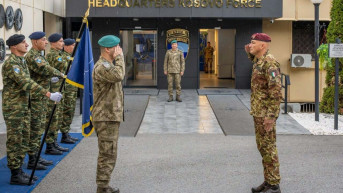
General Ozkan Ulutas’s second term at the helm of KFOR officially ends tomorrow, when he will hand over command to Italian General Roberto Vergori. Ulutas is departing at a time when, according to NATO, the favorable security situation in Kosovo has paved the way for a planned reduction in troop numbers, as well as for Kosovo Police to assume responsibility for securing the main bridge over the Ibar River and to become involved in the security arrangements for the Visoki Decani Monastery. Kosovo Online’s interlocutors are divided over whether the change at the top of KFOR will bring any substantive change.
Written by: Veljko Nestorovic
Incoming KFOR Commander General Vergori has been deployed on numerous occasions in international missions, including in Kosovo, North Macedonia, Afghanistan, Lebanon and Libya. In October 2021, he assumed command of the “Folgore” Parachute Brigade, whose members were deployed as part of the KFOR mission in Kosovo, including in the protection of the Visoki Decani Monastery.
Outgoing Commander Major General Ozkan Ulutas recently told Kosovo Online that the optimization of KFOR did not constitute a transfer of KFOR’s mandate or responsibilities to Kosovo Police, nor did it represent a withdrawal or reduction of NATO’s commitments to Kosovo.
At the time, he also said that “the gradual transition from KFOR’s permanent presence on the Ibar Bridge and the inclusion of Kosovo Police in the security architecture around the Visoki Decani Monastery are part of a broader optimization process.”
Analyst Nexhmedin Spahiu told Kosovo Online that outgoing KFOR Commander Ozkan Ulutas had not distinguished himself during either his first or second term in any way that would substantially set him apart from other KFOR commanders.
Spahiu recalled KFOR Commander Marcel Valentin, who held the post in 2002 and who, according to him, did something beneficial for society in Kosovo by enabling people to move freely into and out of enclaves.
Spahiu does not expect anything particularly noteworthy from the new KFOR Commander.
“For now, there is nothing on the horizon that could represent, how should I put it, a challenge to the security situation. Nevertheless, I expect KFOR to preserve its credibility, that is, the reputation it has built in Kosovo, and to remain the most reliable institution in Kosovo,” Spahiu said.
Security studies researcher Nikola Vujinovic believes that outgoing KFOR Commander Ozkan Ulutas will be remembered for his position that Kosovo had become so secure that KFOR no longer needed to protect the Visoki Decani Monastery or the Ibar Bridge in Mitrovica, and that the security of all communities was at a very high level.
Vujinovic told Kosovo Online that Ulutas had acted more as a Turkish general than as the KFOR Commander.
“Accordingly, he implemented the kind of policy that Turkey itself pursues in Kosovo: strengthening the Kosovo Security Force, training it and maintaining very close relations with Kosovo’s security sector. He should not have such relations because he holds that position under Resolution 1244 and should not merely refrain from tolerating the Kosovo Security Force, but should prevent its existence. However, we see that he not only tolerates it, but actively assists it,” Vujinovic said.
Regarding incoming KFOR Commander Roberto Vergori, Vujinovic said that the Italian general would have a somewhat fairer approach toward the Serbian community.
“From what I have been able to follow, that Italian general is a paratrooper who, among other places, also served at Visoki Decani, where, as I understand it, he was responsible for security. I therefore believe that he will show greater understanding for the Serbian community, as Italian soldiers and Italian KFOR units have always done. That would prevent what Mr. Ulutas allowed—the so-called Kosovo behaving as though northern Kosovo were simply an integral part of its territory. Formally speaking, that area is part of the territory of Kosovo, but the majority Serbian community there must be treated with much greater care and tolerance. Ulutas did not devote sufficient attention to that, but instead allowed both the police and the Kosovo Security Force to behave as they did, continually accepting their explanations that they had taken a wrong turn,” he said.

0 comments