
Kurti's Balkan tour: Messages for Belgrade, Brussels, or voters in Kosovo?
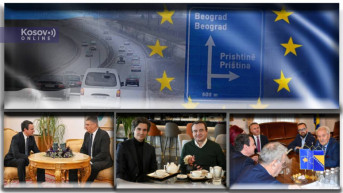
Sarajevo, Zagreb, Ljubljana, then Pristina. Prime Minister Albin Kurti finishes his "Balkan tour" on Friday at home, with a joint session of the Kosovo and Albania assemblies. For Kosovo Online's interlocutors, it's undeniably a pre-election "ride". The only uncertainty lies in the "road signs" - were they more directed towards Belgrade, Brussels, or the voters ahead of February 9th.
Written by: Arsenije Vuckovic
The unilateral abolition of visas for Bosnia and Herzegovina citizens from January 1 was Kurti's first regional message announced in Sarajevo.
The second was even more specific.
"As Serbia blocks the Western Balkans, so does Republic of Srpska block Bosnia and Herzegovina and holds back the entire country because of its fear," Kurti stated, alongside his hosts, the Bosniak and Croatian members of the tripartite Presidency of Bosnia and Herzegovina, Denis Becirovic and Zeljko Komsic.
The third member and chair - of the tripartite Presidency of Bosnia and Herzegovina, Zeljka Cvijanovic, was not only absent but would not have attended since Bosnia and Herzegovina does not officially recognize Kosovo.
"Albin Kurti is not content with harassing Serbs in Kosovo, now he has come to further poison relations in Bosnia and Herzegovina, which will suffer the greatest damage from this visit," Cvijanovic assessed.
However, reactions were not absent from Serbia either.
Serbia's Foreign Minister Marko Djuric stated that the decision of the Presidency members Denis Becirovic and Zeljko Komsic to receive Kurti as a representative of Kosovo, "is deeply contrary to the principles of good neighborliness and mutual respect between Serbia and Bosnia and Herzegovina and undermines the foundations of the relationship between the two countries."
The third message came from Zagreb and was even more specific.
"For nearly two centuries, Serbia has only had two years of democracy. Serbia is not a democratic state there; human rights and minority rights are not respected," Kurti announced at a joint press conference with Croatian Prime Minister Andrej Plenkovic.
In Slovenia, there was much less politics and more culture.
Kurti visited an exhibition about the house of the Albanian Bruti family and attended the promotion of the book "Ancient Albanians and the Creation of Istria," which brought together representatives of the Albanian community and associations from Slovenia, Croatia, and Italy.
There were also official meetings, albeit in a cafe.
In one of them, Kurti spoke with the Deputy Prime Minister of Slovenia and the Minister for Labor, Family, Social Affairs, and Equal Opportunities, Luka Mesec.
"The meeting discussed bilateral relations between Kosovo and Slovenia, possibilities for deepening cooperation, and the role of the Kosovo diaspora in strengthening the bridges between the two peoples," stated in the announcement. "Zone of Influence"
The Balkan tour of Kosovo's Prime Minister Albin Kurti is his attempt to consolidate Kosovo-Albanian allies ahead of parliamentary elections and present himself as a local leader, evaluates Petar Donic from the New Third Way.
"He is trying to establish himself as a regional leader, communicating with different states and trying to use his prime ministerial role for pre-election purposes," Donic stated for Kosovo Online. Kurti's tour is seen as an attempt to replicate the result from 2021 when he formed a government with parties from minority communities.
"His entire tour is painted with this pre-election color," emphasizes Donic in a conversation for Kosovo Online.
He believes Kurti aims to "consolidate his power" and expand his "zone of influence."
"He is certainly trying to consolidate his power. Of course, this is in his interest, he has been doing this from the beginning. Now he is trying to expand his zone of influence, and there are certainly some effects. What effects it will have will, of course, be seen in the coming period and in the elections themselves," believes Donic.
He explains that after the elections, it will also be known whether he succeeded in changing perceptions regarding European agreements, as well as relations with the USA.
"Appointing Trump's cabinet, appointing Grenell as a special advisor, other activities that America will undertake, will certainly have a slightly different color than during Biden's administration. Now, how much this will affect Kurti's power is a question of how he will fare in the elections. If he manages to form a coalition without concessions, to be again in a position to win a majority plus minority parties, this will not hinder him in further governing Kosovo. On the other hand, if he has a poorer result and has to make compromises, it will have a completely different dynamic," believes Donic.
Commenting on the messages that Kurti sent from Sarajevo, Zagreb, and Ljubljana, this analyst says they do not differ from previous rhetoric.
"These were critical messages also aimed at Serbia. They were concentrated through this tour in a short time, but these messages are not much different from the messages sent through previous years. I would see this case as Kurti's endeavor to consolidate traditional Kosovo-Albanian allies in gathering support for his current campaign and of course, in the midst of the redistribution of cards regarding America, because it is quite uncertain how Trump's cabinet will play the Balkan issue," emphasizes Donic.
Image and Proof
Political analyst from Pristina Artan Muhaxhiri goes a step further, assessing that the Balkan tour of Kosovo's Prime Minister Albin Kurti should be interpreted as an attempt to show that despite having a lot of problems in relations with the international community, primarily the USA and EU, he has not lost political influence.
"Kurti has a lot of problems with the international community. He failed to establish good relations with the USA, and from the EU, he received sanctions. The only way for him to prove his image is to do something through regional visits and projects," says Muhaxhiri for Kosovo Online. Kurti is aware that Kosovo cannot progress without the help of allies, and in such political circumstances, claims Muhaxhiri, he tries his best to establish new cooperation with countries from the region.
"He can't go to Washington, he can't easily go to Brussels, Paris, Berlin, but instead, he tries by going to countries in the region to prove his image and try to establish new cooperation. However, such a type of tour is incomparable because people in Kosovo know that going to Washington or Berlin is not the same as going to Sarajevo or Zagreb. But, that's his plan on how to change his image," explains this analyst.
The joint session of the assemblies of Kosovo and Albania is also seen as an attempt to repair bad political relations.
"In terms of building relations with Albania, he does not have good relations with the Albanian Prime Minister Edi Rama. There are a lot of political conflicts, especially when it comes to the Open Balkans, but also other topics," believes Muhaxhiri.
He reminds that in a similar way, the Kosovo Prime Minister tried to get involved in the political life of North Macedonia.
"So, he has opened many political fronts, but I think his only goal and only obligation will be to improve relations with the USA and the EU. This is the basic thing, this is the most basic because without improving these relations, nothing significant can be done in the near future for Kosovo," concludes Muhaxhiri.
Regional Players
Associate of the Institute for European Studies Dusan Ilic believes that the "Balkan tour" of Prime Minister Albin Kurti should be seen as an attempt to establish Kosovo's "geopolitical position" ahead of the arrival of the new American administration, which is why he opted for "regional players" who have so far led a pro-Albanian policy.
"Albin Kurti, ahead of the arrival of the new administration in Washington, is trying to establish his political, and we can freely say, geopolitical positions of the so-called state in Pristina. Of course, as has been the case before, he will rely on those regional players who have led a pro-Albanian policy, that is, an anti-Serbian policy. The best address for such a thing are precisely the former Yugoslav republics, which, together with the Kosovo Albanian separatists, participated in the disintegration of the former state of Yugoslavia. In this context, I would assess his visits to Zagreb and Ljubljana, but also the unofficial visit to Sarajevo, which was somewhat, at least in attempt, formalized," says Ilic in a conversation for Kosovo Online.
Commenting on the upcoming joint session of the parliaments of Kosovo and Albania, Ilic believes that it has already become common practice which, he claims, effectively formalizes the existence of "Greater Albania."
At the same time, he views Kurti's tour as a "parallel" attempt to assert himself both domestically and on Kosovo's foreign front.
"It's the desire to work simultaneously on both domestic and foreign plans. Domestically, of course, it's a battle with his political opponents, where he wants to establish himself as a protector of Albanian national interests, but also as someone who will preserve intact what Albanians have so far achieved in negotiations with Belgrade and under Western patronage. On the foreign front, he wants to strengthen the position of the so-called state in Pristina before the change of administrations that will happen in January when Donald Trump takes over the White House," Ilic specified. According to him, his visit to the region facilitated this goal.
"He didn't even need to make an effort to win over the region to his side, because it's about the so-called unprincipled coalition, as it was once called during the time of SFRY, or the anti-Serbian coalition from Ljubljana to Pristina that works against the Serbian people and generally against Serbian national interests, so he is practically welcome in Ljubljana, Zagreb, and Sarajevo precisely for these reasons, keeping in mind that this is, let's say, just a continuation of the traditional cooperation that these centers have had since the time of the former Yugoslavia and from the time when they worked on the disintegration of the common state," Ilic noted.
He assessed that even without Kurti's tour of the region, Serbia is currently in a very difficult position and is "vulnerable" due to current geopolitical events.
"We are in a particularly sensitive place and in a very sensitive position, so we are vulnerable, unfortunately, also because of demography, we are vulnerable because of our geographical layout. We are vulnerable, of course, because we opposed that NATO, American unipolar order in the 90s. Even without this action by Albin Kurti, the current geopolitical moment does not play into our hands, at least for now. We will see in some nearer and farther perspective," Ilic believes.


0 comments