
Kurti's Pre-Election Messages: Reaching Voters and "Rattling Weapons"
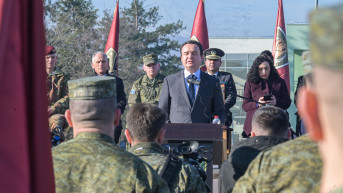
Messages that are brief and impactful. And resonant. In his election campaign, Kosovo's Prime Minister Albin Kurti emphasizes the accelerated training and arming of the Kosovo Security Force (KSF) and the Kosovo Police, and their readiness to defend against any attempted aggression from Serbia. Analysts undoubtedly see this as saber-rattling for propaganda purposes, reminding that it is a strategy seen before. Four years ago, this approach earned Kurti the premiership.
Written by: Arsenije Vuckovic
"For the youth, we have employment; for women, we offer equality; for children, we provide allowances; for the opposition, we have opposition; for Serbia, we have police and military; for the elderly, we have pensions; for everyone, healthcare. Your will is our responsibility, your decision is our country," Kurti said at his first pre-election rally in Djakovica on January 11.
Since then, cities and sports halls have alternated as the venues for his pre-election rallies, but the messages have been almost identical.
"Whoever touches our border, we will chase them over the fence," Kurti declared at a pre-election rally in Gnjilane, adding that the budget for the police had been increased by 66 percent, the training budget had been tripled, and expenditures for armament had increased threefold.
Incendiary Rhetoric
Marko Savkovic, a senior advisor at the ISAK Fund, believes that the "weapon rattling" by Kosovo's Prime Minister Albin Kurti during the election campaign is expected rhetoric and a continuation of his policy of confrontation in which Serbia is the "imagined or real enemy."
"He must establish himself as the undisputed leader of Kosovo. His policy has largely been one of confrontation. A policy of imposing will, especially on the citizens living in the north. But it has also been a policy where it is constantly speculated that Serbia is the imagined or real enemy, which we cannot fully know, with whom Kosovo will one day enter into conflict. Therefore, he needs to equip with more modern weapons and build new alliances," says Savkovic in an interview for Kosovo Online.
Savkovic views this incendiary rhetoric as a clear message from Kurti to his voters.
"This is the message he sends to his voters that with him, Kosovo will be strong, independent in decision-making, sovereign throughout its territory, and ready to confront those he sees as enemies," Savkovic specifies.
Asked about the likelihood of such a scenario occurring, Savkovic believes that due to the presence of KFOR, it is not realistic, but local conflicts are possible.
"There is always a local risk of conflict erupting. I don't believe in a broader conflict, still, mostly because of the presence of KFOR and the risks for both regimes," emphasizes Savkovic.
He believes that Kurti directs such messages to those who want to hear them, especially to the diaspora, which for him is a "base of support."
"This is again a Balkan paradox. The diaspora is often more radical in its views and I think it is partly responsible for his success, but also the memory of the failures of previous governments. It’s not like the previous governments in Kosovo were overly successful, whether from the standpoint of achieving certain national goals or from an economic standpoint," says Savkovic.
He recalls that Kurti, upon coming to power in 2020 and again in 2021, promised "jobs and justice."
"Those who criticize him say he has provided neither," Savkovic clarifies.
Election Strategy
Security expert from Pristina, Bedri Elezi, thinks similarly.
In a discussion with Kosovo Online, he assesses that Kosovo's Prime Minister Albin Kurti is using security issues as an election strategy because he won the last elections on such rhetoric.
Commenting on Kurti's claims made at a pre-election rally in Kosovska Kamenica that his government will guarantee borders with neighbors and that anyone who compromises Kosovo's security will be severely punished, Elezi says that these should be viewed strictly in the context of the election campaign.
"Kurti has made similar statements during previous election cycles, which earned him political points and enabled him to form a government. These statements are primarily political in nature and part of his strategy to win voters' trust," Elezi highlights.
Reminding that there have been multiple security challenges, including the arrest of Kosovo police officers and incidents in Banjska, but that the security of the borders is exclusively under the jurisdiction of KFOR.
"The security of Kosovo is a crucial issue, but it is important to emphasize that, according to UN Security Council Resolution 1244, KFOR has the mandate to guarantee the sovereignty and security of Kosovo while also securing the borders. Kosovo institutions must coordinate their activities with the NATO mission and not act unilaterally," said Elezi.
He added that after the incidents in Banjska and North Mitrovica, KFOR increased its presence in the north of Kosovo, which led to stabilization of the situation.
However, he warns that there are many factors that can affect security and that instability within Serbia could also impact it, citing student protests.
"Kosovo must be cautious and continue to cooperate with international partners to avoid escalating tensions," Elezi said.
He emphasized that Kosovo must not undertake actions that could endanger the citizens of neighboring countries or violate borders.
"Kosovo has the right to defend its sovereignty, but it must do so in accordance with international rules and in cooperation with KFOR and other stakeholders," Elezi stresses.
He recalls that Kurti has had several unfulfilled pre-election promises concerning the security sector and points out issues with the Kosovo Police.
"The Kosovo government has not fulfilled even the minimum obligations it took on in the last election campaign, especially regarding health insurance for members of the Kosovo Police. Realistically, we can say that the Kosovo Police is not in good condition because Kurti's government has not been properly committed to it," believes Elezi.
He also highlights problems around the budget increase for the KP and issues with supplies, from ammunition to clothing.
"We have also seen serious problems with the lack of additional payments for Kosovo police officers who worked outside of official working hours," says the analyst.
An additional problem is the engagement of the police in contentious cases that were based on poor analyses.
"We have seen attempts by Prime Minister Kurti to engage the police in contentious cases based on poor analyses. The Kosovo Police is an institution that guarantees safety to all citizens regardless of gender, race, age, and ethnic background. Accordingly, actions should not be taken without prior coordination with NATO, the USA, and the EU," believes Elezi, adding that the Kosovo Police should guarantee safety to all citizens, especially Serbs living in the four municipalities in the north.
"The Kosovo Police must be dedicated to their duties and at the same time must have the support that has been lacking," concludes Elezi.
Because of this, he expects more members of other communities in the Kosovo Police, as this will ensure safety to all citizens regardless of nationality or gender.
"The Serbian Factor"
For Belgrade-based military analyst Aleksandar Radic, Kurti's tactic is clear: use the "Serbian factor" whenever needed.
"The internal political issue for the authorities from Pristina is raising tension. There are no real circumstances in which a radicalization of the situation in front of KFOR, under pressure from a foreign factor, can be imagined. Therefore, Kurti can relatively harmlessly, in terms of international consequences, through media pressure and demonstration of force on the ground, create an image of how there is a threat to Pristina and try to achieve some effects that need to be reflected and seen in the vote counting in February," Radic tells Kosovo Online.
He believes that the attacks on Serbian institutions in Kosovo that occurred during the election campaign should be viewed in this light.
"This only shows how shortsighted Albin Kurti's policy is because, on one hand, he has not offered anything else to the residents, especially the Albanian population. On the other hand, he is antagonizing the relations between Pristina and Serbia, between Serbian institutions and Pristina. In the long run, this will adversely affect the already bitter and tense relations between Serbs and Albanians," this historian emphasizes.
He warns that Kurti's claims that Kosovo has strengthened its security forces and police are not grounded in facts.
"If we look at the indicators and statistical data of Pristina's security forces, they are in the lower third in terms of strength among the countries that are ranked. The security forces, the army, and the police of Serbia are in the upper third. In other words, he is not 'a big person with a big stick,' and this behavior is, as our people would say, 'a barking dog doesn’t bite.' Unfortunately, I think the long-term consequences of such behavior will be extremely negative," Radic believes.
Asked whether Kurti is addressing a certain segment of voters with this inflammatory rhetoric, Radic emphasizes the opposite.
"What is specific about Self-Determination is that they actually have voters and an electorate from various segments of Albanian society: rural, urban, older, and younger. They are one of the few political movements and forces that have such a reach," says Radic.
However, failures during four years in power can disrupt such a combination.
"It seems that failures in other fields, primarily in the economy, will lead to a decrease in popularity compared to previous elections," this historian believes.
He assumes that Kurti’s "positive messages" are most heard by the younger population.
"Young people are probably the most interested in some kind of 'positive messages' that Albin Kurti is sending, like fencing Kosovo, fully establishing territorial sovereignty... That is all he has to offer," specifies Radic.
As a particularity of Kurti's campaign, he points out the fact that he also addresses those communities in Kosovo from which military and political leaders of the former KLA come.
"Such as Ramush Haradinaj’s party, which is strong in Metohija, DSK which is strong in urban areas, or DPK which is traditionally strong in those communities from where the military and political leaders of the KLA come," Radic highlights.


0 comments