
Legality of decisions by Kosovo's caretaker government in question – courts to have final say
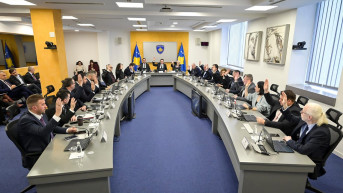
The delay in constituting the Kosovo Assembly has created an institutional vacuum—the majority of members of the caretaker government are now effectively also MPs, even though the two positions are incompatible under the law. Consequently, the decisions adopted by that government are unlawful, Kosovo Online's interlocutors assess, pointing out that the courts will ultimately have to determine whether the MPs who also serve as ministers are in breach of the law and whether their decisions are legal.
Written by: Jelena Milenkovic
Albin Kurti, Glauk Konjufca, Donika Gervalla, Xhelal Svecla, Ejup Maqedonci, and another 14 of their government colleagues took the oath as MPs on August 6. Six days later, at an electronic session of the Kosovo Government, they adopted 24 decisions.
Although these decisions mainly concern the appointment of commissions tasked with selecting candidates for certain positions within ministries, along with several other matters, the contentious issue is that those who adopted them are, in practice, simultaneously performing two incompatible functions—ministerial, or executive, and parliamentary, or legislative.
Eugen Cakolli of the Kosovo Democratic Institute immediately argued that the decisions adopted at the August 12 government session were unlawful, stating that every decision taken by the ministers, either individually or collectively as members of the Government, had been adopted without legal authority.
Analysts find support for this position in last year's Supreme Court ruling annulling an Administrative Instruction signed by caretaker Finance Minister Hekuran Murati because he was simultaneously serving as an MP. Murati described the ruling as absurd, while the Government called it an arbitrary interpretation of the law.
The opposition is also demanding that the disputed decisions be annulled. Alliance MP Besnik Tahiri announced today that his party would submit them to the prosecution, arguing that the caretaker government lacked the legitimacy to take such actions and that the decisions should be annulled immediately.
Meanwhile, the Group for Legal and Political Studies (GLPS) stated that on August 6 it had submitted a request to the Prime Minister's Office for access to information and public documents concerning the resignations of government members elected as MPs. It requested a list of members who had resigned, the dates of their resignations, and the decisions accepting those resignations.
Despite the statutory obligation to respond, the Prime Minister's Office failed to do so within the seven-day deadline prescribed by the Law on Access to Public Documents. As a result, the organization today filed a complaint with the Information and Privacy Agency, requesting that it order the Prime Minister's Office to provide the requested information.
Violating the law they themselves adopted
Former President of the Court of Appeals Hasan Shala pointed out that the decisions adopted last week were contrary to Article 72 of the Kosovo Constitution and Article 26 of the Law on Government.
He explained, however, that the decisions could not be automatically annulled. Proceedings must first be initiated before the Supreme Court, which would have to determine that they were contrary to the law.
"These decisions are unlawful; they are contrary to the Law on Government. However, they cannot automatically be declared 'null and void'; court proceedings must be initiated. The provision is clear. The members of the Government have not merely had their parliamentary mandates confirmed—they have also taken the oath in parliament. These people have violated the law they themselves adopted," Shala said.
Vullnet Bugaqku of the Kosovo Democratic Institute also maintains that the decisions of the current Government are unlawful, noting that the law does not permit two public offices to be held simultaneously.
"As stipulated by the Constitution and the laws in Kosovo, it is not permitted to hold two positions simultaneously. I believe that, in the case of this kind of decision-making, the consequences for public officials who have simultaneously abused their official position by performing two functions—as MPs and as members of the current Government—could be not only constitutional and administrative, but also criminal," Bugaqku said.
Milos Pavkovic, Strategy Director at the European Policy Centre, also says that the courts will ultimately have to decide the matter. He recalled that questions surrounding the legality of decisions by the caretaker government had already arisen last year, when the situation was similar and decisions were adopted that effectively exceeded the scope of its mandate.
"The constitution of parliament is once again being delayed, while those serving as caretaker prime minister or ministers are simultaneously MPs. If we look at this strictly, according to the letter of the Constitution, they are in a form of violation. However, the final decision should be made by the Constitutional Court of Kosovo, as the highest authority for interpreting that document," Pavkovic told Kosovo Online.
He said that one could therefore expect the opposition or another institution to refer the matter to the Constitutional Court so that it could issue a final ruling on whether MPs who simultaneously serve as government members are in violation.
He noted that the constitutional deadline for constituting parliament had already been exceeded, meaning that the ministers remained in caretaker positions not only by operation of law but also because of their own political preference.
"That is why the issue is now coming to the forefront—whether there is a deliberate attempt to extend the Government's caretaker mandate beyond the existing constitutional deadlines," Pavkovic said.
Pavkovic also explained that one issue was whether the caretaker mandate itself expired once the constitutional deadlines had been exceeded, while a separate issue concerned the types of decisions a caretaker government was permitted to make.
He recalled that during last year's election campaign, the caretaker government had allocated funds to citizens and adopted a budget revision, measures that certainly exceeded the powers of a government operating in caretaker capacity.
"What is contentious now is this delay in the process, and that is a question for the Constitutional Court. It is likely that the Court would find that constitutional principles have been violated in this case," Pavkovic concluded.


0 comments