
Macron in Belgrade: What messages does he bring regarding the dialogue with Pristina, and what is the significance of the visit?
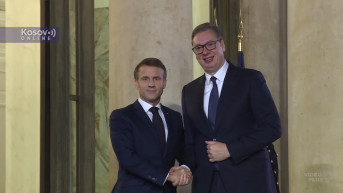
Call for the resumption of dialogue between Belgrade and Pristina and adherence to the agreements made in this process, as well as support for the constructive approach Serbia has shown so far, are the messages that interlocutors of Kosovo Online believe could be heard from French President Emmanuel Macron, who is arriving today for a two-day visit to Serbia. The fact that he will be in Belgrade again within five years is seen as confirmation of the development of bilateral relations between France and Serbia, as well as the personal friendship built by the heads of the two states.
Written by: Dusica Radeka Djordjevic
According to a statement from the Élysée Palace, during his visit, Macron will reaffirm his support for Serbia's European integration, and he will discuss with his host topics such as the economy, healthcare, energy, culture, and artificial intelligence. Although the dialogue with Pristina is not officially listed as a topic, it is certainly expected that this issue will also be addressed.
It is logical that suggestions from Paris, as a co-author of the French-German plan for the normalization of relations between Belgrade and Pristina, will be made on how to unblock the dialogue, which is deeply in crisis. One of the interlocutors of Kosovo Online believes that the time Macron will spend in Serbia should also be used to present Serbia's arguments and interests regarding Kosovo.
Macron himself, speaking about the Kosovo issue, wrote in an op-ed for "Politika" ahead of his visit to Serbia that he will personally remain engaged in the implementation of the Ohrid Agreements, particularly in establishing the Community of Serb-majority Municipalities.
"The path we have proposed towards the necessary normalization preserves the essence: the possibility for Serbs to live in Kosovo while respecting the law, without renouncing their identity or their natural ties with Serbia; but also the existence of guarantees concerning the preservation of Serbian cultural and religious heritage," stated the French president.
Macron arrives in Belgrade amidst announcements from the Kosovo government that it will open the main bridge on the Ibar River between North and South Mitrovica, to which France has already responded in a way, with the Ministry of Foreign Affairs issuing a statement at the beginning of the month strongly condemning the increasingly frequent unilateral actions of the Kosovo authorities in the north of Kosovo, which affect the daily lives of the Serbian community.
Previously, when the Council of Europe debated Kosovo's membership in the organization three months ago, official Paris, along with Berlin and Rome, according to media reports citing diplomatic sources, emphasized in a letter to Kosovo's Prime Minister Albin Kurti that Pristina had not met the conditions set by the international community regarding membership in the Council of Europe, as no concrete steps had been taken towards the formation of the Community of Serb-majority Municipalities. In the end, France requested that the decision on Kosovo's membership be postponed at the meeting of the Committee of Ministers of the Council of Europe.
Aleksandra Kolakovic, a senior research fellow at the Institute for Political Studies, told Kosovo Online that it is extremely important that French President Emmanuel Macron is making his second visit to Serbia during his second term. This visit represents a continuity of France's interest in the Western Balkans and confirms the development of bilateral relations between France and Serbia from 2019 to the present. According to her, this dynamic development of relations between the two countries demonstrates that there is room for further understanding of Serbia's concerns regarding Kosovo, whose independence France has recognized.
"We have seen this in the recent period because France has insisted on respecting the agreements made in the dialogue. The French president himself has put forward his ideas and perspectives on how the issue of Kosovo and Metohija can be resolved. In this context, France's efforts to postpone the discussion on Kosovo's entry into the Council of Europe and its insistence on continuing the dialogue should also be viewed. On the other hand, France also emphasizes the importance of adhering to the roadmap that has already been outlined, which first involves the establishment of the Community of Serb-majority Municipalities, followed by other points. I expect that the message from the French president will be precisely focused on the need to calm the situation, respect what has been agreed upon, and continue the dialogue, rather than escalate violence, as Kosovo and Metohija, along with Bosnia and Herzegovina, are recognized as potentially risky areas for security when we talk about the Balkans," Kolakovic said.
Arno Guyon, the Director of the Office for Public and Cultural Diplomacy in the Government of Serbia, stated that Kosovo is indeed a topic that burdens the relations between France and Serbia, but thanks to the friendship and personal relationship between President Aleksandar Vucic and President Macron, progress has been made.
"For example, because of this, Pristina was not admitted to the Council of Europe in the previous period, as Macron vetoed it. Why? Because Pristina does not respect what has been agreed upon and signed, unlike Serbia. Of course, unfortunately, we cannot expect a significant change in the foreign policy stance of the Republic of France towards Kosovo and Metohija, at least for now. However, this does not mean that we should not cooperate on economic and political levels and in other areas. This cooperation positively impacts our position in Kosovo and Metohija, where we can at least make some progress. It also affects the daily lives of our compatriots in Kosovo and Metohija. We should continue in this direction," Guyon told Kosovo Online.
During the visit of the French President to Serbia, historian Stanislav Sretenovic suggests that the Serbian side could emphasize to France the importance of protecting Serbian cultural heritage in the southern Serbian province and the identity significance of the Kosovo issue for Serbia and its citizens. He also highlights how the international community often violates its proclaimed principles for certain political interests when it supports Kosovo's independence.
However, he cautions against harboring illusions that Macron's visit to Serbia will change France's general stance on the Kosovo issue.
"The French side should certainly be made aware of the double standards where the independence of a self-proclaimed province is supported in the Serbian case, but not in other cases, such as Ukraine. These are arguments that can be presented, and I believe that Serbian diplomacy will do so. While this will not change France's general stance, Serbia might be able to count on greater understanding from the French side regarding its position in UNESCO and the Council of Europe. It is possible to influence the French side at least to consider the Serbian argument concerning the cultural and historical significance of Kosovo for Serbia and its identity significance, and to perhaps gain French support, along with other Latin European Union countries like Italy and Spain, for Serbia's position in UNESCO and the Council of Europe," Sretenovic told Kosovo Online.
As Sretenovic emphasizes, it is important to insist on specific situations, such as ensuring the protection of the Serbian people in Kosovo, preventing further arrests of Serbs for their political views, and addressing concrete issues for the benefit of all citizens.
"From the Serbian side, there will likely be an insistence on implementing what has already been agreed upon, starting with the formation of the Community of Serb-majority Municipalities," Sretenovic says, noting that Macron's second visit to Serbia in five years demonstrates that he views Serbia as an equal partner.
Dimitrije Milic, Program Director of the "New Third Way" organization, believes that among the topics the two presidents will discuss today, there will likely be issues related to the situation in Kosovo, the Ibar bridge, and the overall question of normalizing relations between Belgrade and Pristina within the context of Serbia's European integration.
He adds that Emmanuel Macron is unlikely to criticize Serbia's approach to the dialogue, as there have generally been no criticisms from Macron regarding Serbia's stance on Kosovo.
"It is more likely that we will hear a positive statement regarding Serbia's constructive role, while if there are any criticisms or suggestions, they will probably be directed more towards Pristina, given the tone we have already heard from the French government in recent days. We will have the two leaders addressing the public on the first day of the visit, and we can expect to hear something more detailed regarding the Kosovo issue. I also believe that there will be deeper discussions beyond what the public will see," Milic told Kosovo Online.
Beyond the Kosovo issue, the interlocutors of our portal agree that the key topics of discussion between Macron and Vucic will be economic cooperation and the purchase of "Rafale" aircraft.
"According to the announced program of the French president's visit, he will visit not only Belgrade but also Novi Sad, where he will tour the IT center and discuss the engagement of young people and the issue of artificial intelligence. The key to the relationship between France and Serbia is the transfer of knowledge, experience, and technology. Other important topics will include energy, healthcare, and cultural cooperation, within which Macron will visit the Matica Srpska Gallery," says Kolakovic.
She emphasizes that the arrival of the French president at a time when he is facing an extremely complicated political situation in his own country, just a day after the opening of the Paralympic Games and the commemoration of the 80th anniversary of the Normandy landings, sends a strong message in political, geopolitical, and geostrategic terms, and is in favor of Serbia.
Economy will dominate the discussions during Macron's visit, as noted by Sretenovic, who mentions that French companies in Serbia currently employ around 12,000 Serbian workers.
"Of course, there is room for improvement; other European countries, particularly Germany, employ significantly more Serbian workers. However, this trend is on the rise. French investments have recently encountered some issues that the two presidents will certainly address, such as the situation with Nikola Tesla Airport, which has seen its ups and downs. We will see this resolved with the unveiling of a plaque at the airport by the two presidents. There will likely also be discussions about the Belgrade metro project, which involves some Chinese investments. The French side is very cautious about Chinese capital, and they will certainly seek guarantees from the Serbian side to ensure that these investments are framed by solid legislation in the area of investments," our interlocutor says.
He adds that another likely topic will be the potential sale of French "Rafale" fighter jets, though there is still no confirmation that Serbia will purchase them.
"It's mentioned that around three billion euros have been reserved for these aircraft. If one 'Rafale' costs over 100 million euros, then by that calculation, Serbia would acquire about 25 aircraft. The question arises whether such a number of jets is necessary, but on the other hand, with these aircraft and French investments come personnel, maintenance materials, engineers, and French expertise, which Serbia desperately needs. So, any investment is welcome," Sretenovic notes.
He also recalls that the two presidents have announced discussions on energy, potentially including some form of cooperation in nuclear energy utilization. France has a top-tier electric company, EDF, which is currently the strongest company in electricity production.
Sretenovic highlights that Presidents Macron and Vucic have built a personal friendship, which is highly significant in today's international relations. Macron's visit comes in the context of strong, upward-trending French-Serbian bilateral relations, building on a centuries-old tradition of good relations between the two countries.
During this visit, Milic points out that we can expect more discussions on economic cooperation and the issue of energy, which has become a new topic in the relations between Serbia and France since the last visit of the Serbian president to France earlier this year.
"This will likely be connected to discussions about nuclear energy, considering that France has been engaging with many other countries on this topic, such as Kazakhstan, which will soon have a referendum on building a nuclear power plant on its territory, with French assistance. There's also the issue of arms, particularly the potential purchase of 'Rafale' jets from France, though it is still unconfirmed whether a contract will definitely be signed. What we can see in the international media is that discussions are ongoing, and efforts are being made to remove existing obstacles. This thematic framework will also likely cover artificial intelligence and green energy," Milic explains.


0 comments