
A month since the outbreak of the Middle East conflict – is a new exodus toward the Balkans on the horizon?
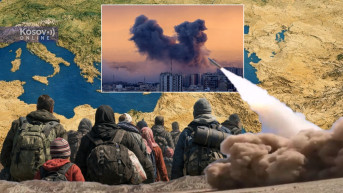
It has been exactly one month since the outbreak of the conflict in the Middle East, and interlocutors of Kosovo Online emphasize that, for now, there are no clear indicators of a new large-scale refugee wave like the one in 2015. However, they warn of long-term consequences for the global economy and migration if further escalation occurs. They assess that Europe is still dealing with the aftermath of the previous crisis, but has also “learned its lesson,” while the Western Balkans remains an important transit route.
Written by: Petar Rosic
A few days after the United States and Israel bombed Iran on February 28, followed by Iran’s retaliatory attacks on countries in the region, the EU warned that the conflict could lead to the largest refugee flows in decades.
A report by the European Union Agency for Asylum (EUAA) on migration states that even partial destabilization in the Middle East could generate refugee flows of unprecedented scale.
International organizations warn that the conflict is already turning into a serious humanitarian crisis and that millions of people are being forced to leave their homes. UNHCR stated that around 3.2 million people have been internally displaced within Iran since the beginning of the conflict, while hundreds of thousands of civilians, including children, have been forced to evacuate to Lebanon due to intense fighting and relocation orders.
Politicians warn: We must be prepared
Numerous European politicians have continuously warned about the risk of a new migration crisis.
Greek Prime Minister Kyriakos Mitsotakis said last week, upon arriving at the European Council summit in Brussels, that the conflict must not lead to a refugee crisis “like the one in 2015,” calling on European partners to send a clear message about protecting the bloc’s external borders.
“We have not reached that point, but we must be prepared for all possibilities,” he said, as reported by the Greek portal Ekathimerini.
Similar warnings were issued by Swedish Minister for Migration Johan Forssell, who stated that the EU cannot afford another refugee crisis like that of 2015, but cautioned that “things can change quickly” if the conflict spreads.
Cyprus’ Deputy Minister for Migration Nikolas Ioannides also warned that the EU “cannot ignore the possibility of a new refugee crisis,” while Slovak Prime Minister Robert Fico posted a video on social media warning that the attack on Iran creates a significant risk of a large-scale refugee crisis.
Analysts: Early stage of the conflict
Although indicators on the ground point to a potential deterioration of the situation, Radoš Djurovic, Director of the Center for the Protection and Assistance of Asylum Seekers, assesses that this is still an early phase of the conflict and that there are no signs of a scenario similar to 2015, when the Balkans was the main migration route.
“This is only the initial phase of hostilities, so it is difficult to make long-term predictions. What is certain is that there are attacks on civilian infrastructure. In the past two weeks, oil and gas depots, warehouses, industrial zones around major cities, and ports have been targeted—everything necessary to ensure the uninterrupted flow of goods, food, the functioning of society, electricity, and fuel,” Djurovic told Kosovo Online.
He points out that there are currently serious indicators of internal displacement within Iran and that, despite negative signals, there is still no significant outflow of people across borders, especially not from Iran.
“When it comes to people leaving Iran, this is currently a controlled outflow. The Iranian state generally does not allow people to leave, except those with dual citizenship. Neighboring countries are also quite restrictive and are trying to prevent any uncontrolled outflow. Turkish controls are also in place, queues are forming at the borders, but nothing dramatic,” Djurovic said.
Speaking about possible scenarios, he warned that further escalation could have long-term consequences.
“Will there be a refugee crisis? It is possible if the war intensifies further, particularly with continued attacks on civilian infrastructure or the disintegration of the state and its institutions. In such a scenario, the Middle East could become a generator of refugee flows over a longer period, even up to a decade. It should be emphasized that at least 12 million people live in and gravitate toward western Iran alone,” he noted.
Secondary consequences for the Balkans
According to him, even in the event of deterioration, the Balkans would not be at the forefront.
“The Balkans would feel the secondary effects of such population movements—not through an exodus like the one when tens of thousands of people crossed our borders daily, but rather through smuggling networks and the continuous movement of people toward Western Europe,” he said.
Djurovic recalls that the European Union today has more experience in crisis management.
“Europe has learned from the refugee crises since 2015, and the war in Ukraine has further tested European countries, when more than eight million people were received within a month. The principle of solidarity was upheld. Even today, around four million people remain in EU countries, and reception and integration systems are functioning very well,” he stated.
He added that this demonstrates that when countries are willing to accept refugees or seriously address the issue, they have the capacity to respond.
As for Serbia, he believes that capacities are insufficient for larger crises.
“I would not say that Serbia is ready for any major influx of people. Out of 19 camps that once operated, today we have six officially open, of which four are operational, while the others are inactive. There is a response plan, but we only have temporary accommodation, which would suffice only for short stays and the quick transit of people across our territory,” he said.
He also sees an additional challenge in regional cooperation.
“In the south we have North Macedonia, the territory of Kosovo, Bulgaria, and Albania, where it is difficult to expect that readmission would function or that there would be solidarity. Therefore, in a worst-case scenario, the situation for us would be very serious if people arrived in larger numbers and stayed. However, all indicators suggest that if inflows occur, they would be gradual, with people quickly moving onward with the help of smugglers, rather than arriving in large waves over a short period,” Djurovic concluded.
Every migration crisis is difficult in itself
A similar level of caution is expressed by university professor Trpe Stojanovski from Skopje, who emphasizes that migration waves are not yet certain at this stage and that they typically remain in neighboring countries first. However, if conflicts persist and living conditions further deteriorate, a broader migration crisis cannot be ruled out.
“Every migration crisis is difficult in itself. Leaving one’s home creates problems, and we most often define this as a refugee crisis. Refugees usually seek shelter in areas close to their country. If they opt for longer journeys, they may end up in other parts of the world. Europe is one of the preferred destinations, but I repeat—at this moment there are no indications that a new migration crisis is imminent, let alone that it would affect Europe,” Stojanovski said.
He notes that the consequences of the 2015–2016 migration crisis in Europe are still being felt today.
“Since 2015 and 2016, Europe has been one of the key destinations and, as such, still feels the consequences of opening its borders to refugees from Afghanistan, Syria, Iraq… This issue is not only economic but also political and social, and many aspects of that crisis remain relevant today. In many European countries, elections are won or lost on migration issues. There are states with stricter approaches, such as Hungary, Slovakia, the Czech Republic, and Poland, and such policies will likely continue,” he points out.
He believes Europe has partially absorbed lessons from previous crises.
“Europe has learned certain lessons, but it cannot fully implement solutions when it comes to migrants and refugees. The European Pact on Migration and Asylum has introduced stricter standards and regulations to reduce migrant arrivals in the EU. In that regard, the Balkan route—on which North Macedonia lies—is particularly important. Since 2016, many lessons have been learned and are being applied along this route,” the professor said.
A transit zone toward Western Europe
On the other hand, President of the Kosovo Business Alliance Agim Shahini warns that the consequences may be delayed and that larger migration flows could occur after the conflict ends due to economic devastation in affected countries. He assesses that the Balkans, including Kosovo and Serbia, could again become a transit zone toward Western Europe.
“We still do not have migration from Arab countries because there is a state of war and people cannot even move. However, when the war ends, people will have nowhere to return to—they will have nothing to eat or drink,” he said, noting that around 80 percent of food products in those countries are imported, while about 20 percent of petroleum derivatives are exported.
Because of this, he warns of a major crisis that may emerge after the war ends.
“There will be a major crisis there after the war, and for us the crisis is already significant while the war is ongoing, as we are facing increased fuel prices,” he added.
Asked about the possibility of a new migration wave, Shahini assessed that Europe is not fully prepared.
“Europe, as we see, is not even fully prepared for war. If a new migration wave occurs, each country will handle it in accordance with its own laws,” he said.
He concludes that the Balkans, including Kosovo, will likely again serve as a transit zone.
“Kosovo is small, but we already have migrants from various countries, especially from Arab states. The same situation exists across the Balkans. Serbia will be a transit country, as will Kosovo, because they all intend to go to Germany and other countries where living conditions are better,” Shahini concluded.


comments