
Illegal migration and organized crime – Security challenges of the Western Balkans
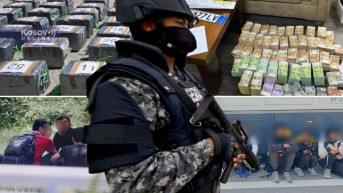
The crisis in the Belgrade–Pristina dialogue, tensions in northern Kosovo, and within Bosnia and Herzegovina are just part of the broader security challenges facing the Western Balkans. According to experts in this field, illegal migration and organized crime remain the region’s key problems.
Written by: Djordje Barovic
In a recent security assessment, the Global Peace Index website ranked all Western Balkan countries in the middle tier out of 163 countries analyzed.
Each country was evaluated using 23 parameters, including “relations with neighboring countries,” which is why Serbia, Kosovo, and Bosnia and Herzegovina were each given three out of a maximum of five negative index points.
On the list, Montenegro ranks highest among the countries in the region that are not EU members.
Globally, Iceland, Norway, Finland, Japan, and Singapore are the top five safest and most peaceful countries, while Russia, Ukraine, and Sudan rank at the bottom.
On the other hand, Europol identifies the Western Balkans as key for illegal arms trafficking to the EU and as one of two primary migration corridors to the EU.
The Global Initiative Against Transnational Organized Crime emphasizes that Europol, Frontex, and other international migration agencies have reported an increase in migrant smuggling.
“What stands out in the current situation is the increasing involvement of various international actors, often migrants themselves. Criminal groups now include smugglers from Iraq, Syria, Afghanistan, Morocco, Algeria, Turkey, and the Netherlands, who work across borders to coordinate the movement of migrants from conflict zones toward Europe,” the report warns.
Regional Challenges
Experts interviewed by Kosovo Online also stress that illegal migration and organized crime are key issues for the Western Balkans.
Nikola Vujinovic, a security studies researcher from Belgrade, points out that the region is essentially facing two real and one artificial security challenge.
“The two real challenges are illegal migration and organized crime. These two problems, though varying in intensity, dominate the political and security agenda in every country in the region,” Vujinovic tells Kosovo Online.
He identifies the “threat of malign Russian influence” in the Balkans as an invented security issue.
“To justify the two real problems to political elites in North Macedonia, Bosnia and Herzegovina, Croatia, or Montenegro, a ‘malign Russian influence’ is fabricated. In BiH, migration issues are becoming increasingly pressing, especially after the UK decided to send some migrants there. Even Kosovo has been listed as one of the destinations for those migrants,” he notes.
He explains that the arrival of migrants is particularly concerning when it comes to Kosovo.
“It is a highly problematic security area,” Vujinovic emphasizes.
Copenhagen Criteria
Lulzim Farizi, a political analyst from Skopje, claims that crime and corruption are currently the key problems for the Western Balkans.
“Throughout the Western Balkans, in all countries in the EU accession process, crime and corruption are the main reasons why many NGOs give them low rankings,” Farizi tells Kosovo Online.
Regarding Kosovo, he believes the main problem is that it does not meet the Copenhagen criteria.
“The key issue is the failure to meet the Copenhagen criteria, which include the rule of law and guarantees of regional peace. On top of that is the ongoing dispute with Serbia. All of this negatively impacts Kosovo’s rankings in security indices,” Farizi stresses.
Reality on the Ground
When it comes to Kosovo, security expert Hisen Gecaj adds another problem – tensions in the north and the international community’s stance on the actions of the authorities in Pristina.
“We need to be realistic and look at the situation on the ground. In the last three to four years, we’ve seen unrest in northern Kosovo, accompanied by an increased police presence, especially in North Mitrovica. The international community has not agreed with this, as it considers that part of Kosovo a political issue rather than one of law and internal order,” Gecaj tells Kosovo Online.
He emphasizes that every action in northern Kosovo must be coordinated with international actors, or it will escalate and spill over into the region.
“Given the political lens through which the situation is viewed, if the state takes action with the intent, as the Prime Minister says, to ‘calm the situation,’ without coordination with international actors, it will immediately be seen as a potential cause of unrest, dissatisfaction, insecurity, and regional instability. If conflict arises between Kosovo police and the local Serbian population in the north, the political situation will further deteriorate,” Gecaj explains.
Economy and Investment
The way out of the security and political problems facing the Western Balkans lies in investment and economic development, says political analyst Ben Andoni from Tirana.
“These challenges exist in every country in the region, but the situation seems calmer,” Andoni tells Kosovo Online.
He notes that strengthening economies and boosting investment contribute to stability, with Montenegro serving as a good model for such a strategy.
“Despite its numerous problems, Montenegro knows how to manage concerns and ease tensions through economic means. Tourism and other investments have a major impact on the country, helping to overshadow political issues, which are also quite serious,” Andoni notes.
Analyzing the regional situation, he says that after the change of government in North Macedonia, the country is now in a “status quo.”
“To be fair, (Hristijan) Mickoski has contributed to technical issues within North Macedonia, but he gains credit for fighting corruption and encouraging domestic investment,” Andoni believes.
He recalls that North Macedonia was the first to sign the Western Balkans Growth Plan agreement.
“This shows that North Macedonia is more focused on domestic issues and improving the well-being of its citizens, leaving the political aspect aside. That’s because the previous leftist government’s corruption left Mr. Mickoski with plenty of room to continue his agenda,” Andoni concludes.


0 comments