
New police stations in the north: Does it smell like 'rain or a storm'?
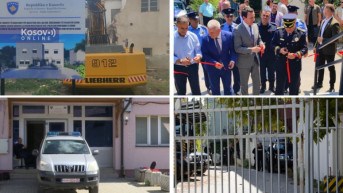
Springing up like mushrooms after the rain, although Serbs in the north claim the more fitting phrase is 'springing up after a storm.' In the past year, dozens of military and police bases have been established in northern Kosovo, and after taking over Serbian institution buildings, that number is set to increase significantly as these buildings are repurposed into police stations. For the sources speaking to Kosovo Online, the increasing number of police stations in the north sends a clear message: the authorities in Pristina want to keep this part of Kosovo under control at all costs.
Written by: Arsenije Vuckovic
Last week, the Kosovo police signed a €1.1 million contract for the construction of a police station in Zubin Potok. Prior to that, Prime Minister Albin Kurti attended a ceremony laying the foundation stone in Lesak, with similar events taking place earlier.
Following the takeover of the Temporary Administrative Bodies in four northern municipalities, it was announced that most of these buildings would house police stations.
At the same time, over the past three years, 4,808 hectares of land have been expropriated for the needs of the Kosovo Security Forces. This year, the KSF was also given the former Dumoshi airport, a space of around 48 hectares, where a base will be built, located about 15 kilometers from the border with Serbia.
The European Union Office in Pristina stated in May last year that it was aware of the preliminary decision by the Kosovo Government regarding the expropriation of land for public interest in the municipalities of Leposavic and Zubin Potok, and it urged the Kosovo authorities to strictly adhere to legal procedures when expropriating immovable property.
The establishment of four Kosovo police bases on land owned privately and publicly, in some cases before expropriation procedures even began, has raised concerns regarding property rights in northern Kosovo, which institutions must address appropriately.
Professor of Constitutional Law at the University of Pristina, Mazlum Baraliu, stated in August for Kosovo Online that the construction of police stations and bases in northern Kosovo is a security matter and that it came about because Serbia 'behaved aggressively.'
'This is a security issue. Serbia behaved aggressively. They committed aggression, and it was a military aggression, not terrorist but state aggression. There are about five or six police sub-stations in Socanica and other places, and this is for the benefit of all citizens, as all citizens were endangered,' Baraliu said after Prime Minister Kurti ceremonially opened a new police station in Socanica."
This article describes the rapid expansion of police and military infrastructure in northern Kosovo, a region marked by long-standing tensions between local Serbs and the Pristina government. The increase in police stations, often built on expropriated land, is seen by Pristina as necessary for maintaining security, though local Serbs interpret it as an attempt to exert control, raising concerns about property rights and local autonomy.
(Dis)Trust of Serbs
Miodrag Milicevic, Executive Director of the NGO "Aktiv" from North Mitrovica, stated in an interview for Kosovo Online that the authorities in Pristina are trying to make a clear departure from the Brussels Agreement through the establishment of police stations in northern Kosovo.
Commenting on the €1.1 million tender for the construction of a new police station in Zubin Potok, Milicevic emphasized that while the procedures and mandate of the police should not be in question, the key issue is the change in the ethnic composition of the police in the north and the trust that the local population has in it.
"This is not just about a single police station, if we are only talking about the latest tender for the construction of the police station in Zubin Potok, nor about the mandate the police are supposed to implement. That is unquestionable and defined by law. The bigger question is the trust of the local population in the police. And the question of all questions is the change in the ethnic composition of that same police force in northern Kosovo, something not only our organization has pointed out over the past year and a half to two years. Simply put, the ethnic makeup has been completely altered, and this goes against what was agreed upon in Brussels. There is a persistent attempt, at least from the Kosovo side, to distance themselves from the Brussels Agreement and from what was signed and agreed upon," Milicevic stressed.
This statement highlights concerns among local Serbs about the shifting ethnic composition of the police forces in northern Kosovo and how this shift is perceived as a move away from the commitments made under the Brussels Agreement. The trust of the local Serbian population in the police is seen as critical, and the changes are viewed as contributing to a sense of unease and distrust in the authorities.
Miodrag Milicevic adds that Pristina is trying to present the situation on the ground as different compared to previous periods. For this reason, he stresses, there is little need to speculate about what the Serbs in northern Kosovo think or hope for regarding this topic.
"Reality reminds us just how bad the security situation is. Unlike two years ago, today we have seven permanent police bases, or rather, special police bases. There is a significant presence of that same police force, which is linked to numerous incidents," Milicevic points out.
He also notes that there is widespread concern, and the issue is not only about constant detentions or arrests.
"There is general concern, especially recently, among the younger female population of our society, who are increasingly complaining about harassment, either from known civilians or, in some cases, members of the Kosovo police," says Milicevic.
He also mentions the growing number of arrests of political activists.
"These are all situations that exist in a gray zone and require an urgent reaction, but such reactions are not forthcoming. If you're asking me from whom, the reaction should primarily come from the international community, which, in my personal belief, is now obliged to publicly declare whether the Brussels and Ohrid agreements are still in effect, and if they are, what the next steps are toward de-escalation. This was discussed a lot last year, but little to nothing has been done," Milicevic concludes.
Rising Tensions
Vuk Velebit, Executive Director of the Pupin Initiative, highlights that the increasing number of police stations and bases in northern Kosovo is the result of Albin Kurti’s destabilizing policies, aimed at provoking new tensions and intimidating the Serbian population.
"Albin Kurti's extremist, anti-Western, and destabilizing policy aims precisely at continuously raising tensions. It continuously creates unlivable conditions for the Serbian community. When you look at it, these bases are often built through the expropriation of land from Serbs living in Kosovo and Metohija, directly targeting one people and one ethnic group," Velebit told Kosovo Online.
This narrative reflects a deep concern among the Serbian population about the rising number of police stations, the changing security dynamics, and perceived targeted actions against them, all contributing to an atmosphere of fear and distrust. Both Milicevic and Velebit emphasize the lack of a clear response from the international community and the potential escalation of tensions in the region.
Vuk Velebit further emphasizes that the special police bases in northern Kosovo are intended to intimidate ordinary citizens.
"I recently had the opportunity to visit the northern part of Kosovo and saw what these bases look like. I saw the Kosovo police, heavily armed, controlling the traffic. This is being done without any justification, violating both international agreements and coordination with the international community. Kurti continues to escalate tensions, and I expect him to keep doing so in the coming months as Kosovo's elections approach and as we enter the final stages of the U.S. elections," Velebit notes.
He believes the solution lies in greater willingness from the international community, particularly the EU and the U.S., to sanction Albin Kurti's "extremist policies," which he claims are "directly opposed to the interests of both the EU and the U.S."
Velebit sees the increasing number of police stations and bases in the north as both a symbolic and direct message to Serbs that they should feel even less secure.
"I think it’s both a symbolic message to the Serbs and a very concrete action designed to make them feel even less safe. When Serbs see the Kosovo police on the streets, they feel insecurity, which is not normal. When you see the police, you should feel secure, knowing they are there to protect you and maintain public order. But when you see heavily armed Kosovo police, you can only feel afraid of them and think that the police are there for you—but not to protect you, rather to make you feel insecure and unsure about their actions," Velebit explains.
He adds that he has heard from the Serbian community that the police in the north not only use excessive force and detain citizens without reason but also verbally insult them.
"What we've heard from the Serbian community in Kosovo is that the police verbally insult members of the Serbian population, use excessive force, and often act outside the law, even Kosovo's own laws. There are Serbs who have been arrested and are being held without any charges. Such selective law enforcement and actions by the Kosovo police have only one goal, and that is to intimidate the Serbian people in Kosovo and Metohija," Velebit concludes.
Symbolic (and other) Messages
Srđan Barac, an associate of the Center for Social Stability, argues that the increasing number of police stations in northern Kosovo is no longer just a symbolic message from the Pristina authorities, but rather a clear intent to assert control and create additional tensions in the four predominantly Serbian municipalities.
"It’s no longer just symbolic messages in Kosovo and Metohija, particularly in the northern part where Serbs are the majority. In that area, Pristina's political leadership—or, let's say, the Albanian factor—has not yet exercised real authority. The construction of these police stations and all the other measures taken over the past year aim to show the Serbs that Pristina will gain substantive and factual control over the north. The other effect, which is also not hidden or symbolic but essential, is the creation of a tense atmosphere to provoke an incident. They need an incident. Riding the wave of such an incident gives them the opportunity to advocate for their cause in European or global public opinion," Barac told Kosovo Online.
Barac’s analysis underscores how the increasing police presence in northern Kosovo is seen by the Serbian population as part of a broader strategy by the Pristina government to assert control over the region, further escalating tensions.



0 comments