
The number of murders in August is alarming: Has the security situation in Kosovo deteriorated?
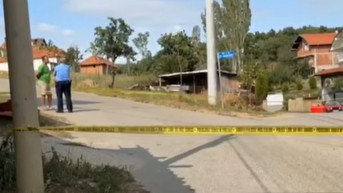
The number of murders in Kosovo has risen in recent weeks, with the case that drew the greatest public attention being the killing of three people in Gnjilane. According to our interlocutors, the deterioration of the security situation is felt most acutely by the Serbian community, particularly in northern Kosovo, while experts view this as an alarm bell calling for cooperation at all levels and an increased presence of Kosovo Police officers on the ground.
Written by: Milena Miladinovic
Five people were killed in August — three in the Gnjilane shooting, one in Ajvalija, while another person in Prizren died from injuries sustained in a knife attack.
Kosovo Police processed two individuals in three of the cases, while the main suspects in the Gnjilane killings remain at large. Police have issued arrest warrants for Mefailj Shkodra and his two sons, Edonis Shkodra (25) and Endzjul Shkodra (22).
The Gnjilane case stirred public outrage, given that Mefailj Shkodra had shared photos on social media with Kosovo President Vjosa Osmani, acting Prime Minister Albin Kurti, and acting Interior Minister Xhelal Sveçla.
According to security experts, the rising number of crimes resulting in death is a clear alarm for greater cooperation and coordination at all levels, as well as for inevitably increasing the presence of Kosovo Police on the ground. Interlocutors of Kosovo Online emphasize that the security situation in Kosovo has indeed worsened and that this is felt most strongly by Serbs, especially in northern Kosovo, where, in their view, the number of attacks has increased.
However, they note, these attacks most often come from the Kosovo Police, who are supposed to protect them.
A “Party Police” under Kurti’s Government
Milan Radojevic, candidate of the Serb List for mayor of North Mitrovica in the upcoming local elections, stated that the issue of security and the functioning of the Kosovo Police has become crucial during the tenure of acting Prime Minister Albin Kurti.
“The question of security and the role of the Kosovo Police has become central during Kurti’s government. With his arrival in power, the Kosovo Police turned into a purely party-controlled police force under Kurti’s government, because it is directly overseen by Interior Minister Xhelal Sveçla, although by law this is not possible, as responsibility should lie with the Police Director. International organizations that once carried out direct monitoring of the police also bear responsibility. At that time, the work of the Kosovo Police was much better,” Radojevic told Kosovo Online.
He added that the security situation, particularly in northern Kosovo, has worsened, but that statistics fail to reflect this — which, he argued, reveals the way cases of attacks on Serbs are treated.
“When it comes to security, the best witnesses are the Serbs in Kosovo and Metohija. For them, security has been endangered during Kurti’s government. Unfortunately, the Kosovo Police often fail to rise to their tasks and do not respond appropriately. Statistics are misleading because, according to Kosovo Police records, there are virtually no cases categorized as violence against minorities, ethnically motivated crimes, or hate crimes. Yet we witness daily attacks on Serbs across Kosovo, particularly in the last two or three years in the north,” Radojevic said.
He stressed that most of the attacks on Serbs come from the Kosovo Police themselves, who always find justification for their actions, while the EULEX mission observes silently.
“As in the recent incident in the village of Vucak, Kosovo Police officers always have some so-called justification for their actions, while Serbs are told to turn to the Police Inspectorate. Unfortunately, the lack of professionalism of the Kosovo Police is compounded by the international community, which no longer monitors or oversees their work as before. I refer primarily to the EULEX mission, which is static and fully justifies every move made by the Kosovo Police,” Radojevic said.
He pointed out that EULEX has never responded to letters from NGOs in the north that complained about police misconduct, and therefore, he added, EULEX bears part of the responsibility for the poor security situation in northern Kosovo.
Criminal Groups Shielded by Police
Security studies researcher Nikola Vujinovic agreed, stating that the Serbian community in Kosovo feels the greatest pressure in terms of security.
“When we look at general crime statistics in Kosovo and Metohija, they show a decline. But the subjective perception, especially among the Serbian political community, is negative. Serbian women, Serbian youth, are under daily pressure not from criminals, but from the Kosovo Police,” Vujinovic told Kosovo Online.
He stressed that the Serbian community is the main target of all groups in Kosovo.
“This is part of a struggle, but not a struggle for the rule of law. It is a struggle for an ethnically pure Kosovo, particularly in the north. This is political violence against the Serbian community. We have the case of the village of Vuca, where children on an excursion were harassed by Kosovo Police patrols with long-barreled weapons. This is a blatant example of political violence,” he said.
He added, however, that there has been a significant rise in the most serious crimes across Kosovo this summer.
“In Gnjilane, Lipljan… whether this is due to the ongoing economic or political crisis, I cannot say, but it is a fact. Last year, 17 people were killed in all of Kosovo and Metohija. In just the past few weeks, a quarter of that number occurred. I expect the statistics to reflect this — the numbers will be worse than before,” Vujinovic stated.
Regarding the murders in Gnjilane, where the suspects remain at large, Vujinovic said the fact that one of them had close ties to Kosovo officials shows that certain individuals are protected.
“The Gnjilane case shows that the killer had ties with the Kosovo President and Government. This demonstrates that there are protected individuals, and that various criminal groups have their own police, instead of the police fighting against them,” he concluded.
Strategy and Coordination
Security expert Avni Islami stated that improving security in Kosovo requires coordinated measures by all institutions, including the development of a crime-prevention strategy. He particularly emphasized the importance of increasing the presence of police patrols on the ground.
“All Kosovo institutions should develop strategies, not just those empowered by law enforcement such as the police. Municipal mayors, councilors, NGOs, the Prime Minister, ministries, the Emergency Management Agency — all must be active in monitoring citizen movement and gathering places,” he said.
Islami argued that the number of police officers on the ground, both in uniform and in civilian clothing, must be increased. In this way, he said, potential offenders would not feel safe.
“Static checkpoints should be established by the police, and it is particularly important for the police to patrol on foot rather than only in cars, as the uniform has its own effect. It is also necessary to increase both the number and efficiency of plainclothes police. Those considering committing crimes, or who have already committed them, should not feel secure, whether it be robbery or another murder,” Islami concluded.



0 comments