
The path of Serbian Statehood – From the Sretenje Constitution to the Kosovo question
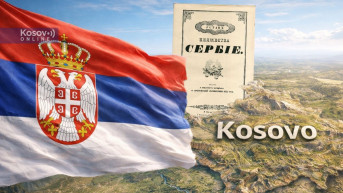
On Sretenje (Candlemas) in 1835, by adopting the Sretenje Constitution, Serbia began the process of building a modern state founded on the principles of civil rights and equality before the law. That document marked a turning point in Serbia’s development, but it also opened a long constitutional process that shaped the country’s internal organization in the decades that followed. After the Second World War, the Kosovo question was also opened, and the political and legal consequences of the decisions made at that time, historians told Kosovo Online, are still being felt today.
Written by: Petar Rosic
On February 15, Serbia celebrates Statehood Day in remembrance of two important historical events — the day when the First Serbian Uprising began in Orasac in 1804 and the day when the Sretenje Constitution was adopted in Kragujevac in 1835, one of the most democratic and liberal constitutions of its time.
Its main provisions were inspired by the liberal ideas of the French Revolution and European constitutions of that period. Legislative, executive, and judicial powers were clearly defined; the Constitution guaranteed fundamental freedoms, including the protection of private property and personal rights; many feudal elements were abolished; and for the first time a representative body was established with certain legislative functions.
Ahead of Its Time
Although it was in force only briefly, the Sretenje Constitution left an indelible mark on Serbian history and marked the beginning of modern constitutional law, historian Aleksandar Gudzic told Kosovo Online.
“The Sretenje Constitution is certainly an important date in the modern history of the Serbian people. By adopting it, the political elites of the Principality of Serbia, that is, the Serbian state, sought to place Serbia and the Serbian people among the ranks of modern, civilized European nations,” Gudzic emphasized.
According to him, it was an exceptionally advanced act for its time.
“It was a progressive constitution, one of the most advanced of that era. Naturally, the great powers opposed it — primarily Austria-Hungary, Imperial Russia, and the Ottoman Empire — because they did not wish, as was said in diplomatic circles at the time, to have a ‘French preserve in a Balkan forest,’” Gudzic noted.
He recalled that international opposition was used as grounds for abolishing the constitution.
“Prince Milos Obrenovic used the opposition of the great powers to suspend the constitution. Nevertheless, the adoption of the Sretenje Constitution remains an important milestone in the formation of the modern Serbian state,” Gudzic said.
Speaking about the circumstances of that time, historian Aleksandar Savic, Assistant Professor at the Department of History of the Faculty of Philosophy in Belgrade, told Kosovo Online that the internal struggle between Prince Milos Obrenovic and his political opponents resulted in a rebellion that forced him to adopt the constitution in 1835. Dimitrije Davidovic played a prominent role in drafting it.
“Serbia believed it had the right to adopt a constitution as an autonomous province of the Ottoman Empire, and Prince Milos was persuaded of this by Dimitrije Davidovic, one of the most educated Serbs of that time, originally from Austria-Hungary but in the service of Serbia since the 1820s. Davidovic drafted the constitution in some twenty days, but of course he had previously worked on constitutional drafts and had extensive material prepared,” Savic explained.
Opposition of the Great Powers
According to him, the constitution was proclaimed at a special assembly held on Sretenje, from which it derived its name, although it was not formally adopted on that holiday.
He also pointed to the reasons why the great powers opposed its adoption.
“The great powers, primarily the Ottoman Empire as Serbia’s sovereign, believed that Serbia had exceeded the limits of its autonomy and did not wish to allow it. Russia, as the protector and guarantor of that autonomy, joined in opposition. Austria also joined, considering it dangerous, since it was not itself constitutionally organized,” Savic said.
He recalled that the constitution was also criticized because of certain provisions.
“Particularly contentious were the articles concerning equality of all citizens before the law and the provision that any slave who set foot on Serbian territory would become free,” Savic noted.
The historian emphasized three key characteristics of the Sretenje Constitution.
“The significance of that constitution lies in the fact that it was the first Serbian constitution, that it limited the absolutist rule of Prince Milos, and that it was adopted without the consent of the sovereign and the protector. Although it restricted Milos Obrenovic’s authority, he nevertheless believed it should be defended against the great powers, but he was ultimately forced to suspend it,” Savic said.
The Kosovo Question Opened After the Second World War
After the Sretenje Constitution, Serbia adopted more than ten constitutions that significantly influenced the country’s further development and internal relations. In the context of Kosovo, the constitutions adopted after the Second World War are particularly important.
“The 1963 Constitution and the 1974 Constitution certainly shaped Kosovo and produced the problem, the consequences of which we continue to feel today,” he said.
Gudzic also referred to earlier constitutional acts that established autonomy.
“It is important to mention the first post-war constitution, when the autonomy of the Kosovo-Metohija region was formally structured. Each subsequent constitution only increased the degree of autonomy of Kosovo Albanians, ultimately resulting in open separatism and aspirations for secession,” Gudzic assessed.
He pointed out that these constitutional changes had long-term consequences.
“This ultimately contributed to the wars over the Yugoslav legacy in the 1990s and later, in 2008, when Kosovo unilaterally declared independence,” Gudzic concluded.
Savic also reminded that Kosovo did not exist as a separate entity before 1945.
“The territory of Kosovo and Metohija was part of the Ottoman Empire until 1912, after which it was incorporated into the Kingdom of Serbia, and in the Kingdom of Yugoslavia, that is, the Kingdom of Serbs, Croats and Slovenes, it did not exist as a separate unit, although certain constitutions applied to that territory,” he said.
He explained that the constitutional history of Kosovo begins after the Second World War, when in 1945 the Autonomous Kosovo-Metohija Region was established by law of the National Assembly of Serbia.
This was confirmed by the 1946 Constitution of the Federal People’s Republic of Yugoslavia and the 1947 Constitution of the People’s Republic of Serbia, and further development, he noted, led to the formation of a province.
“In line with the intentions of the Communist Party of Yugoslavia, that is, the League of Communists of Yugoslavia, the aim was for the Autonomous Kosovo-Metohija Region to evolve over time into an autonomous province, similar to Vojvodina. The culmination of that process was the 1963 Constitution,” Savic stated.
He added that constitutional changes in the late 1960s and early 1970s further transformed the province’s status.
“Through constitutional amendments, the name of the province was changed and ‘Metohija’ was removed. This was objectionable to the Albanian leadership. They believed it should be called Kosovo and Dukagjin. Belgrade did not agree, and a compromise solution was reached for it to become simply Kosovo, that is, the Socialist Autonomous Province of Kosovo. The culmination of that process was the 1974 Constitution, when the autonomous provinces of Kosovo and Vojvodina were equalized in status with Serbia,” Savic said.
He emphasized that this undermined Serbia’s sovereignty as one of the federal units and that from 1974 Serbia was officially divided into three parts.
“Serbia no longer had any real authority over them; it had it formally in legal terms, but not de facto, and thus the sovereignty of Serbia as one of the federal units was undermined,” Savic stated.
Restoration of Competences
Savic pointed to attempts to correct this through constitutional amendments in the late 1980s.
“Through the constitutional amendments of 1989 and 1990, Serbia partially restored its authority over the territory of Kosovo and Metohija, and at that time the full name of the province was reinstated. Since then, it has been referred to as Kosovo and Metohija, both in the 1990 Constitution and in the Constitution adopted by the Republic of Serbia in 2006,” he said.
Finally, he noted that since then it has officially been regarded, in accordance with the constitutions, as an integral part of the Republic of Serbia.
“Hence the expression ‘the southern Serbian province.’ However, the fact remains that in public discourse the term Kosovo increasingly prevails, and we should nevertheless retain that official designation and uphold, as stated in the Constitution, that this is the territory of Kosovo and Metohija,” Savic concluded.




0 comments