
Possible elections and dialogue with Belgrade: The old–new excuse for the absence of the Community of Serb-majority Municipalities
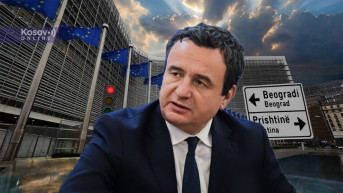
If the political knot in Kosovo in the first weeks of spring is cut by calling yet another snap election, the dialogue between Belgrade and Pristina will remain in hibernation. Brussels will, according to interlocutors of Kosovo Online, convene technical rounds of talks in order to formally maintain the image that the process continues, but under such circumstances there will be no substantive negotiations, nor implementation of previously unfulfilled agreements. Political opponents of Kosovo Prime Minister Albin Kurti even advance the thesis that avoiding the implementation of the agreements reached in Brussels is the very reason why Kurti is once again leading Kosovo to the polls.
Written by: Dusica Radeka Djordjevic
Only a month has passed since the High Representative of the European Union for Foreign Affairs, Kaja Kallas, congratulated Albin Kurti on the election of a new government and stated that she was ready to soon host a high-level meeting within the framework of the dialogue with Belgrade, yet political parties in Pristina already have one foot in a new pre-election campaign.
Without a winning combination for the election of a president, Kosovo has found itself on the verge of yet another parliamentary election.
Kurti said today that it would be neither correct nor useful to go to new elections. However, if the forecasts of those who see elections as inevitable come true, the dialogue in the coming months is unlikely to record any results, while a government in a technical mandate will have an old–new alibi as to why it is not initiating the process of forming the Community of Serb-majority Municipalities (CSM).
Former MP of the Alliance for the Future of Kosovo Semsedin Dresaj believes that Prime Minister Albin Kurti is leading Kosovo toward elections precisely because of his unwillingness to implement the Ohrid Agreement on the CSM.
“He was seeking a coalition partner who would take over the ‘hot potato’, but this time such a partner was not found, which again led to elections,” he stated.
Similar accusations were voiced by Democratic League of Kosovo MP and former Prime Minister Avdullah Hoti. In his assessment, Kurti is provoking crises and leading Kosovo toward a third election because he wants to avoid the international obligations he undertook in Brussels and through the Ohrid Annex.
If snap parliamentary elections are called, according to Stefan Surlic, Assistant Professor at the Faculty of Political Sciences in Belgrade, this will serve as yet another excuse to postpone the dialogue with Belgrade on normalization of relations and to avoid concrete solutions.
Surlic assumes that in the event of elections there would still be dialogue at the technical level in the form of meetings between negotiating teams, so that Brussels could at least formally preserve the appearance that the process continues and maintains continuity.
“But in reality, for years we have had nothing substantial that is the product of the dialogue. Above all, there has been no concrete progress in the implementation of the Community of Serb-majority Municipalities in Kosovo, because we see that all other issues within the dialogue depend exclusively on whether the framework for those topics will be the Community of Serb-majority Municipalities,” Surlic told Kosovo Online.
Regarding assessments that Kurti is leading Kosovo toward new elections because he lacks the will to implement the CSM agreement, Surlic says that several factors are at play.
“The first factor is certainly to push the dialogue aside and continue with unilateral and excessive actions in northern Kosovo. The second goal was to sideline Vjosa Osmani, who has nevertheless gained a certain additional leadership credibility, and the third is to consolidate absolute power so that neither the Serbs nor the Albanian opposition in Kosovo represent an obstacle to him,” he emphasized.
However, Surlic does not believe that if elections take place their outcome will be favorable for Kurti in the sense that he will repeat the result achieved in the previous elections.
“I think he is aware of that, and most analysts who closely follow this situation say that at this moment he has overplayed his hand because he has put many cards on the table, including the dialogue with Belgrade and the continued persecution of Serbs in Kosovo,” Surlic said.
Former Kosovo ambassador to Albania Silje Ukshini believes that this year will pass without any substantive dialogue if Kosovo again goes to elections, as well as because of, as he says, the internal political situation of Aleksandar Vucic.
“I think that 2026 will be completely lost due to internal circumstances. The only thing that might happen are sporadic meetings between the parties, just enough to control the situation and to say that Serbs and Albanians are negotiating in Brussels, but not in order to achieve progress on specific points,” Ukshini told Kosovo Online.
He emphasizes that the dialogue between Pristina and Belgrade has stalled since the Ohrid Agreement was reached and that he is not optimistic that the agreement can be implemented.
The EU, he adds, is focused on the war in Ukraine rather than on this dialogue.
“The developments following the Ohrid Agreement represent a failure of the EU because of the way it was prepared. On the other hand, neither Kosovo nor Serbia have shown much willingness to implement the Ohrid Agreement. Vucic spoke about the Association, Kurti demanded a signature, which means they were passing the ball to each other. In other words, there were no parties ready to implement the agreement. Nevertheless, the EU made major promises because the agreement followed the model of two Germanys. However, the agreement did not meet expectations and is gradually losing value. The dialogue will probably begin with some other agreement. I am not optimistic that the Ohrid Agreement can be implemented,” Ukshini said.
If elections take place, as indicated by Dusko Celic, Assistant Professor at the Faculty of Law of the University of Pristina with temporary seat in Kosovska Mitrovica, there will once again be several months of postponement of all processes.
“We would have a prolonged situation of a technical mandate lasting almost continuously for more than a year and a half, which is a situation that I believe the political West at least does not view with sympathy. Let us recall that last year the president of the Assembly was elected only on the 58th attempt,” Celic told Kosovo Online.
Such a situation, he says, would benefit Kurti, because Pristina’s conduct under his government has contributed to undermining the essence of the Brussels dialogue.
“Whatever might eventually be agreed there, he either implemented unilaterally or did not implement at all. This time, the situation will certainly serve as an excuse for him not even to formally launch the dialogue, although a high-level meeting with Kaja Kallas in Brussels had been announced. I fear that this situation could be an excellent excuse for him,” Celic emphasized.
Dialogue and the Path Toward the EU
After the European Parliament adopted the EU Enlargement Strategy the day before yesterday, experts on the European integration process in Kosovo reminded that progress in the dialogue is closely linked with Kosovo’s progress in the EU integration process.
“The EU has clearly made it known that it is not interested in admitting new members that have unresolved bilateral disputes. Therefore, every progress in the dialogue, both for Kosovo and for Serbia, will represent progress on the path toward the EU,” Njomza Arifi, Executive Director of the Group for Legal and Political Studies, told Kosovo Press.
Arifi believes that the internal political situation in Kosovo has also contributed to slowing down reforms related to the integration process.
“We are entering the second year of a political crisis. The year 2025 was a year of stagnation for Kosovo due to that crisis. Consequently, we had no progress not only in the dialogue but also in reforms directly linked with the EU. At a moment such as the one we are in today, when enlargement is a priority for the European Union, we cannot afford new political crises that would affect the reforms Kosovo has committed to on its path toward integration,” she stressed.
Expert on European integration Adrian Zeqiri also pointed out that the dialogue remains one of the key conditions for progress in the integration process.
“This report shows that there has been a standstill in the dialogue and that without progress in that process there will be no major steps by Kosovo toward European integration,” he said.
0 comments