
The role of soft power in resolving the Kosovo issue: The political facet of the entertainment industry
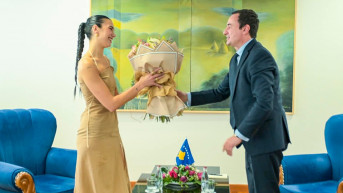
Many consider the entertainment industry to be merely producing noise and fury for entertainment, with its only desired effect being commercial success. On the other hand, there are opinions that it involves systematic lobbying and consciousness change aimed at legitimizing and supporting the realization of a political agenda.
Renowned American political scientist Joseph Nye popularized the concept of soft power in the 1980s, explaining how for a state, the power of attraction and persuasion of others is equally important as military and economic power. Four decades later, as the entertainment industry, media, social networks, and other important levers of soft power gained momentum that Nye might not have foreseen, it is logical to ask - where is the power, and who are its bearers?
Could Nye, who developed the concept, answer how much the fate of Kosovo is influenced by the speeches of the President of the European Commission Ursula von der Leyen, and how much by an interview with singer Rita Ora in which she says that Kosovo was a part of Albania? Why do the messages from Brussels officials that Serbia must recognize the independence of Kosovo provoke much less revolt than when global star Dua Lipa displays the double-headed eagle?
If everything is just a well-thought-out performance, to get as many likes from a global audience, why doesn't it entertain us then? If it is carefully planned strategies with more serious political motives, how should we respond to them?
These are cases that should not be viewed in isolation but as a part of the broader process of "manufacturing consent", Slobodan Vladusic from the Faculty of Philosophy in Novi Sad emphasized for Kosovo Online.
"It is a process or phenomenon that we can call the manufacture of consent, which means that the same message is always broadcast from various places, from various spheres. These messages have a very clear political tone that is, of course, harmful to us: an independent Kosovo, Serbian crimes, and everything that can justify the Greater Albania project, which I sincerely hope will never come true. So, these things should never be viewed in isolation but as a part of a broader process involving the entertainment industry and celebrities who are an integral part of that entertainment industry and who are not autonomous individuals with their own views on some issues but rather an extension of working hours: to push a political agenda that suits the owners of the entertainment industry", Vladusic emphasizes.
He believes that there should be a system that would counter that system and try to push "not our truth, but the truth".
"Because it's not about two truths; it's actually about, on the one hand, the truth, and on the other hand, about forgeries. This forgery is also the takeover of the Serbian Church, which is turning into a Catholic one. So, it's not a conflict between two sides equally right, but on one side, there are historical facts and data, and on the other side, there is sheer force and readiness to falsify history to legitimize an occupation", our interlocutor explains.
According to him, soft and hard power cannot be compared because they are a part of the same sphere and are strictly connected.
"Soft power depends on possessing hard power. No one has had soft power so far without hard power behind it“, Vladusic concludes.
On the other hand, journalist Idro Seferi assesses for Kosovo Online that this should not worry anyone because "systematic things are not at stake", and he points out that lobbying goes through highly organized systems.
“But in the Balkans, when someone succeeds somewhere in the world, then he is ours. And as long as he is in the Balkans, we won't let him succeed, and then that's why people compete over Djokovic, Rita Ora, Dua Lipa, and others who are still world names and have a global audience", Seferi emphasizes.
He adds that such people are expected "to say something, not to forget their people".
"They primarily have PR services that deal with much more serious topics than political issues in the Balkans. But, simply, when they say something, we are always a little happy about it. On the other hand, they are still millionaires by nationality, compared to what they are actually ethnically. Although, of course, there is this thing that they are associated with some emotions, but it is ungrateful and unfair to ask them to always express themselves about some things that our governments cannot solve so easily on their own", our interlocutor says.
According to him, normal states solve problems and conflicts related to politics through institutions.
"Obviously, culture in the Balkans seems to be the most dangerous thing. It can bring people together but also create major conflicts, depending on how it is used. Of course, there are also sports. Generally, everyone says that politics should not interfere in these activities, but politics somehow loves sports and culture because realistically, these people have more fans than heads of governments, states, etc. Simply put, they attract a larger part of the audience, and as public figures, they attract people from different parties, and there is also the need to use them for various political campaigns. But I would say, may we have more people like Djokovic, Dua Lipa, and Rita Ora around the world, and fewer tensions. Who knows where we would end up", Seferi concludes.
The levers of soft power have been used in the West for decades, but the views of even very well-known public figures like Dua Lipa or Rita Ora are unlikely to influence anyone to change their stance on Kosovo, Andrea Jovanovic from the Institute for Political Studies emphasizes for Kosovo Online.
"It's a slightly autistic bubble - they are addressing people who have already decided on this issue. It's not like Rita Ora will change Russia's stance on that issue. And those who will hear her already think that way. So, it's 'preaching to the priest' - addressing someone who is already on the line. In that sense, I don't see that it has a very great effect from our perspective“, our interlocutor notes adding that the only effect is commercial.
Moreover, Jovanovic wonders what Kosovo or Serbia even means to the average American.
"Even if it were to change the opinion of an average American who might google whether Kosovo is the heart of Serbia or Rita Ora, his voice in America today means nothing", our interlocutor emphasizes.
Despite the mentioned, she believes that we should take the aspects of soft power more seriously, "not as a response to what anyone else is doing but for ourselves, for our conscience".
"Absolutely, everything that contributes to reminding the whole world of what is happening here now – the precedent, the violation of international law, the bombing of our country in 1999, which was a rehearsal for many things that would happen later – yes, we absolutely need to take on that role and understand that we were pioneers and insist on that through all possible channels. The other problem is that our cultural scene is pretty much occupied by the West, and then auto-occupied, auto-colonial, so unfortunately, they often do completely opposite things, and that is what is a much bigger problem. Perhaps the state should deal much more with it, just as a counterweight to the state of our so-called cultural scene today", Jovanovic concludes.


comments