
Is Self-Determination’s move to obstruct the Serb List ahead of the elections a calculated one?
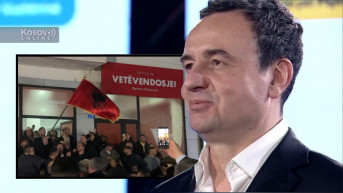
Although Self-Determination has already “hit a wall” twice in its attempts to prevent the Serb List from participating in elections, experts say that this third attempt, ahead of the 28 December vote, is equally doomed to fail, as it lacks any legal basis—just like the previous ones. Despite numerous criticisms from international organizations and Kosovo’s allies, Albin Kurti’s party, according to interlocutors for Kosovo Online, is likely calculating that this maneuver will mobilize part of its electorate by portraying itself as “standing alone against everyone.”
Written by: Dusica Radeka Djordjevic
As before, the pattern is repeating. In its decision rejecting the Office for the Certification of Political Entities’ recommendation to certify the Serb List for participation in the elections, the Central Election Commission (CEC) states that the office had carried out all necessary checks and confirmed that the Serb List met all criteria for registration.
However, after discussion, the recommendation failed to secure the required two-thirds majority to certify the party.
the Serb List received two votes “in favor”—from CEC Chairperson Kreshnik Radoniqi and Gordana Laban. Two members, Sami Kurteshi and Alban Krasniqi of Self-Determination, voted “against,” while the remaining seven members—representatives of LDK, PDK, AAK, and representatives of the Turkish, Roma, and Bosniak communities—abstained.
Thus, the responsibility for the failure to certify the Serb List does not lie solely with Self-Determination, though its members were the only ones who explicitly opposed certification.
Rarely has a CEC decision sparked such broad disapproval from international organizations and embassies in Kosovo.
The UN Mission in Kosovo expressed concern, stressing that election processes must be transparent, inclusive, and impartial. The EU Delegation voiced regret, noting that politicization of the CEC harms an inclusive process. The OSCE Mission condemned actions that undermine the right of political entities to participate in elections.
The Kosovo Ombudsperson stated that the decision lacked a sustainable legal basis and violated legally prescribed procedures.
Diplomatic reactions followed as well. The U.S. Embassy in Pristina emphasized that Self-Determination’s attempts to block the certification of the Serb List are shortsighted and divisive, undermining Kosovo’s stability and U.S. interests, including the relaunch of strategic dialogue.
Germany’s Ambassador, Rainer Rudolph, warned that electoral processes and technical preparations must remain free of political manipulation. The U.K. Ambassador, Jonathan Hargreaves, said such actions risk damaging Kosovo’s reputation as a multiethnic democracy and harming relations with its close partners.
Calling the CEC decision “anti-democratic and anti-Serb,” the Serb List President Zlatan Elek announced that the party had filed a complaint with the Election Complaints and Appeals Panel (ECAP) regarding the refusal to certify the party for the 28 December elections.
The panel’s decision is pending.
Pristina-based political analyst Artan Muhaxhiri told Kosovo Online that Self-Determination’s attempts to prevent the Serb List’s participation aim at capturing voters who do not analyze matters deeply, since it is clear that there are insufficient legal arguments against the party.
Muhaxhiri notes that it is “very sad” that after six years in power, Albin Kurti and Self-Determination have no other arguments or political platforms to seek votes except playing with the issue of the Serb List.
“What Self-Determination is doing is very hypocritical, because two key ministers in Kurti’s cabinet—Interior Minister Xhelal Sveçla and Foreign Minister Donika Gërvalla—gave the green light for the Serb List to participate in the elections. Their ministries determine whether there are obstacles to forming a political party. That means they found nothing illegal that would prevent the Serb List from running. They did not object then, but now they are playing populist games to gain votes,” Muhaxhiri said.
He is “100 percent convinced” that Self-Determination’s attempt will fail, but says Kurti’s motives lie in social media—Facebook and TikTok—where he seeks to create an artificial narrative that he alone is pro-Albanian and pro-Kosovo, while other parties are aligned with the Serb List.
“This approach was successful in the last two election cycles, when he won 50 percent and 42 percent. He hopes for the same now. But legally he has no grounds. Without legal arguments against the Serb List, institutions have only one option—to allow the party to participate in the upcoming elections,” Muhaxhiri concluded.
Political scientist Ognjen Gogic explains Kurti’s insistence on attempts that repeatedly fail in court by saying he wants to signal consistency to his voters. At the same time, he tries to turn international criticism into an advantage by telling his supporters that “everyone is against him and against them.”
“The attempt to bar the Serb List from the elections has become a ritual accompanying every electoral cycle, even though everyone knows the outcome—the decision cannot stand. Kurti uses this to demonstrate his principled stance that cooperation with the Serb List is impossible, and that the party must be banned and eliminated from political life. He is sending a message of consistency to his voters,” Gogic said.
Kurti knows, Gogic argues, that the decision will be overturned, but the attention it brings benefits him.
“He does not shy away from criticism—he thrives on it. Whenever the international community criticizes him, he flips it to his advantage, portraying himself as the ‘last Mohican’ defending Kosovo from the Serb List, as he presents it. He will use the expected ECAP and Supreme Court decisions—confirming the Serb List’s right to participate—to claim the courts are also against him and undermining Kosovo. He will turn it into a full campaign to gain political points,” Gogic added.
Gogic further believes Kurti has become trapped by this narrative. If Self-Determination’s members in the CEC were to vote to certify the Serb List, the opposition would accuse Kurti of softening his stance or seeking post-election deals.
He sees a problem in the fact that no one has been held accountable—legally or politically—for this happening for the third time. He highlights the significance of the U.S. Embassy’s call for sanctions or dismissal of Self-Determination CEC members.
Aleksandar Sljuka of the NGO “New Social Initiative” said that Albin Kurti has created a situation in which every election cycle requires him to attempt to block the Serb List’s participation in order to signal a message to his supporters—even though the political benefits have diminished and Self-Determination is only harming itself.
Sljuka recalls that Self-Determination previously attempted to portray the Serb List as almost a terrorist organization during past elections.
“This was part of a political campaign to gain points, which, as we can see, both then and now, Kurti and Self-Determination lack,” Sljuka told Kosovo Online.
The other issue, he says, is that Self-Determination created an uncomfortable situation for itself: after its previous attempt failed and ECAP overturned the CEC decision, it cannot simply ignore the issue now.
“If new elections are called—and there is talk that they may happen next year—and they were to ignore the issue and vote ‘yes’ or abstain on the Serb List’s certification, they would be sending the message to their voters: ‘We blocked it before, but now we’re allowing it.’ What does that mean? Has their stance toward the Serb List improved? Does it mean the party is now seen as a potential partner?” Sljuka explained.
Self-Determination has created such a narrative around the Serb List that it has become “politically costly” to change course and vote in favor of its certification.
Despite numerous condemnations from the international community, Sljuka doubts their effectiveness, believing that support for Self-Determination and Kurti declines with each cycle and that the party is placing itself in an increasingly difficult position.
“ECAP overturns their decisions, the Serb List participates, and we are left with a farcical situation. The only institution that can bar a political party from elections is the court—and no such decisions exist,” he concluded.
Petar Ivic of the Pupin Initiative told Kosovo Online that caretaker Prime Minister Albin Kurti’s maneuver to block the Serb List’s participation may gain him points with his established voter base but simultaneously attracts a broad international consensus of criticism.
Ivic stresses that Kurti “went too far this time,” as reflected in reactions from foreign ambassadors, the EU, and international organizations such as the OSCE and UNMIK.
“This is a moment of deep, months-long crisis, where I fear that any further escalation will boomerang. His support is only falling, and this is a semi-rational move,” Ivic said, adding that the refusal to certify the Serb List “is not a politically profitable move” for Kurti.
“Kosovo depends on international support. Through these actions, he only strengthens the international coalition against himself. The ambassadors of France and the United Kingdom made it clear that the Serb List—that is, the Serbian community—must participate in political life in Kosovo. The U.S. Embassy also voiced strong criticism. This simply cannot be a politically beneficial move,” Ivic stressed.



comments