
U.S. withdrawal from Kosovo: Trump’s message to Europe, risk to regional stability
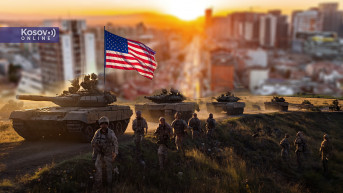
Washington is seeking to reduce the European Union’s dependence on U.S. defense capabilities and protection, and reports that America may scale back its presence in Kosovo are seen as a message to Brussels to assume greater responsibility for the continent’s security and within NATO, interlocutors told Kosovo Online. Such a scenario, they warn, could undermine regional stability, although they note that KFOR would retain its presence and continue to function through a reorganization of troops.
Written by Jelena Novakov
The Brussels-based outlet Politico recently reported, citing unnamed sources, that the United States would request a reduction of NATO missions, including in Kosovo. These claims were later denied by the U.S. European Command, as well as by unnamed Pentagon and NATO officials.
The possibility of changes in KFOR’s composition was also dismissed by Commander Özkan Ulutaş, who stated that no significant changes to KFOR are currently under consideration and that the United States continues to play a fundamental role in supporting security throughout Kosovo and regional stability.
Analysts recall that U.S. President Donald Trump, since the beginning of his second term, has increased pressure on allies, including the European Union, to assume greater responsibility for security and defense financing. Last year, he also called on each NATO member state to raise defense spending to five percent of GDP from the previous two percent, although the United States itself does not meet that threshold.
The European Union responded with an €800 billion rearmament plan, announcements of strategies aimed at achieving technological independence from the United States, and a renewed focus on the enlargement agenda.
Meanwhile, the security situation in the Western Balkans is evolving. Serbia’s state leadership and the Collegium of the Chief of the General Staff have expressed concern that the military alliance of Albania, Kosovo, and Croatia is directed against Serbia and poses a risk to both national and broader regional security. Although Albanian, Croatian, and Kosovo officials have denied that the alliance is aimed at any state, interlocutors for Kosovo Online warn that reduced U.S. presence in Kosovo would certainly represent an additional risk for Serbia and regional stability.
Retired U.S. Colonel Ray Wojcik, who previously served as head of the Office of Defense Cooperation at the U.S. Embassy in Pristina, also warned that any sudden change in the U.S. presence in Kosovo would lead to destabilization. He assessed that such a development could create space for expanded Russian and Chinese influence in the Western Balkans.
According to him, the United States is reassessing its global military posture, making it necessary for European NATO allies to assume greater responsibility for collective defense on the continent. Nevertheless, Wojcik considers the U.S. presence in Kosovo a key deterrent factor, adding that a major reduction of American troops would affect crisis prevention and rapid response capabilities more than everyday security.
Responsibility of the U.S. and the EU in the Western Balkans
Security studies researcher Nikola Vujinovic believes that reports of a potential American withdrawal are an attempt to prompt the European Union to take greater responsibility on the continent and within NATO.
“The United States wants a reconfiguration of relations in Europe. It wants European allies to assume greater responsibility, and accordingly, at all points where they are present in Europe, the U.S. insists that Europeans carry a greater burden,” he told Kosovo Online.
Vujinovic does not believe the United States will withdraw from Kosovo and considers such a move highly negative under current global circumstances.
“The U.S. will not withdraw from Kosovo and Metohija, and in my deep conviction, that would be very negative at this moment. The global situation is such that it would create another hotspot, which is not needed—not only for Serbia as a state, but for the Serbian people as a whole, and for the region. I believe this is merely a diplomatic step in negotiations between European allies and the United States aimed at ensuring Europe assumes greater responsibility, as there is no operationalization—only statements,” he said.
He noted that unnamed officials have stated that no withdrawal will occur, but he still expects certain adjustments.
“There will certainly be some changes, but changes have been ongoing since 1999 and have never meant anything overly significant for the security of Kosovo and Metohija,” Vujinovic concluded.
Reorganization of KFOR
On the other hand, Marko Savkovic of the ISAC Fund stated that there is a possibility the U.S. could reduce its military presence in Kosovo, but that KFOR would continue to operate through troop reorganization and greater participation by other countries, potentially including some from the region.
“It seems to me that at this moment there are several options. One is for KFOR to continue as it currently exists, with clearly defined zones of responsibility and without major changes in composition. The second, if Americans were indeed to leave, would likely require certain countries to compensate for their presence. There are countries naturally interested in doing so,” he said.
Speaking about the current U.S. administration, Savkovic noted that its focus has shifted compared to Trump’s first term and that the Western Balkans is no longer among top priorities.
“Priorities of the U.S. administration constantly change; it is much less predictable in its conduct. It is quite clear that, unlike during Trump’s first term, this region is not in focus to the same extent,” Savkovic said.
Symbolic Presence
Analyst Nexhmedin Spahiu said he does not expect a complete withdrawal of KFOR from Kosovo, adding that it will maintain a symbolic presence until Serbia recognizes Kosovo.
“KFOR will remain, in some form, until there is an agreement between Kosovo and Serbia, that is, until Kosovo is recognized by Serbia,” he stated.
If the number of U.S. troops in Kosovo were reduced, Spahiu does not expect major changes in KFOR’s functioning.
“The number of KFOR troops in Kosovo is symbolic. They are proof of sovereignty,” he said, recalling that European countries sent a small, also symbolic number of troops to Greenland when President Donald Trump threatened the annexation of that Danish territory.
“An attack on Greenland would mean an attack on their army. Likewise, it is not the number of troops here in Kosovo that matters, but that the mission is present, and that any attack on Kosovo is also an attack on KFOR,” Spahiu told Kosovo Online.
The U.S. and NATO
American diplomat and former ambassador Jonathan Moore told Kosovo Online that the United States remains committed to NATO and assessed that the KFOR mission will continue because it is important both for Kosovo and for the rest of the region.
Moore emphasized that NATO is the most successful security organization in history and that while the United States has long contributed the most to the Alliance, other members must now allocate greater resources.
Commenting on reports of a possible U.S. withdrawal from Kosovo, Moore said that NATO will retain its presence while the United States reviews the regions of the world to which it should devote attention.
“I do not know what the decisions will be, but the essence will be that NATO will maintain its presence. KFOR is very important—for the entire region, for Kosovo’s neighbors, as well as for Kosovo itself. If you look at Albania and North Macedonia, both in NATO, Montenegro in NATO, Greece in NATO—this is a fundamental structure that will remain the same. People are speculating and, frankly, overinterpreting. There is debate about where the United States has ambassadors and where it does not. The fact is that we have embassies. We have the same diplomatic network. We have professional diplomats and ambassadors as representatives of the President around the world. This is not about Kosovo. This is not about the Balkans. It concerns a broader reassessment being conducted in the United States to determine where we should contribute our forces, our talents, and our resources,” Moore said.
He added that the number of U.S. troops in Kosovo is not large and that forces from other countries would remain present even if U.S. deployments were adjusted.
“We do not have a large number of troops on the ground in Kosovo. Again, even if that number were reduced by some factor, NATO remains present. Italian forces are there. Turkish forces are there and will continue to be there. People should not think in terms of advantages or disadvantages. They should understand that the commitment to NATO, which the United States strongly supports, will not change,” Moore concluded.




0 comments