
A way out or a new deadlock: Will the Constitutional Court’s decision resolve the political crisis?
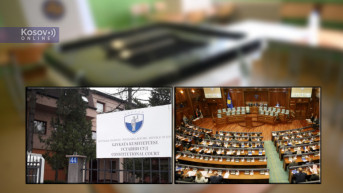
Following a temporary measure to suspend all actions related to the constitution of the Kosovo Assembly, the Constitutional Court has issued a new decision, which, according to interlocutors for Kosovo Online, is clearer than the court’s earlier ruling of June 26. Although the decision imposes certain obligations on MPs and provides guidelines on how to form the parliament within 30 days, the question remains: what happens after that period if the Assembly is not constituted?
Written by: Milena Miladinovic
At the request of the Democratic League of Kosovo (LDK) and the Democratic Party of Kosovo (PDK), the Constitutional Court decided that the constitution of the Assembly must continue with an open vote and that MPs have 30 days to form the parliament. According to the decision, the representative of the largest parliamentary group has the right to nominate a candidate for the Speaker of the Assembly, for whom voting can take place publicly up to three times.
The Court also unanimously determined that MPs had not implemented the June 26 judgment and therefore declared null and void all sessions held from June 27 to July 26. It further found that the presiding officer of the constitutive session, Avni Dehari, did not act in accordance with that judgment and that his actions were incompatible with Article 116(1) of the Constitution, which concerns the legal effect of decisions.
While opposition parties see the ruling as a confirmation of the truth and a legal blow to the current government—showing that Self-Determination failed to respect the Constitution—Self-Determination claims the Constitutional Court itself violated the Constitution with this decision.
International representatives in Pristina have called on all actors to comply with the Constitutional Court’s decision on the constitution of the Assembly and to find a compromise. Constitutional law experts view the ruling as clear but not without shortcomings.
Interlocutors for Kosovo Online agree, pointing to one major gap:
What after 30 days?
Aleksandar Sljuka, an associate with the NGO New Social Initiative, said the decision does not resolve the situation because it does not specify what will happen if the parliament is not formed within the 30-day deadline.
“The Court didn’t say what happens after 30 days. Opinions on this differ: some think the Court should act this way—help remove the institutional deadlock but not resolve it completely, or amend the Constitution and Kosovo’s legal system to prevent such crises in the future. Some argue it would be wrong for the Constitutional Court to send Kosovo to new elections. I partly agree with all that, but I think this doesn’t fully resolve the situation,” Sljuka told Kosovo Online.
He interprets the ruling as just one possible way to address the parliamentary deadlock.
“The Court has offered a new perspective and a way forward, but that doesn’t necessarily mean the situation will be resolved. We could have repeated failed votes, Self-Determination could nominate another candidate, and still fail… After a month, if we still don’t have a Speaker, we don’t know what happens, because the Court left it open. It didn’t say that new elections would automatically be called, for example. So the situation hasn’t been resolved once and for all—just one possible way forward has been provided,” he added.
Sljuka stressed the importance of the Court declaring invalid all sessions in which the formation of a Commission for secret voting was proposed.
“In its first decision, the Court said the constitution of the Assembly must continue with an open vote. Now it has said that forming a committee for secret voting is outside the rules and that all such sessions are invalid. That’s significant. I expect the process to continue, with item 3 of the agenda, but we could still face a deadlock if after a month we get new Self-Determination candidates who the opposition won’t support. We’d be in the same position,” he said.
The solution, in his view, would be to eventually give the right to nominate a candidate to another party.
“If Self-Determination repeatedly fails to secure a majority, the right could be transferred to the opposition. The Court should specify the exit strategy, the endgame, which probably means elections,” Sljuka said.
He noted that the Court had not altered the constitutional provision giving the winning party the right to nominate the Speaker.
“As far as nominations go, that still belongs to Self-Determination. The Court hasn’t interpreted this differently; the Constitution says the party with the most votes should nominate the candidate. The Court said that after three failed votes, Self-Determination can nominate a new candidate, but the right doesn’t pass to the opposition,” he concluded.
Political analyst Shkëlzen Maliqi described the new decision as good and responsible, clearly stating that the Assembly’s constitution must proceed under the Rules of Procedure with an open vote for the Speaker.
He added that this puts everything in order so the Assembly—and then the Government—can be formed, marking an exit from the deadlock.
“Self-Determination had a convincing lead with 48 seats, but couldn’t form a majority, a government, or elect a Speaker. They used delaying tactics, perhaps aiming to align local and snap parliamentary elections. The Court said before, in more complicated terms, what it says now: voting must follow the Rules. The attempt to switch to secret voting is void; all those sessions are invalid, and the process must continue. The first party should nominate a candidate, but can’t do so endlessly. Whether it’s the same or a new candidate, we’ll see—but usually parties negotiate, the whole Assembly votes, and every vote counts,” Maliqi told Kosovo Online.
He expects the Assembly to be constituted soon, followed by government formation. If caretaker PM and Self-Determination leader Albin Kurti fails to secure a majority, the mandate would pass to PDK’s Bedri Hamza.
“Everything is now in place for the process to move forward. I assume the Assembly will be constituted, a second candidate will be proposed if Albulena Haxhiu fails, and then the focus will shift to forming a government. Kurti will get the mandate again, but if he can’t get a majority, the process moves on and the second party—Bedri Hamza—takes over,” Maliqi said.
He highlighted that the new ruling introduces a deadline and a maximum of three votes for the same candidate, adding that it was good the Court recognized Self-Determination’s “game.”
“The Court understood it had to be explicit—adding deadlines and the three-vote limit. This isn’t written anywhere, but the Court, as an authoritative body, saw that Self-Determination could drag this out for years, which makes no sense. This is a good and responsible decision, and we must get out of this deadlock,” Maliqi concluded.
Analyst Predrag Rajic said the Constitutional Court might allow opposition parties to propose a candidate if the Assembly isn’t formed within 30 days. But without the Serb List, they couldn’t secure enough votes.
In his view, such a scenario would give Kurti political ammunition to topple any new government from the opposition.
“The opposition couldn’t elect a Speaker without the Serb List. I can’t imagine PDK entering such an arrangement, because forming a government with Serb List support would let Kurti take many PDK votes and then work to bring down that government and return to power. He could easily form his third government,” Rajic told Kosovo Online.
He believes this would be too risky for the opposition and doubts Kurti will change his nominee.
“Kurti’s main goal is to prolong this situation as long as possible. He wouldn’t mind new elections—they mean a new campaign, and he hopes for similar results, leading to another stalemate. This buys him time until next year’s U.S. midterms. He wants to survive politically until November next year, and if elections are repeated—as in Bulgaria in recent years—it’s possible. Kurti hopes U.S. Democrats regain the House, maybe even the Senate, making it easier for him to govern until the end of Trump’s term,” Rajic said.
According to him, any outcome suits Kurti.
“This is all part of Kurti’s game. If his candidate is elected, it’s good for him. If not, and the process drags on, that’s also fine—he remains caretaker PM and keeps control. As far as he’s concerned, this can go on for a long time,” Rajic concluded.



0 comments