
Welcomed with applause in the White House, now covered in dust: Does the Washington Agreement have a second chance?
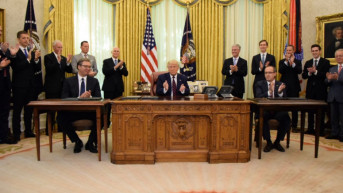
On September 4, 2020, then-President Donald Trump and his team applauded as Serbian President Aleksandar Vucic and then-Kosovo Prime Minister Avdullah Hoti signed the Washington Agreement in the White House. With Trump set to return to the White House on January 20, analysts believe it’s possible that the Washington Agreement, or at least parts of it, may re-enter the spotlight during his second term.
Written by: Dusica Radeka Djordjevic
The Agreement on Economic Normalization was largely sidelined by the first half of 2021. Trump was succeeded by Joe Biden, and in August 2021, Kosovo’s Assembly, under the leadership of Albin Kurti, rejected a resolution calling on the government to implement the Washington Agreement. The resolution was proposed by the opposition Democratic League of Kosovo, the party of Avdullah Hoti, who had signed the agreement.
Several points in the agreement were contentious for Kurti’s Self-Determination Movement, including a one-year moratorium on Kosovo seeking membership in international organizations, participation in the Mini-Schengen initiative (later renamed Open Balkan), and the American feasibility study for joint management of Lake Gazivode. The study was completed and presented to both sides on June 23, 2021.
Asked earlier this week whether the Washington Agreement is now acceptable to him if a new Trump administration insists on its implementation, Kosovo Prime Minister Albin Kurti avoided giving a direct answer.
"Let’s start with the latest agreement, which is comprehensive as it normalizes relations between Kosovo and Serbia. I can only speak for agreements I participated in and accepted, and I expect the same from Belgrade," Kurti stated.
On the other hand, Serbian Foreign Minister Marko Djuric emphasized Belgrade’s support for the economic aspects of the document signed in the White House.
"The agreement focused on the economy, improving transport links, and creating opportunities for young people—this core of the agreement enjoys our support. However, I honestly doubt Kurti will approach this constructively," Djuric told RTV.
It remains uncertain whether a new Trump administration would work on reviving parts of the agreement, such as the Peace Highway project or a railway connection between Nis and Pristina. Richard Grenell, Trump’s former special envoy for Kosovo-Serbia negotiations, advocated for economic progress with his motto: "The people of Kosovo and Serbia deserve a chance for economic prosperity; let’s leave politics aside."
Regarding Kurti’s statement that last year’s agreement on the path to normalization with Serbia should be implemented first, political analyst Visar Imeri told Kosovo Online that he does not see the two agreements as conflicting and believes both can be implemented.
"The Washington Agreement primarily deals with economic and infrastructure projects. It doesn’t touch on the political issues we have, while the Brussels Agreement is entirely political. Implementing the Washington Agreement doesn’t mean the Brussels Agreement can’t be executed—when it comes to the Association of Serb-Majority Municipalities, de facto recognition, passport recognition, and other Brussels agreements. I understand that for the Kosovo government, starting with the Brussels Agreement is politically more significant, but I see no issue in implementing the Washington Agreement at the same time if it remains as it was. It even includes points unrelated to Kosovo-Serbia relations. Serbia has obligations unrelated to Kosovo, and Kosovo has obligations unrelated to Serbia," Imeri explained.
When it comes to the part of the agreement addressing infrastructure, highways, and railway construction, Imeri emphasizes the importance of having as many connections and joint infrastructure projects as possible. These, he says, are investments in improved economic relations, which also translate into better political relations in the region.
"The Washington Agreement does not conflict with the Berlin Process, which focuses on joint trade, requiring infrastructure such as railways, highways, and other systems. This means that if the agreement is fully implemented, it will benefit both Kosovo and Serbia, as well as the entire region," Imeri believes.
He adds that the United States could use the Washington Agreement as a framework for dialogue between Kosovo and Serbia. However, he notes that this will largely depend on the nature of the new Donald Trump administration's relationship with the European Union and whether the EU-sponsored dialogue remains the main platform for negotiations or if it partially shifts to Washington.



0 comments