
Vucic tells Rutte in letter: KFOR withdrawal premature, assessment fails to recognize all risks to security of Serbs
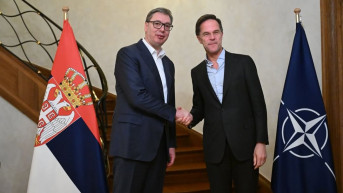
Serbian President Aleksandar Vucic, in a letter sent today to NATO Secretary General Mark Rutte, expressed deep concern over KFOR's decision to withdraw from the Ibar Bridge and to include the Kosovo Police in the "security architecture" around Visoki Decani Monastery. He stressed that the move was premature and that KFOR's security assessments had failed to adequately recognize all risks to the security of the Serbian and other non-Albanian populations in northern Kosovo, as well as to the security of the monastery, which he described as a jewel of Serbian and world cultural heritage.
In the letter, which Kosovo Online had exclusive access to, Vucic stressed that more than 800 ethnically motivated attacks against Serbs had been recorded between 2021 and 2026 and recalled a series of unilateral measures that had further aggravated the position of the Serbian community.
As examples, he cited the ban on the use of the Serbian dinar, the closure of Serbian post offices and banks, the seizure of land through expropriation proceedings, the demolition of structures, and the arrests of Serbs and other non-Albanians. He assessed that such a situation would not have arisen had the European Union and the international community insisted on the implementation of what he described as Pristina's sole obligation under the 2013 Brussels Agreement—the establishment of the Community of Serb-majority Municipalities—which, he believes, would have prevented what he described as the persecutory conduct of the Pristina authorities toward the Serbian people.
At the beginning of the letter, Vucic thanked Rutte for their recent open and substantive conversation in Paris and stressed that he particularly appreciated Rutte's understanding of Serbia's positions regarding the situation in Kosovo, as well as his willingness to listen carefully to Serbia's arguments and concerns.
"I am convinced that we share the view that responsible and serious conduct by all actors, as well as the preservation of peace and stability, are of essential importance for the future of the entire region. I therefore felt the need to address you with deep concern regarding the decision of the international security presence in Kosovo and Metohija to remove temporary structures from the main bridge over the Ibar River in Kosovska Mitrovica, as part of preparatory activities for their complete withdrawal from the controlled area around the bridge," Vucic wrote.
He recalled that during August, KFOR Commander General Ozkan Ulutas had announced that the Mission was beginning a process of optimizing the number, deployment, and engagement of its personnel, citing an "improved security situation on the ground" as justification.
"As part of activities intended to correspond with such a security assessment, on August 10 steps were taken to withdraw members of the Italian Carabinieri from the northern section of the main bridge in Kosovska Mitrovica, as well as to begin transferring responsibility for the security of this security perimeter to the police service of the Provisional Institutions of Self-Government in Pristina and to include the police of the Provisional Institutions of Self-Government in Pristina in the 'security architecture' around Visoki Decani Monastery. Bearing in mind the justified concern and fear of the majority-Serbian population living in the northern parts of the city and the Province, as well as the broader political and security aspects of this sensitive issue, I believe that this step has been taken prematurely and that KFOR's security assessments have failed to adequately recognize all the risks to the security of the Serbian and other non-Albanian populations in northern Kosovo and Metohija, as well as to the security of a monastery that is a jewel of Serbian and world cultural heritage," Vucic stressed.
In order, as he wrote, to deconstruct the euphemism "improved security situation on the ground," the Serbian President recalled that on February 8, 2024, the United Nations Security Council had held an emergency session over threats to peace arising from unilateral escalatory actions by Pristina that had created intolerable living conditions for Serbs and other non-Albanians in Kosovo.
"Since then, the situation has continued to deteriorate rapidly, while institutional and extra-institutional pressure on Serbs and other non-Albanians aimed at driving them out has resulted in the displacement of more than 20 percent of Serbs from Kosovo and Metohija to central Serbia," Vucic stressed.
He said that, unfortunately, the brutal violation of fundamental human rights and threats to the security of non-Albanians were continuing.
"Beatings, intimidation, and arrests have become an everyday reality for all non-Albanians, primarily Serbs living in the four Serb-majority municipalities in northern Kosovo and Metohija. The trend of ethnically motivated attacks directed against Serbs and other non-Albanians has intensified over the past several years, weeks, and days," Vucic said.
He informed the NATO Secretary General that more than 800 ethnically motivated attacks had been recorded between 2021 and 2026.
"The Provisional Institutions of Self-Government in Pristina have unilaterally and unlawfully banned the use of the Serbian dinar, closed Serbian postal and bank branches, seized more than one million square meters of Serbian-owned land through purported expropriation proceedings, demolished dozens of family homes and other structures along the shores of Gazivode Lake, forcibly closed and taken over 132 facilities belonging to Serbian institutions, deprived more than 257 persons of Serbian and other non-Albanian ethnicity of their liberty, including directors of healthcare and educational institutions, imposed administrative obstacles on pilgrims and visitors traveling from central Serbia to Kosovo and Metohija, continued politically motivated proceedings against prominent individuals and the Serb List, politicized and abused the process of determining the fate of missing persons in order to terrorize the local population, and undertaken other actions that make everyday life intolerable, including preventing Serbs from returning to the police and judiciary of the Provisional Institutions of Self-Government in Pristina," President Vucic listed.
He added that the list of pressures on Serbs did not end there.
"I therefore also emphasize that members of the police of the Provisional Institutions of Self-Government in Pristina, whom the KFOR Commander now seeks to 'integrate into the security architecture,' directly participated in the arrest and mistreatment of 36 people, including women, during the Vidovdan commemoration at Gazimestan on June 28, 2026; threatened organizers of a cultural and artistic program during the celebration of the patron saint's day at the Holy Archangels Monastery in July; subjected pilgrims and their children to serious mistreatment and sniper surveillance; brutally abducted and beat Nenad Raskovic in the village of Dren, Municipality of Zubin Potok; and directly participated in activities related to the demolition of Serbian houses on the shore of Gazivode Lake," Vucic stressed.
He recalled that, thanks to what he described as the correct decision of the international security presence to close the main bridge over the Ibar River in North Mitrovica in 1999, the city had survived as the only multiethnic urban area in Kosovo—unlike Pristina, Pec, Djakovica, Prizren, Gnjilane, Urosevac, and other cities from which, he said, Serbs had been completely ethnically cleansed within several weeks of the end of the conflict in 1999.
"Although the closure of the Ibar Bridge protected Serbs from expulsion and mass violence, the area around the bridge, as well as the Suvi Do area, have to this day remained locations from which more than 200 ethnically motivated attacks against Serbs have been carried out from the southern part of the city. For all these reasons, and given the fact that the main Ibar Bridge and its surroundings have become a flashpoint for attacks against Serbs and other non-Albanians, the residents of Kosovska Mitrovica view the opening of the main bridge with fear, solely as a technical preparation for the continuation of their ethnic cleansing through the circumvention of the 2015 Dialogue Agreement," the President wrote to the NATO Secretary General.
In that regard, he recalled that the KFOR Mission, pursuant to UN Security Council Resolution 1244 (1999), was of fundamental importance for ensuring the security and freedom of all those living in Kosovo.
"Its importance is all the greater because the fulfillment of its primary mission also serves to support the Belgrade-Pristina Dialogue process, conducted with the mediation of the European Union pursuant to UN General Assembly Resolution 64/298 (2010), and because the conditions stipulated in the agreements concerning the Ibar Bridge, including the delineation between 'North Mitrovica' and 'South Mitrovica' in the 'Suvi Do' cadastral area, have still not been fulfilled," Vucic stressed.
He said that he would not have needed to write any of this had the EU and the international community respected the Brussels Agreement signed in April 2013, under which, he said, the sole obligation of the Pristina side was to establish the Community of Serb-Majority Municipalities, whose existence would have entirely prevented what he described as the arbitrary and persecutory conduct of the Albanian authorities toward the Serbian people in Kosovo.
"Nevertheless, even 13 years later, implementation of the Pristina authorities' obligation under that agreement remains at zero, while, as you know, the EU remains silent and fails to react even to the non-implementation of decisions that its own representatives personally signed. I am absolutely convinced that you will carefully consider the facts I have presented to you in this letter and that, as before, you will have full understanding for the sensitivity of the issue of opening the main bridge over the Ibar River, as well as for the necessity of adequately protecting Serbian holy sites in Kosovo and Metohija, bearing in mind their importance for the continued presence and survival of Serbs and other non-Albanians in Kosovo and Metohija, and therefore for regional peace and stability," Vucic added.
He said that he emphasized this not only because he held Rutte's work as NATO Secretary General in high regard, but also because he knew how deeply committed Rutte was to preserving peace and stability in the Western Balkans.


0 comments