
What has really changed in KFOR’s role since 1999, and how much influence does NATO still have in Kosovo?
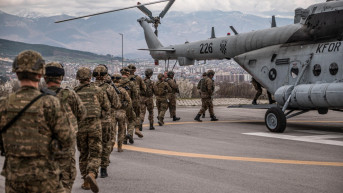
NATO troops began entering the territory of the then Federal Republic of Yugoslavia on June 12, 1999. At the same time, Serbian military forces started withdrawing, as did a large number of Kosovo Serbs. Analysts interviewed by Kosovo Online assess that KFOR’s role has not fundamentally changed, as it continues to operate under the framework of UN Security Council Resolution 1244, while NATO itself indicates that it will continue supporting the Belgrade–Pristina dialogue and has no immediate plans to terminate the mission.
Written by: Veljko Nestorovic
In the months immediately following the arrival of NATO forces, the highest number of ethnically motivated crimes against Serbs were committed in Kosovo, and most of the Serbian population that left the province never returned.
From KFOR’s first commander, Mike Jackson, who passed away in 2024, to Turkish General Özkan Ulutaş, who has assumed command of NATO’s longest-running mission for a second time, the number of KFOR personnel has steadily declined. Fewer than 5,000 troops are currently stationed in Kosovo. At the outset of the mission in 1999, NATO had approximately 50,000 troops deployed; by 2002 that number had fallen to 39,000, and by 2003 around 17,500 KFOR personnel remained on the ground.
Nevertheless, KFOR continues to provide security for the Visoki Decani Monastery monastery, while Italian Carabinieri remain deployed at the main bridge over the Ibar River connecting North and South Mitrovica, which remains closed to vehicular traffic.
The arrangement under which members of the Kosovo Security Force (KSF) cannot enter northern Kosovo without the explicit approval of the KFOR Commander also remains in force.
Military and political analyst Fadil Kajtazi told Kosovo Online that KFOR is still regarded as the organization responsible for maintaining peace in Kosovo and the wider region.
“What has changed is the number of KFOR personnel, which has been reduced in accordance with circumstances and assessments of the security and stability situation in the region,” Kajtazi said.
He also pointed to changes in the structure of countries participating in the mission.
“The composition is narrower than it was at the beginning of the mission,” Kajtazi noted.
Marking the 27th anniversary of NATO’s entry into Kosovo, NATO issued a statement emphasizing that it continues to support the EU-facilitated dialogue between Belgrade and Pristina and calls on both sides to engage constructively in resolving outstanding issues and achieving solutions that respect the rights of all communities, which it considers essential for lasting security in Kosovo and regional stability.
The statement noted that the security situation in Kosovo has continued to improve in recent years.
“Accordingly, in January NATO suspended the deployment of reserve forces assigned to the KFOR mission after more than two years of continuous rotations. As the overall security situation in Kosovo remains stable, NATO will optimize KFOR’s deployment in Kosovo and gradually adjust its current force posture over the coming year,” the statement said.
NATO recalled that since 1999 KFOR’s deployment has been continuously adapted to ensure that the mission remains fit for purpose and responsive to changes in the security environment.
“Following heightened tensions and violence in 2023, including the unprovoked attacks against KFOR personnel in Zvecan, KFOR received its largest reinforcement in more than a decade, with the deployment of nearly 1,000 additional troops,” the statement added.
The Alliance further stressed that the announced optimization is being carried out within the existing authority of the Supreme Allied Commander Europe and follows a comprehensive intelligence-based assessment of the security situation.
“The gradual reduction in force levels is expected to follow national rotation and redeployment cycles between now and next year. The optimization will be implemented progressively and in line with conditions on the ground and could be halted if relevant security circumstances so require,” NATO stated.
Security researcher Nikola Vujinovic told Kosovo Online that NATO arrived in Kosovo 27 years ago as an occupying force and was not there to preserve peace, but rather to strengthen Kosovo’s independence.
“Twenty-seven years have now passed, which provides sufficient historical distance to assess NATO’s conduct upon entering Kosovo. It allowed a certain vacuum to emerge between the withdrawing Yugoslav Army troops and the arrival of NATO forces. It was precisely within that vacuum that numerous crimes were committed and ethnic cleansing took place in many areas. If I am not mistaken, nearly 300,000 people left Kosovo and Metohija. NATO was not there to preserve peace, but to strengthen Kosovo’s independence,” Vujinovic said.
He does not believe the Alliance intends to end the mission in Kosovo in the foreseeable future.
“Only the leading actor has changed. For many years, indeed for decades, the United States was the primary actor insisting that the mission remain in place. I believe circumstances have changed and that Turkey is now the dominant factor advocating for KFOR’s continued presence, simply because Turkey quite clearly uses KFOR as a framework for projecting its influence on the ground. This is evident in Camp Sultan Murat, the large number of Turkish troops, and the fact that the current KFOR commander is a Turkish officer.
By all indications, his successor will also come from the Turkish Armed Forces. For that reason, I believe KFOR provides a very suitable framework for demonstrating geopolitical influence on the ground,” Vujinovic concluded.
0 comments