
Who is more loyal to the KLA – Rama or Kurti?
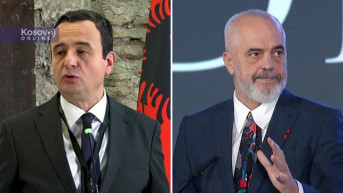
The attitude toward the Special Court in The Hague, where former leaders of the Kosovo Liberation Army (KLA) are on trial for war crimes, has become a new front in the political rivalry between Albin Kurti and Edi Rama. Disputes flared after a protest in Tirana in support of former KLA commanders. According to Kosovo Online’s interlocutors, beyond strengthening his authority among Albanians in the region, Rama’s persistent support for the accused in The Hague may also be tied to concerns that Albania would be negatively affected if the court were to issue convictions.
Written by: Dusica Radeka Djordjevic
It all began when Albanian Prime Minister Edi Rama called on citizens from Kosovo, North Macedonia, and the entire diaspora to gather in Tirana on October 17 for a protest supporting the former KLA leaders in The Hague.
The Self-Determination Movement responded, suggesting it was worth remembering who supported the establishment of the Special Court at the time of its creation.
“Many of those who now oppose the Special Court were its greatest advocates. Before protesting, these actors and politicians should at least show minimal remorse for their wrong stances in the past. A clear example is the current Prime Minister of Albania, Edi Rama, who even made an emergency visit to Kosovo by helicopter to convince local parties to vote for the court’s establishment,” the Movement led by Albin Kurti said.
Rama struck back, saying he had condemned the “farce” against Hashim Thaçi and others whenever and wherever necessary, and accused Kurti’s party of wanting Thaçi to remain in The Hague forever.
Journalist and analyst from Tirana Dritan Laci believes Kurti gains nothing from Thaçi’s imprisonment.
“If you look at the political influence map in Kosovo, Thaçi’s party remains strong in many areas, meaning the KLA still has significant power across Kosovo. Kurti therefore has to cooperate with the political force of the Democratic Party of Kosovo – the KLA – which remains influential, as shown in recent elections. I don’t think Kurti benefits from Thaçi’s detention in The Hague,” Laci told Kosovo Online.
Discussing Rama’s attitude toward the KLA, Laci says the organization helps the Albanian prime minister boost his patriotic credibility.
“What Rama is doing stems from his usual inconsistency. The Open Balkan policy hurt his reputation, and his frequent visits to Serbia certainly weakened his image in Kosovo. Unlike some previous leaders who enjoyed authority there, Rama appears politically diminished. He needs such symbolic acts as a kind of ‘crutch’ to boost his patriotic image or to distract from domestic problems, of which there are many,” Laci added.
The Verdict and Albania’s EU Path
Senior Research Fellow at the Institute of International Politics and Economics in Belgrade, Aleksandar Mitic, also believes Rama’s support for the Tirana protest may reflect a rivalry over who is the leading proponent of the “Greater Albania” idea — Rama or Kurti. Yet, he also points to another motive behind Rama’s support for the Hague defendants.
“If Hashim Thaçi were to be convicted — and given the experience with judicial institutions formed primarily by the West — that would create a problem for Tirana. At present, Albania is viewed as one of the ‘flag-bearers’ of the EU enlargement process. If he were convicted, Albania’s past involvement in forming, training, arming, and supporting the KLA’s actions against the Federal Republic of Yugoslavia could negatively impact Albania’s EU accession prospects,” Mitic told Kosovo Online.
If Thaçi is acquitted, Mitic added, Rama’s show of support would represent a rekindling of ties that had long existed between the two. “Thaçi’s party achieved solid results in local elections, and an acquittal would certainly help reinforce those relations,” he noted.
“Kurti Believes He Deserves All the Glory”
As for the competition to be seen as the number one “Greater Albanian” leader, Mitic observes that Rama has not always been an open advocate of the idea, though his actions show he has supported it behind the scenes, while Kurti has been far more vocal.
“Rama sees Kurti as weakened — despite being given another mandate to try to form a government. It’s uncertain whether he’ll secure a majority. Meanwhile, his results in local elections were poor, and he’s under some, albeit limited, pressure from the U.S. So Rama may see this as a chance to appeal to hardline voters in Albania and the wider Albanian population in Kosovo, Metohija, and North Macedonia, positioning himself as the true torchbearer of the ‘Greater Albania’ idea,” said Mitic.
On the other hand, regarding the Self-Determination Movement’s ties with the KLA, Mitic reminds that Albin Kurti was a political protégé of Adem Demaçi — the political leader of the KLA — and that many of Kurti’s supporters were likely former KLA members.
“They are definitely addressing that audience. Kurti doesn’t want to lose his dominance. He believes he has made concrete strides toward solidifying what he sees as a centralized, sovereign Kosovo. With Western backing — from countries like Germany and the UK — to implement ethnic cleansing and dismantle Serbian institutions over recent years, he believes he deserves all the glory for these ‘successes’ and won’t allow anyone, neither Thaçi who is politically sidelined, nor Rama with whom he’s had many disagreements, to steal that from him,” Mitic concluded.
Commenting on Kurti’s and Self-Determination’s absence from the Tirana rally, Kosovo’s acting Defense Minister Ejup Maqedonci said the protest was more of a symbolic message to the international community than an action capable of real change.
“It’s not a protest that makes a difference. What’s needed is daily effort. The defense of the KLA’s just war must be waged through diplomacy, not only in the streets,” Maqedonci stated.
Among those present in Tirana’s Skanderbeg Square were Hashim Thaçi’s son, Endrit Thaçi, head of the KLA Veterans’ Organization Hisni Gucati, former Albanian President Alfred Moisiu, and DUI leader Ali Ahmeti, one of the KLA’s founders in North Macedonia.
Analyst from Pristina Benjamin Kurti, however, believes it was a mistake for Albin Kurti not to support the protest.
“If he didn’t attend, he should at least have expressed support and said, ‘We stand with these people.’ These are our people from Kosovo, not just individuals. Everyone should stand behind them because it’s about Kosovo’s future,” he said.
Speaking about the ongoing feud between Rama and Kurti’s Self-Determination Movement, Benjamin Kurti added:
“Since Kurti came to power, he and Rama haven’t had a good relationship as prime ministers of Kosovo and Albania. Mr. Rama is a strong and respected politician — respected by President Erdoğan, and has good relations with Giorgia Meloni. Kurti made a mistake by not building good ties with him.”
According to Dritan Laci, the roots of their conflict lie in the Open Balkan initiative and differing positions on Kosovo.
“In Albania, we must understand that Kosovo is developing the mentality of an independent state, with its own institutions, and is trying to break away from what’s called the ‘Mother Albania’ line. It seems that in Albania this hasn’t yet been fully understood, or there’s no desire to understand it. This mentality prevents our leaders from realizing that Kosovo is a state with its own governance,” Laci said.
He added that, at the national level, politicians on both sides must find ways to cooperate.
Meanwhile, Albanian Minister for Parliamentary Relations Elisa Spiropali commented today that the Self-Determination Movement’s statements about Prime Minister Edi Rama’s alleged support for the Special Court’s establishment were “unwelcome political reactions” that should not harm relations between Albania and Kosovo.

0 comments