
Who is rattling weapons in the Balkans: Is the region preparing for war or merely following the trend of the “great powers”?
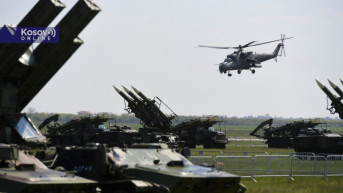
The arms race was not invented in the Western Balkans. The United States and Russia have long been engaged in this “competition,” followed by other major global and regional powers—such as Greece and Turkey, India and Pakistan. Given the global situation, interlocutors for Kosovo Online agree that the Western Balkans could hardly remain outside this race.
Written by: Veljko Nestorovic
Over the past year, alliances have been formed (Croatia, Albania, and Kosovo), Joint Defense Declarations have been signed, drones and modern as well as second-hand Rafale aircraft have been procured, along with U.S.-made howitzers and helicopters, and plans have been announced for the construction of an ammunition factory.
Is this a show of force aimed at neighbors, or preparation for something far more serious? Interlocutors for Kosovo Online believe there are arguments to support both theses.
Marko Savkovic of the ISAC Fund nevertheless notes that the economic capacities of Western Balkan countries are quite limited to speak of a major arms race at this point.
“An arms race—I would say yes and no. Yes, because it is clear and evident that everyone is arming themselves to some extent, modernizing systems, purchasing new equipment or replacing outdated ones. Thus, we have countries that are NATO members and are, to a degree, obliged to do so, as well as countries that are either militarily neutral or aspire to belong to an alliance and, for those reasons, seek to arm themselves. On the other hand, it is not an arms race in the true sense, because I believe the economic capacities of Western Balkan countries are still too limited to speak of a major arms race,” Savkovic said.
Political analyst Nexhmedin Spahiu views the new “arms race in the region” with disapproval, stressing that it would be far better to invest in the economy, healthcare, and education. He told Kosovo Online that it appears as though the region is preparing for war.
“We are preparing for war, which is not good. It would be better to invest in the economy, healthcare, education, and other areas. This, however, shows the level of danger the region is facing and how neighbors are threatening one another and seeking to show their strength. Probably no one here will go to war with Uganda, Nigeria, or Brazil—if there is a war, it will be a war among neighbors,” Spahiu said.
Dritan Laçi, analyst and editor at News 24, says that Albania does not have the economic power to purchase modern military equipment and that its airspace is protected by other countries.
“As far as Albania is concerned, it can serve as a venue for tactical support, helping the alliance with its own resources, because it lacks the economic power to purchase modern military equipment, which is very costly—unlike Greece, Turkey, or even Croatia. Albania can serve NATO very well as a tactical element, as could the Kuçovë air base. Our military power to date is at a minimal level. Take, for example, drone capabilities compared to the rest of the Balkans, Greece, or Turkey. In that regard, we are in a weaker position. This is also due to several other well-known factors. Our airspace is protected by neighboring countries, but there are additional reasons for this situation. In the meantime, we can contribute more by gradually increasing the budget for the armed forces,” Laçi said.
Western Balkan countries that are NATO members follow the Alliance’s policy on armament, but countries outside NATO also perceive a need for adequate military capabilities, Kosovo Online was told by Cane Mojanoski, a university professor from Skopje.
“Here we can include North Macedonia, Albania, Bulgaria, Greece—and if you wish, Turkey—on one side. On the other side, you have countries such as Serbia, Kosovo, and Bosnia and Herzegovina, which are outside the NATO Alliance and which, based on their own assessments, perceive a need for appropriate armament. Particularly significant in this context is the policy and behavior of neighboring Serbia, which is making substantial investments in its military and defense preparations. According to Global Power, the four countries with the greatest military strength in the world are the United States, Russia, China, and India. Serbia ranks around 62nd. On the Balkan Peninsula, Turkey stands out in particular, ranking ninth globally in terms of military strength. Greece follows at 30th, Romania at 51st, Hungary at 55th. Croatia ranks 74th, Albania 68th, North Macedonia 112th, and Montenegro 127th,” he recalled.
Professor Mojanoski also believes that, in addition to arms procurement, we have witnessed the public declaration last year of certain potential military alliances—for example, between a NATO member such as Croatia and Kosovo and Albania.


0 comments